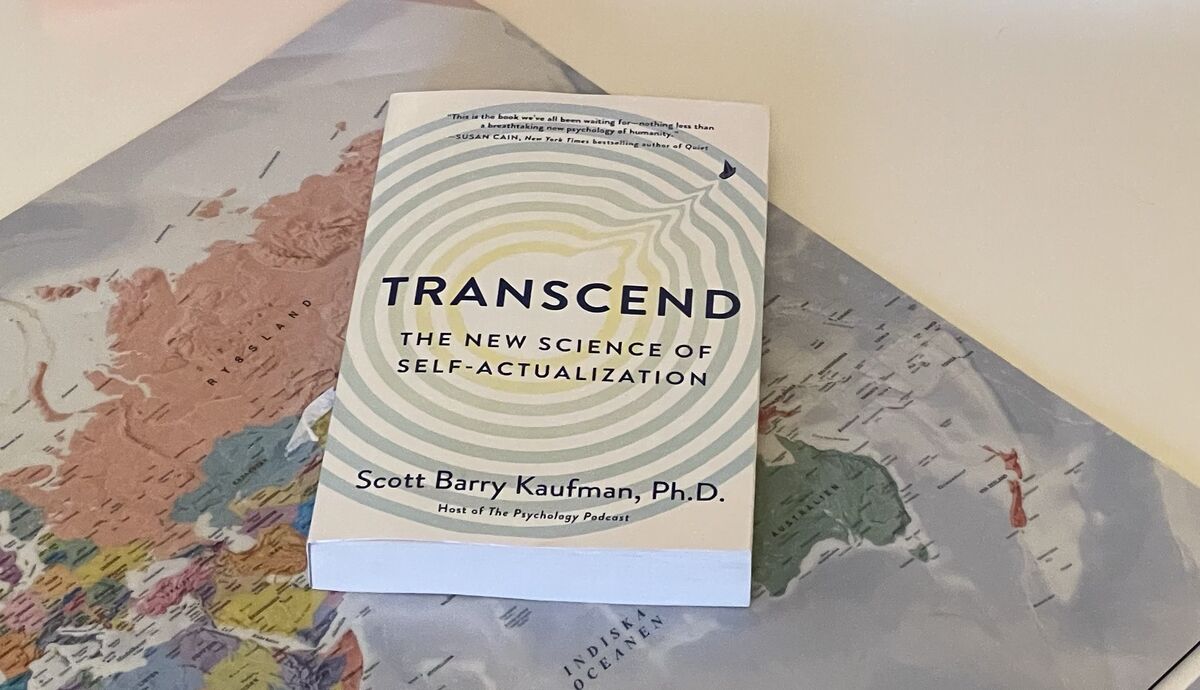
Transcend: The New Science of Self-Actualization
Maslow didn't finish the pyramid — Kaufman picks up where he left off.
You are probably familiar with Maslow's hierarchy of needs. Physiological needs at the bottom, psychological needs in the middle, and self-actualization at the apex of the triangle. Lesser known is the addition of self-transcendence as an even further stage of human existence.
In Transcend, Scott Barry Kaufman presents a history of humanistic psychology centered around the life and ideas of Abraham Maslow along with practical guidance for how to reach the higher levels of human existence.
Is Self-Actualization Selfish?
Maslow's theory of needs has been criticized for being too individualistic and selfish, and like so many scientific theories from the West it has overlooked the more collectivist modes of being that we see in other parts of the world.
But is it really that selfish? Yes, the hierarchy is centered around self-interest to a large extent, but the higher we reach the more paradoxes of being open up to us.
"How could so many of the self-actualizing individuals simultaneously have such a strong identity and actualization of their potential and yet also be so selfless?"
Self-actualizing people have both a heightened sense of individuality AND a heightened sense of connectedness — it's not a dichotomy. This is a false common belief that it has to be either or.
"The fact is that self-actualizing people are simultaneously the most individualistic and the most altruistic, and social, and loving, of all human beings."
Are You Self-Actualizing?
You enter the stage of self-actualization when you take up a unique calling or a purpose beyond yourself. At this stage the line between work and play usually disappears and you find fulfillment in what you do. Life gets simple for the person who self-actualizes.
"Having a purpose often causes a fundamental reordering of the most central motives associated with the self. Things that once preoccupied you suddenly cause you little concern and might even sound trivial."
But balance is needed for healthy self-actualization:
"As you live your purpose it's worth periodically reflecting on whether your passionate activities relating to your purpose have become too obsessive in a way that is impeding your growth as a whole person."
The Obstacles of Self-Actualization
"...there is a growth oriented core to each of us that is full of openness, love and meaning which is held back by our ordinary perceptions, fears, and anxieties."
Self-esteem and actively fighting irrational fears are important in order to reach the stage of self-actualization. Worrying less about what others think, actively taking risks — even if failing makes you look bad — and really testing if people actually demand such a high level of perfection from you can stabilize self-esteem.
"People who actually test their self-beliefs are often shocked to discover how tolerant people are of their imperfections."
In fact, being more open and authentic with others increases social connections. Since no one is perfect and we feel more comfortable with people who are similar to us. Take your worthiness as a given!
📺 Video Review
Death Frees — A Case Against Becker
"There is a rumble of panic underlying everything." — Ernest Becker
This is the result of an existential paradox. We are godlike but at the same time no different from a worm in the dirt.
"This is the terror: to have emerged from nothing. To have a name, consciousness of self, deep inner feelings, and excruciating inner yearning for life and self-expression — and with all this yet to die." — Ernest Becker
This is a terror indeed, but Becker's solution — to take a leap of faith into the invisible mystery of creation that has a design behind human apprehension — offers little guidance on how to actually do so.
According to Becker, and the Terror Management Theory that was later developed based on his ideas, fear of death (mostly unconscious) is the main source of human anxiety. By this line of thinking, awareness of death should increase insecurity and defensiveness. Yet that is very seldom the case with people who experience close encounters with death. Rather, people who come close to death — either through adversity or through thought experiments like death meditations — experience a renewed sense of wonder and joy, a greater focus on what's important, an enhanced experience of the present. Everything becomes more meaningful when you come close to losing it.
Steve Jobs says it well:
"Remembering that I'll be dead soon is the most important tool I've ever encountered to help me make the big choices in life. Almost everything — all external expectations, all pride, all fear of embarrassment or failure — these things just fall away in the face of death, leaving only what is truly important. Remembering that you are going to die is the best way I know to avoid the trap of thinking you have something to lose. You are already naked. There is no reason not to follow your heart."
Self-Transcendence
Maslow put self-actualization at the top of his pyramid, but late in life he suspected that self-actualization was only a bridge to an even higher mode of being — self-transcendence.
The main characteristic of people at this stage is a shift of concern from self to others. Egoism takes the back seat as the focus becomes helping others. Doing what's right, because it's the right thing to do.
This is also the state where spiritual life blooms. Self-transcending people feel connected to a greater whole and a purpose beyond themselves. Peak and heightened emotional experiences are common in this sphere of being: awe, amazement, deep appreciation. Dichotomies are overcome and true integration of the person happens on all levels.
The Four Givens of Existence
Kaufman draws on Irvin Yalom's four givens of existence — the existential dilemmas that form the foundation of existential psychotherapy:
💡 Key Takeaway
Pursue a purpose or calling and happiness is a byproduct. Self-actualizing people don't chase happiness directly — they find it through devotion to something beyond themselves. And healthy self-actualization is not the end; it's a bridge to transcendence.
⚖️ Verdict
A great gateway book into the subject of humanistic psychology and one of those books that leaves you with tons of further reading to do. It had me pick up the 1902 classic The Varieties of Religious Experience by William James in an attempt to explore the religious aspects of self-transcendence. I also read Attached to familiarize myself with attachment theory — secure attachment being a factor on the journey to self-transcendence.
Unstructured at times, oversimplified in places, and with a thin overarching theme? Yes. But I thoroughly enjoyed it and it opened my eyes to subjects and problems that deserve a closer look.