The Art of Loving
Love is not something you fall into — it's a skill you practice. And most of us are doing it wrong.
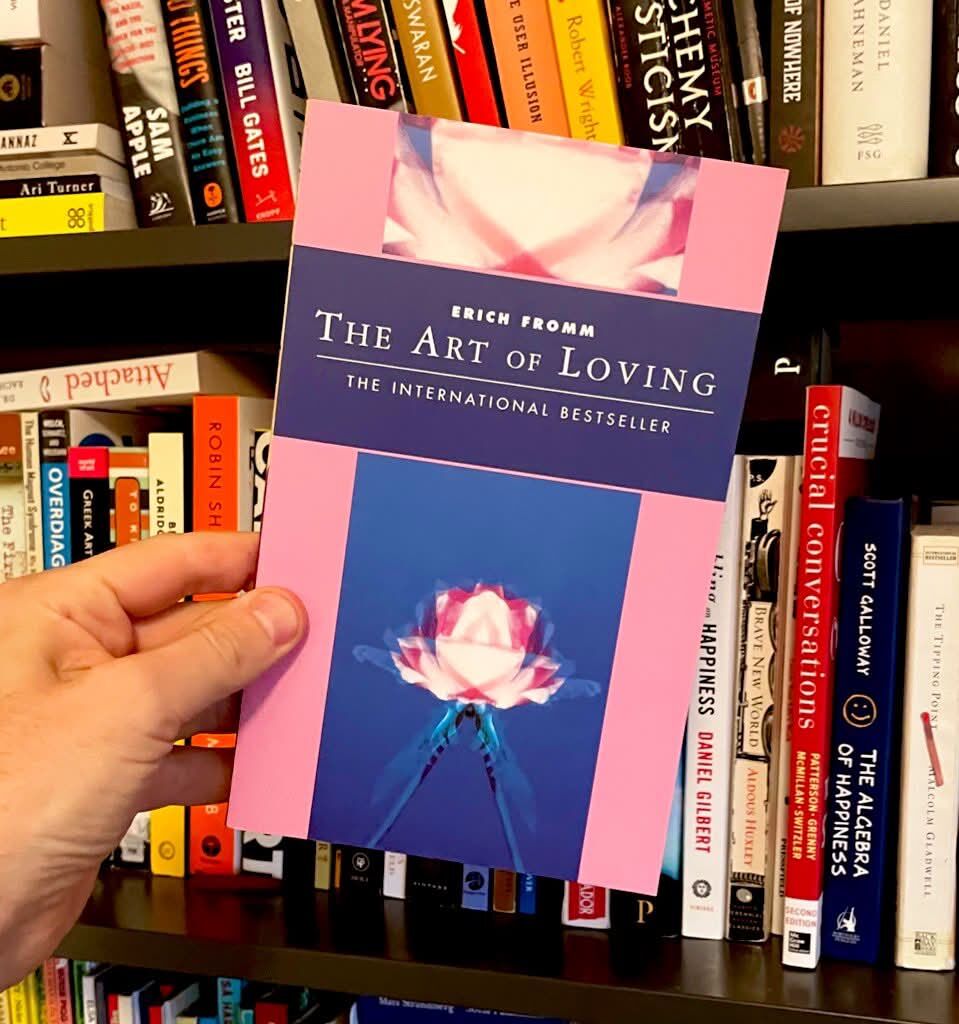
Love as an Art
Is love an art? Then it requires knowledge and effort. Or is it a pleasant sensation you stumble into if you're lucky? Fromm builds this entire book on the former premise — even though most people today believe in the latter.
Social psychologist Erich Fromm explores love in all its aspects: not only the craziness and lofty expectations of romantic love, but also love of God, brotherly love, erotic love, the love of parents, and self-love.
Fromm sees love as an art, and suggests that mastery in the art of loving requires the same knowledge and effort as mastery in any other art. Like music. Like painting. Like anything worth doing well.
The Problem of Separateness
The most interesting aspect of this book is Fromm's theory that our feeling of separateness from the world is the main cause of human anxiety — and love being one way of achieving a sense of oneness.
"The deepest need of man then is to overcome his separateness, to leave the prison of his aloneness."
How do we transcend this separateness? The history of religion and philosophy is essentially the history of answers to this question.
Sexual rituals and orgies in ancient tribes gave a temporary release from separateness. Afterward, people could go on with their lives for a while — until the anxiety built up again and it was time for another round. In non-orgiastic cultures, people turn to drugs and alcohol for the same release.
Conformity to society is another way to protect oneself from separateness. If I'm like everyone else, I'm safe! And people want to conform to a much higher degree than they are forced to — at least in the Western democracies.
Immature vs. Mature Love
The book has quite a harsh tone toward the modern Western notion of love. The romantic love that we're told to strive for in pop culture and mainstream media, Fromm says, is a form of immature love.
The object of love has become more important than the action of love. We've turned love into a consumer problem — shopping for partners, looking for attractive qualities — rather than developing our own capacity to love.
"In fact we take the intensity of infatuation — being crazy about each other — for proof of the intensity of our love, while it might only prove the degree of our preceding loneliness."
That one hit hard.
The Ingredients of Love
For Fromm, love is not a relationship to a specific person. It's an attitude, an orientation of character which determines how a person relates to the world as a whole.
"Love is the active concern for the life and the growth of that which we love."
The ingredients? Care, responsibility, respect, and knowledge. Without all four, it's not the real thing.
Motherly Love vs. Fatherly Love
Motherly love is unconditional — I'm loved just for being. Fatherly love is conditional — I love you because you fulfill my expectations. Because you do your duty. Because you are like me.
The negative side of fatherly love: it has to be deserved and can be lost. Obedience is the main virtue and disobedience the main sin. But the positive side? I can do something about it. I can work for it.
Eventually, Fromm says, a mature person needs to become their own father and their own mother.
And on motherly love — most mothers can give milk (care and affirmation), what the child needs to survive. But not all can give honey too: love, sweetness, the happy life. Being a good mother and a happy person. The effect on the child can hardly be overestimated.
📺 Video Review
Practicing the Art
How do you actually practice the art of loving? Fromm's answer is deceptively simple:
"Anyone who aspires to become a master in this art must begin by practicing discipline, concentration, and patience throughout every phase of his life."
If you're attached to a person because you can't stand on your own feet, then that person becomes a life saver — not a lover.
Being fully awake is the condition. Active in thought and feeling throughout the day. Avoid inner laziness. This is indispensable for the art of loving.
💡 Key Takeaway
Love is not something that happens to you. It's a practice — like meditation, like any discipline. The capacity to love requires effort, self-knowledge, and the courage to stand alone. Without that foundation, what we call "love" is often just a fear of being separate.
⚖️ Verdict
I really loved this book. It's my first book on the topic — and hence, I might be easily impressed — but I love how seriously the subject is treated. May I complain about the book being too short and having too much to note down?!
Isn't it weird that we only have one word for love in English, since romantic love and Love with a big "L" are so different? It's like "scarcity" and "abundance" using the same name.