Escape From Freedom
Why modern freedom terrifies us — and why we keep running back to authoritarianism.
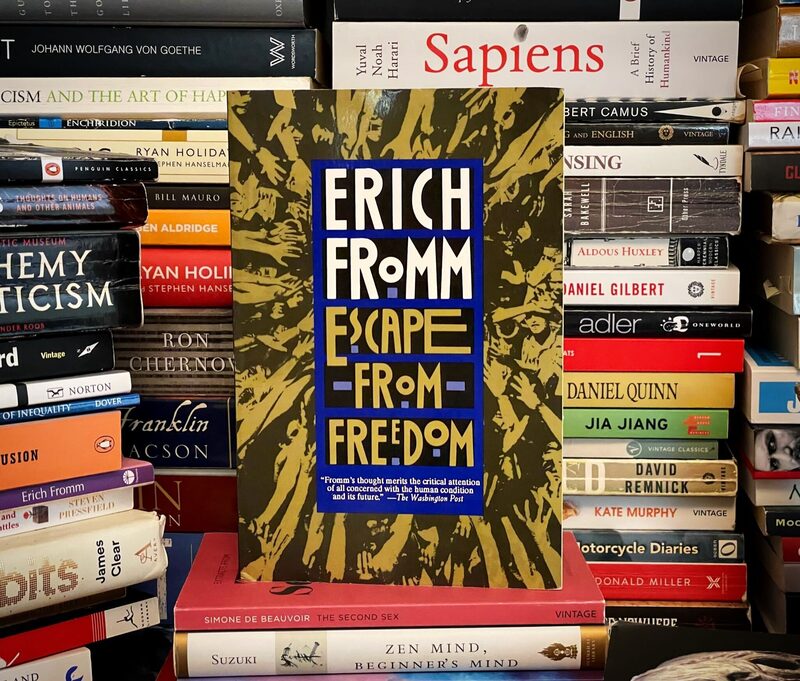
"Is there a hidden satisfaction in submitting, and what is its essence?"
This is the question this book asks.
Escaping from Freedom
We fought for freedom for centuries. We overcame nature, freed ourselves of religious dogma, and WWI was thought by many to be the last battle for freedom. But as we finally attained our goal of personal freedom, a reversal happened. Within a few years, new belief systems popped up that denied everything we believed we had won in centuries of struggle. The totalitarian systems came.
Many wanted to escape from freedom. Others just didn't feel it was worth protecting.
Notes and Highlights
Two kinds of escape: People try to escape from personal freedom in one of two ways — by submission to a strong leader, or compulsive conforming.
Capitalism and self-worth: Before capitalism we had very little control over our life expansion. In capitalism, your sense of worth depends on your usefulness in a competitive economy. Capitalism freed the individual, but increased isolation and doubt.
"Pleasing Personality": Children have a natural capacity to see negative qualities like insincerity and hostility in others. But with time, the child is taught to have feelings that are not her own. She is taught to like people, to be uncritically friendly and smile. If you don't smile you are accused of lacking a pleasant personality — and you need a pleasing personality to sell your services. Everything a smile is supposed to express becomes a switch we can toggle on and off.
Only people at the top and at the bottom of society have the luxury of not needing to be particularly pleasant. Maybe this is why many react with anger or irritation to such people. Are we jealous of their freedom to choose their attitude?
Inflation adds to the feeling of hopelessness, and makes the society ripe for fascism. It makes people doubt their capacity of making their life better through their own work and initiative.
📺 Video Review
⚖️ Verdict
This book gives you insight into the character structure of modern individuals and why freedom can be experienced as a burden. A puzzle piece you need in order to understand the lure of fascism.
There are a lot of gems in it, but I still find it less straightforward than I would have liked it to be.