The Science of Scaling
Your goal is probably too small. 10x it, halve the deadline, and let the goal cut away everything that does not belong.
The Big Idea
Your goal is probably too small. What if I said you should 10x your goal and cut the deadline in half? You would probably call that crazy. This book says that is exactly the point: a goal so big that it forces you to stop doing almost everything you are doing now and strip your processes down to the essentials.
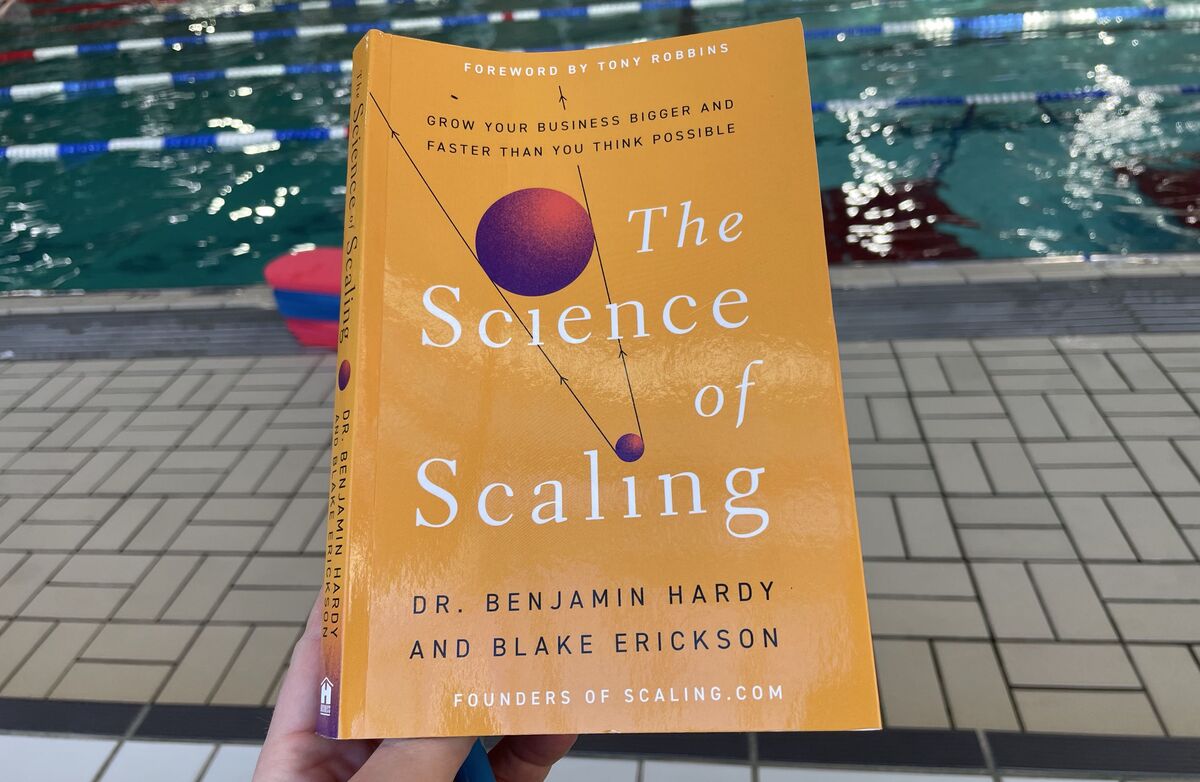
The Science of Scaling is by Dr. Benjamin Hardy and Blake Erickson, the founders of Scaling.com, with a foreword by Tony Robbins. They boil scaling down to one framework: Frame, Floor and Focus.
Frame: The Goal as a Hot Knife
Your frame is what you see, and your goal sets the frame. That goal works as a filter. They call it a hot knife: it cuts through everything you are doing and shows how much of it is sunk cost fallacy or just old habits. Against a goal that big, almost nothing you do right now works, so you have to find a different path that teleports you forward. And if the timeline is too long, then the timeline is wrong.
A humongous goal opens your eyes to new ways forward. You are forced to consider unconventional, bold moves you might never have considered otherwise.
"Your goal determines the opportunities you see."
That is a line I wrote in the margin next to this passage: human perception and behavior is driven by our goals.
Floor: What You Refuse to Do
This was a big one for me. Everyone talks about raising the ceiling. Hardy talks about raising the floor. The floor is the things you refuse to do. If something is below that line, it goes. At the highest level, the game is more about what you do not do than what you actually do.
The book quotes Elon Musk on this: "The most common mistake of a smart engineer is to optimize a thing that should not exist."
For BookLab, I kept writing one sentence in the margins: we help good nonfiction reach its readers. That is my floor. If I put effort into something that does not serve this goal, I am optimizing a thing that should not have existed in the first place.
📺 Video Review
Focus: Complexity Doesn't Scale, Simplicity Does
The second theme is focus. When you have your floor and your goal set, you simplify. Make the system even simpler than feels safe for you. You need concentration of focus, not diversification: one clear path, and the right partners to get there faster. Maybe you have a line of products you try to sell. Do you need all of them? If you think about it hard enough, can you get that number down to two and make each offer very, very focused?
This reminds me of a story. When Steve Jobs came back to Apple in 1997, the company had made dozens of products and was close to going under. He drew a simple grid: consumer, professional, desktop and portable. Four boxes, four products. Everything else got cut. Within a year, Apple was profitable again. As Jobs put it, "Focusing is about saying no."
"If you have conflicting and competing goals, you'll have a complex system that can't scale."
That is one of the main lessons of the book. Here is my version of it: first, get clarity. Then simplify as much as possible, probably more than you are comfortable with. Then keep laser focus on the goal you are committed to. You have to say no to most things, 80/20 everything, and keep things simple in order to scale.
Who This Book Is For
I would say this book is for people who feel stuck improving a machine that does not take them where they want to go. It will also help if you have built a system that overwhelms you, and I can relate to that. I tend to act quite fast on new ideas. I recently started my newsletter and introduced a new type of video, Behind the Book. That series might be exactly the kind of thing I should deem a distraction and cut, because it pulls me away from my main goal.
If you are building something, or have big goals but are not getting the traction you think you deserve, this is a really good guide to scaling and goal setting.
💡 Key Takeaway
Set a goal so big that the old way of working cannot get you there, decide what you refuse to do, and simplify until one clear path is left. Complexity does not scale, simplicity does.
⚖️ Verdict
This is a four out of five book and I really like it. A common critique from reviewers is that it is very strong on the why but lighter on the step-by-step how, and that many of the stories point to the authors' own companies, so it leans a little toward selling their product. I still found it quite delightful. The ideas have been spinning around in my head like a washing machine, and I have had several sleepless nights thinking about how to apply the framework. It made me raise my goals and cut the crap, and I have already implemented a ton of its ideas. I came out the other side more focused and more relentless on my path.
It pairs really well with Richard Koch's The 80/20 Principle. Read these two together and you will never look at your goals, and the path to them, the same way again.
What is the one thing you have to stop doing in order to hit your biggest goal?
⚡ Go Deeper: Productivity and Beating Laziness
Scaling is really about doing less, but better. My productivity reading guide covers the books that helped me focus and stop procrastinating, from Atomic Habits to Four Thousand Weeks. It also includes the best books I have found for overcoming laziness and inactivity.
Read the Productivity Reading Guide →