Four Thousand Weeks
We will all be dead any minute. The question is what to do with that fact — and why productivity isn't the answer.
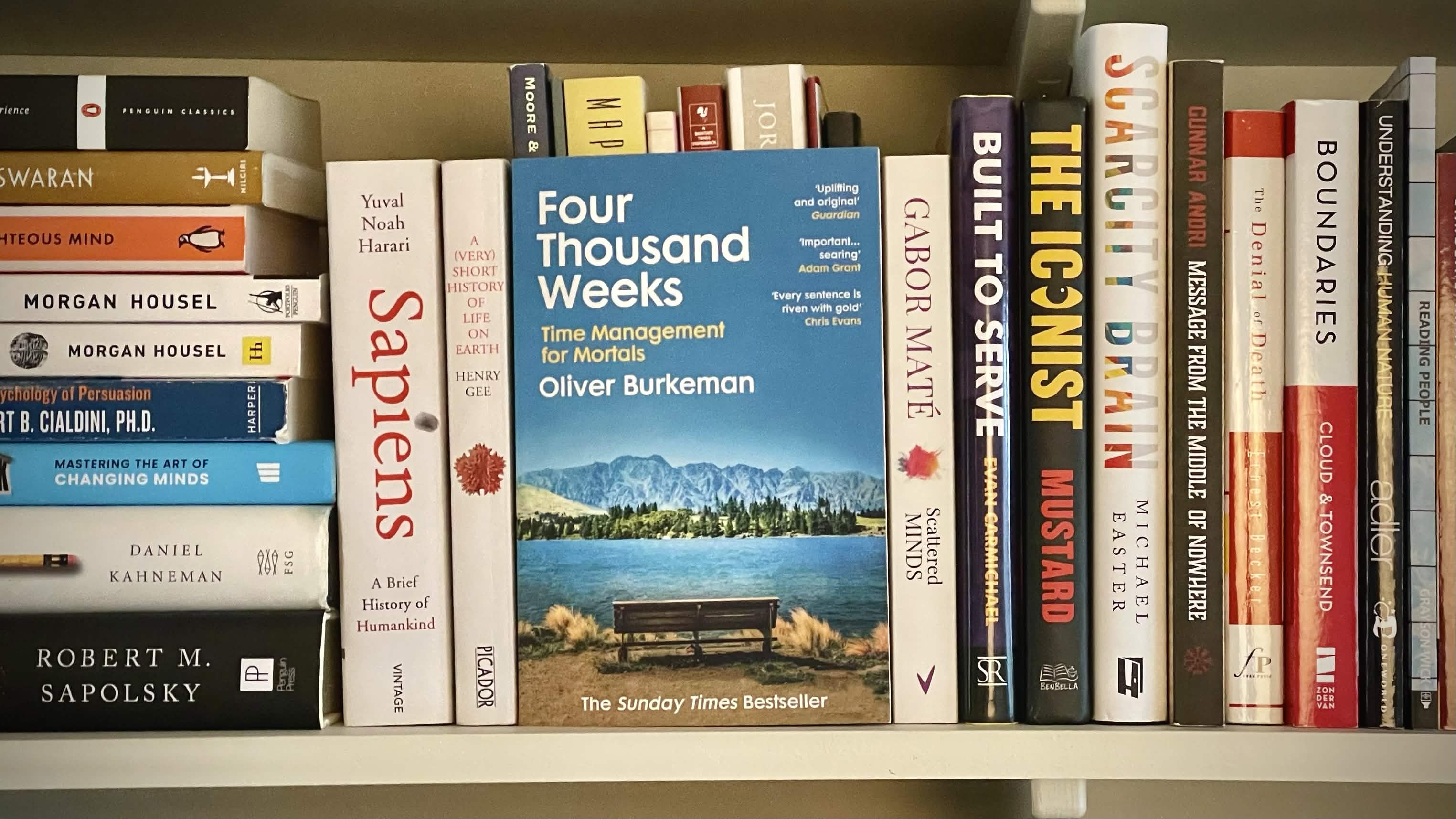
Productivity Is a Trap
The premise of this book is to explore a saner way to relate to time and provide a toolbox for how to do so. It's inspired by philosophers, psychiatrists, and spiritual teachers who have all rejected the urge to try to dominate time.
"Time feels like an unstoppable conveyor belt, bringing us new tasks as fast as we can dispatch with old ones — and becoming more productive only seems to make the belt speed up."
Work-life balance really doesn't exist. Becoming more efficient makes us more rushed, and trying to shake everything off our to-do list will only make new tasks appear even quicker. Just try to answer all your emails and you'll see a flood of new emails come in. Same with finishing work tasks — only more will pour your way. The truth is that we will never get everything under control.
"Work expands as to fill the time available for its completion." — Parkinson's Law
The Joyless Urgency
The reality is that we will never have the time to do everything we want to do. We won't even have the chance to do a small percentage of that. This has been the case for a long time, but in our modern interconnected world there are so many more options and so many more ways to spend our time that we constantly have to face the painful fact that our time is very limited.
To cope with this, we turn to productivity. If I could only be more efficient, then I could get more things done, and then I'll have more time left over to do the things that are really important. But that loop never ends.
"Our troubled relationship with time arises largely from the effort to avoid the painful constraints of reality."
Acceptance, Gratitude, and Sacrifice
If our attempts to dominate time won't work, then what's the solution? Acceptance, gratitude, and sacrifice. Every decision to use a portion of time on anything represents the sacrifice of all other ways you could have spent that time but didn't. This is also known as opportunity cost.
"To willingly make that sacrifice is to take a stand, without reservation, on what's most valuable to you."
It's the price you have to pay to commit to your values and your purpose. Maybe making time for your creative project means you have to live in a messy home, or maybe you can't work out as much as you'd like.
We also need to embrace the unpleasantness that comes with facing our finitude — a feeling that often gets us to procrastinate, because distraction is usually an escape from this unpleasant feeling. When we care about something and do it, we have to face our finitude and the fact that we might not do it as well as we'd hope. We have to give up our godlike fantasies and actually face the fact that we don't have full control over the things we care about. This is why we tend to procrastinate on the most important things in our lives.
📺 Video Review
Why I Picked This Up
I picked this book up in desperation, actually. For years I've been struggling with time management — the common problem of having too many things I want to do and it feeling like there's not enough time. I love my work, I love my creative projects, I love being with my family. I want to learn to play the guitar, I want to sit down and read books, I want to work on BookLab. There's just not enough time to do it all.
I told myself there must be a way to get enough time to do it all, so I built all these systems that I thought were bulletproof. But in the end I'd overextend myself, end up exhausted, eventually collapse, and then try it all over again with the same result. The loop continues.
This book helped me surrender more to time. It helped me accept that there's an opportunity cost to everything, and maybe most importantly, that I will never have enough time to do everything I want to do.
💡 Key Takeaway
You will never get everything under control — and that's not a failure, it's the human condition. The solution isn't better productivity systems. It's acceptance, gratitude, and the willingness to sacrifice some options so you can fully commit to the ones that matter most.
⚖️ Verdict
Four Thousand Weeks is accessible to anyone, and it shines its brightest when it goes into the philosophical and psychological reasons why we humans try to master time the way we do. Recommended for anyone who struggles with time management or priorities in life and has a feeling of overwhelm. Really insightful and a perfect book for anyone in that situation.