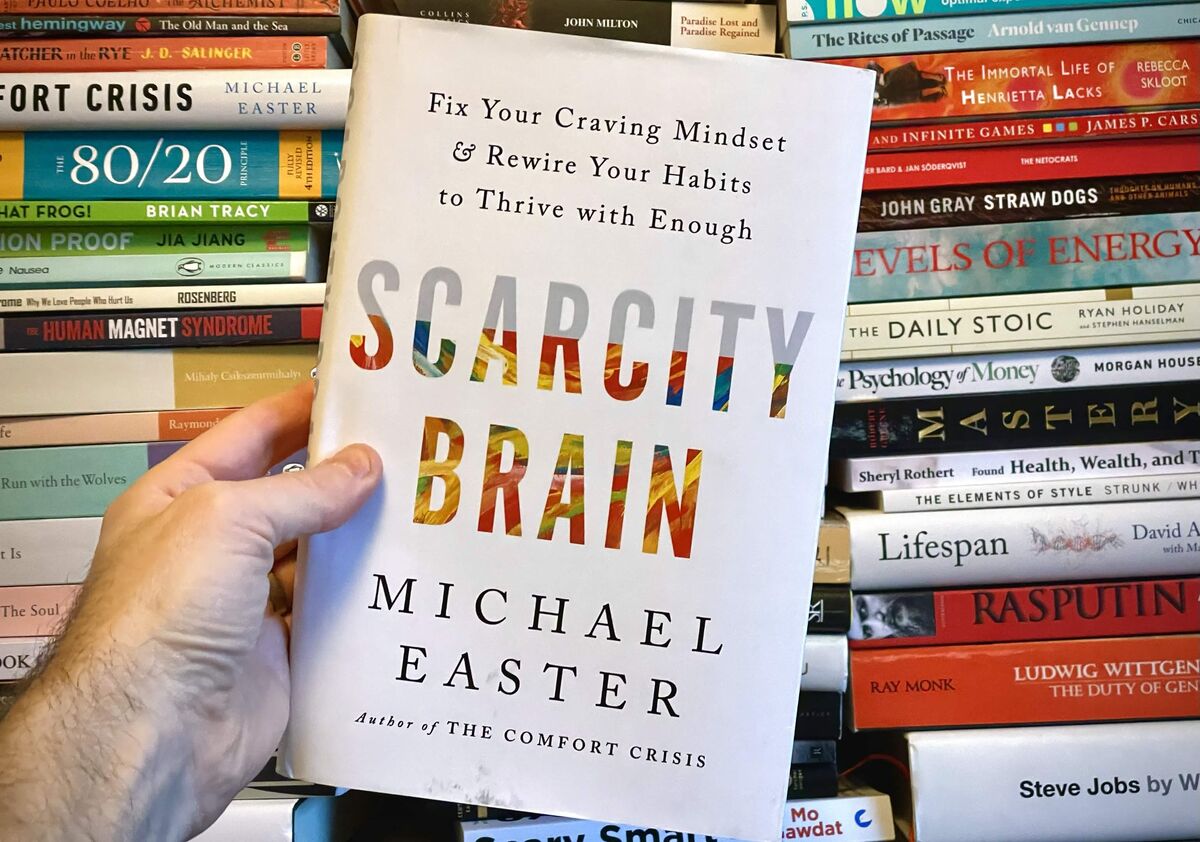
Scarcity Brain
We are wired to crave more — but in a world of abundance, that instinct is hijacking our decisions.
📚 What's It About?
We have evolved for scarcity. From an evolutionary perspective we come from a world of scarce resources. We are hardwired to want more and to never give up in our mission to get it. The problem is that we now live in a world of abundance, and have more than enough in almost every area of life. But the craving for more is still there.
In this book you'll learn the evolutionary theory of why we crave and how commercial forces exploit this urge for more. An evolutionary mismatch is happening — traits that helped us in the past are hurting us in the present. The only way to break free is to understand the issue and take measures to steer our innate desire towards something meaningful and positive.
🎰 The Scarcity Loop
When slot machines went digital and added spin buttons, casino game designers tapped into something powerful. The move to digital allowed the games to have more advanced reward cycles, more smaller wins, losses disguised as wins, and higher jackpots. Spin buttons allowed people to play games quicker — it went from 300 games an hour to 900. Slot machines on casino floors multiplied fivefold. Casino owners even had to buy more chairs, because people now played for hours and had to sit down. Everyone got rich, except the players.
They had tapped a cord in the human mind. The behaviors we do in rapid succession are powered by a scarcity loop. Whether it's drinking, eating, buying, binge watching, or gambling — it has three components:
Today's world is dominated by products powered by the scarcity loop: TikTok, Amazon, playing Candy Crush for way too long, or scrolling Instagram endlessly.
🐒 It's Not Just Us
Experiments with laboratory animals show that it's not only humans who overvalue unpredictable rewards. Roaches, rats, monkeys, and pigeons all prefer to play a gambling version of a test — pull a lever and get no food, a little food, or a jackpot of a lot of food — compared to a non-gambling version with regular outcomes. They keep playing the gamble even if the regular version nets them 700% more food.
Why is this loop so powerful? If we are almost sure the reward will come — like a monthly salary — it's nice. But when we are unsure the reward will come, we get very, very excited. Excited enough to make suboptimal decisions.
Michael Easter gives an answer rooted in evolutionary psychology. In ancient times, when looking for food, we didn't know if and when we would find any — and we needed to stay motivated to keep going. One place, no food. Next place, no food. On and on, then jackpot: a spot with both berries and game to last a week. Humans who could stay motivated through that uncertainty thrived and spread their genes.
📺 Video Review
🧠 How Is the Scarcity Brain Hurting Us?
Our incentives get messed up. Important progress is hard to measure exactly, so when we get exact numbers for messy metrics, our motivations go sideways. Grades as a measure of how much you learn got students focused on how to get good grades rather than how much they actually learn. On Twitter we optimize for reposts instead of saying nuanced things.
"In the human brain, less equals bad, worse, unproductive — and more equals good, better, and productive."
Our tendency to add rather than subtract also leads to problems. Having less planned activities often leads to a more enjoyable vacation. Turning down meeting invites gives us more time to focus on what matters at work. Yet we default to adding.
It reduces creativity, too. When we have less, we find more creative solutions with what we have at hand. In my field, video game development, it has always been the restrictions of the hardware that sparked the most creative solutions.
"Scarce resources make us more creative." It turns us into MacGyver.
🔁 We Substitute One Loop for Another
The author talks about his alcohol addiction and how he managed to escape that loop by replacing it with another: fitness and perfectionism at work. I've done the same thing. When I realized in my twenties that my lifestyle of partying, playing video games, and consuming copious amounts of nicotine was not a satisfying life, the pendulum swung hard into other compulsive behaviors — reading 80 books a year, long distance running, and BookLab. My obsessive tendencies needed another way out.
As Gabor Maté puts it, all problems are ultimately spiritual problems. Michael Easter reaches a similar conclusion — the quest for more will never cease, which is why a spiritual dimension needs to be added.
"It's ultimately up to us to be aware of when and why we are falling into the scarcity loop, and look for ways to change it into an abundance loop."
❓ What's Your Slot Machine?
Here's a question worth pondering: What's your slot machine? And is it a good loop or a bad one?
Here's mine — my YouTube subscriber count:
And here is how this scarcity loop messes me up: I don't share book recommendations to get subscribers. I want to help people find great books and become passionate about lifelong learning. The subscriber count doesn't measure if I succeed in my mission. But the availability makes me overvalue the metric. Now that I know it's a scarcity loop, I know I don't have to check it — but I understand why I have the urge.
💡 Key Takeaway
We are wired for a world of scarcity, but we live in a world of abundance. The scarcity loop — opportunity, unpredictable rewards, quick repeatability — drives our compulsive behaviors, from gambling to doomscrolling. The way out isn't to fight your wiring, but to become aware of which loops you're in and consciously redirect them toward something meaningful.
⚖️ Verdict
I'm torn about this book. On one hand, it feels fresh — the scarcity loop as a concept is something I hadn't come across before, and that gives it unique value. But on the other hand, after finishing it I still can't clearly articulate how the scarcity loop plays out across all areas of life and exactly what to do about it.
The book kept my interest throughout, but it feels like a collection of several ideas tied to the theme of scarcity rather than a clear, focused narrative. It talks about the value of solitude, Benedictine monks who thrive with less, the rise of depression throughout society — all interesting, but only loosely tied to the core topic. Scattered rather than focused.
If you enjoyed The Comfort Crisis, you'll find familiar territory here. Worth reading for the scarcity loop concept alone, but don't expect the same punch.