Games People Play
The most accessible (still hard!) book on the psychological games we play — and the uncomfortable truths hiding behind every social interaction.
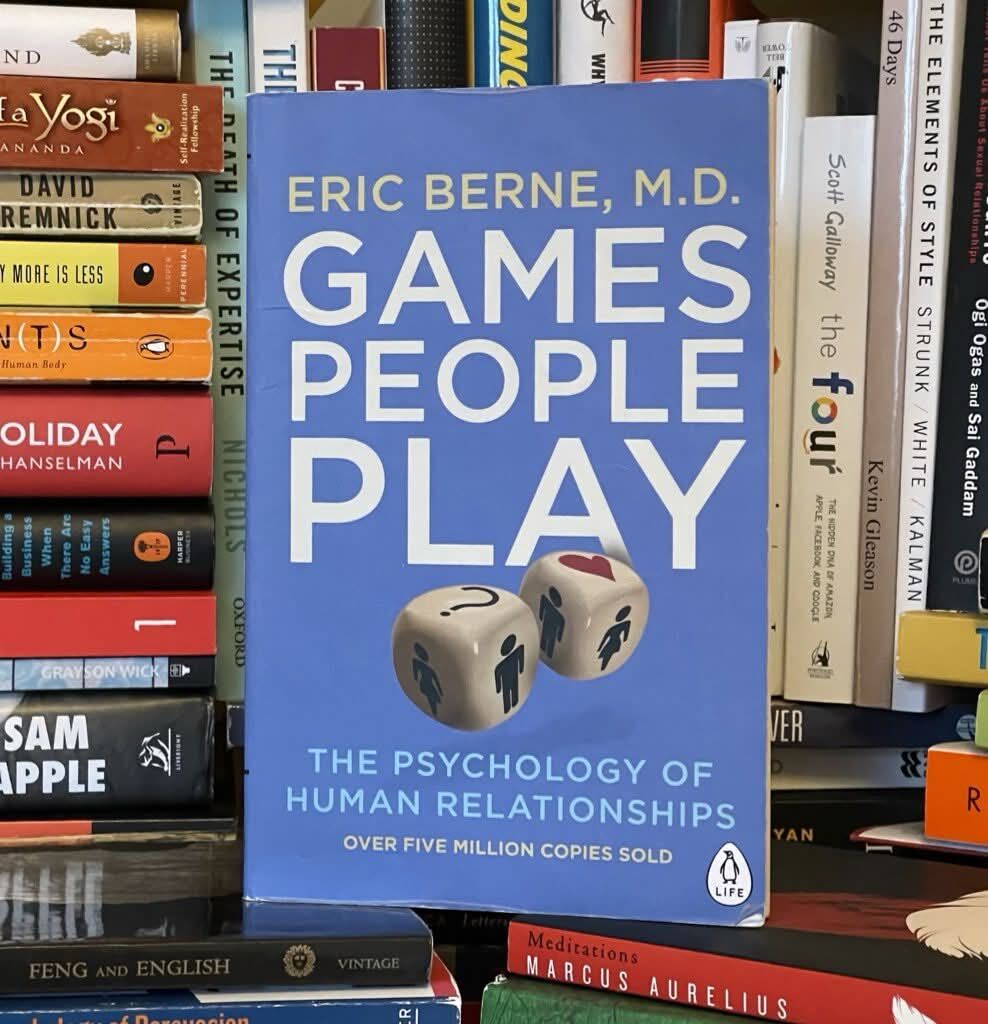
We All Play Games
We all play games. I'm not talking about video games or Bridge here, but psychological games — mental contests with the people we encounter. These games come in many varieties: marital games, life games, party games, and the dark games of the underground.
Berne brings us the most accessible book (still hard!) on games, human social behavior, and our underlying intentions. It all starts off with why we play games — our emotional needs, and the psychological advantages of playing them — and then goes into the ego states involved in each game.
Fascinating? Yes. A bit scary too? YES.
Hunger and Recognition
Emotional deprivation can have a fatal outcome. That's where Berne starts — and it's a gut punch.
"Stimulus hunger has the same relationship to survival of the human organism as food hunger."
Spitz found that infants deprived of handling over long periods will sink into an irreversible decline. But here's the thing — that need doesn't vanish when we grow up. Long after we leave our mother's comfort, we still crave her recognition. Berne calls this stroking. As time goes on, each person compromises this need and individualizes it more and more in his quest for recognition:
"A movie actor may require hundreds of strokes each week from anonymous and undifferentiated admirers to keep his spinal cord from shriveling, while a scientist may keep physically and mentally healthy on one stroke a year from a respected master."
Ego States and Transactions
Everyone carries his parents around inside him. Everyone has an Adult. And everyone carries a little boy or girl around inside him too. That's Berne's framework: three ego states — Parent, Adult, and Child — and every social interaction is a transaction between them.
These positions get fixed surprisingly early — from the second or even the first year to the seventh year of life. Long before anyone is competent or experienced enough to make such a serious commitment.
In social interactions, through pastimes, we play different games. After the cocktail party we assess the participants — often unconsciously — and decide which people we want to spend more time with. And here's the uncomfortable part: Berne says "beautiful friendships" are often based on the fact that the players complement each other with great economy and satisfaction — maximum yield with minimum effort for the games they play with each other.
📺 Video Review
The Games Themselves
The bulk of the book goes through all the games people play. And it will be uncomfortable to read. What if you find a game that you are playing? How do you deal with that new knowledge? Will you go on playing it? Or will you suffer the sort of death and resurrection that new knowledge of this kind demands?
Take "Lunch Bag": the husband who can afford to have lunch at a good restaurant nevertheless makes himself a few sandwiches from leftovers every morning to bring to work. This gives him complete control over the family's finances — what wife would dare buy herself a mink coat in the face of such self-sacrifice?
Or "Frigid Woman": a woman denies her man sex. Her mantra: "All men are swine. All they want is sex." After a while she starts to tease — wearing a sexy negligée, forgetting the towel when taking a bath. If the man makes a move, she plays "Now I Got You, You Son of a Bitch." If he refuses to fall for her seduction attempts, she escalates. At some random point, she stops the advances with: "See, you only want sex!" Then they play "Uproar."
Or the game of "Have One": Mr. White, the alcoholic, goes on a picnic with his non-drinking wife and another couple. He offers them a drink — "Have one!" What appears at the social level to be generosity is at a psychological level an act of insolence. If they accept, White can easily have four or five drinks himself while staying within the "rules of drinking." If they refuse? He'll find more compliant companions for the next picnic. I've seen this game firsthand many times, but it was only when I read about it here that I could really see it clearly — and all those awkward situations where I turned down a drink and was met with a disproportionate reaction suddenly made sense. The dynamics here overlap with what's explored in How to Break Free of the Drama Triangle.
Across many of these games, the analysis often ends at the same uncomfortable conclusion: the unconscious goal of one or both parties is to avoid intimacy.
💡 Key Takeaway
I had several aha-moments where I recognized a game that people I know are playing, or worse — games that I play myself but was unaware of. This book gave me a new lens through which to see the world — through games.
⚖️ Verdict
I found this book just as I started to ask myself if my reading was starting to yield diminishing returns. But after reading it I realized: nah, I'm all good. It provided one of the things I value the most about reading — a completely new lens through which to see the world.
Unfortunately, the descriptions of all games did not live up to my expectations. Some left me more confused than enlightened. But when it hits, it hits — and the best game breakdowns are uncomfortably spot-on.
If you're interested in the deeper mechanics of human nature, this belongs on your shelf.
📐 Go deeper: The Drama Triangle is the model Karpman built on top of Berne's transactional analysis. I wrote a full concept page with a reading path — The Drama Triangle: explained + what to read.