Behave: The Biology of Humans at Our Best and Worst
What is long, and hard, and full of… baboon references?
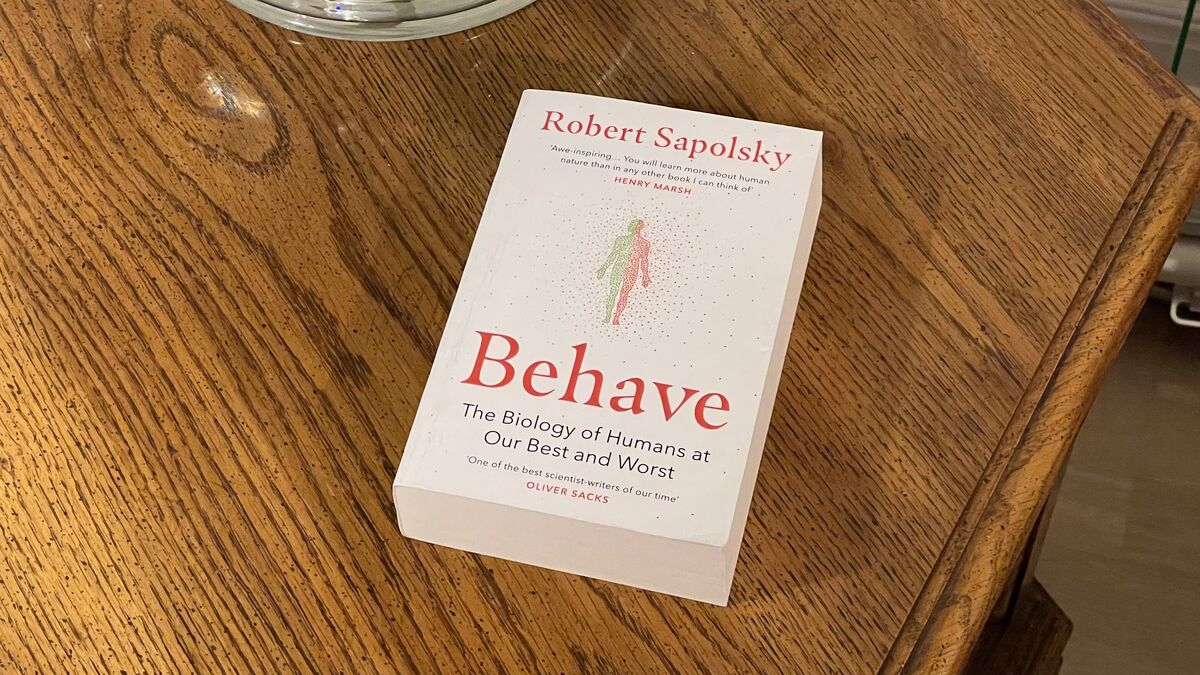
Why We Do What We Do
I can't think of any other book where you can learn more about human behavior than this one. Behave is quite a brick — it gives a great overview of why we humans behave as we do. It's a collection of years, had decades of research, and it dissects what happens in the body the second before we do something, the minute before, the hours before, and all the way back to our evolutionary past.
Depending on what field you study, you'll have a different explanation for human behavior. Psychoanalysts, neuroscientists, biologists — they all see different pieces. Sapolsky's genius is demanding that we think interdisciplinarily. It's hard, but we have to.
The Brain's Three Layers
Sapolsky uses the triune brain model as a starting point — three functional layers working together:
- The reptile brain: automatic, instinctual. Ancient.
- The emotional brain: feel sad, and it sends signals that start cravings for junk food.
- The neo-cortex: cognition, memory, contemplation. The newest and most complex part.
"The frontal cortex makes you do the harder thing, when it's the right thing to do."
The frontal cortex is the last part of the brain to mature — not complete until the mid-20s. It consumes enormous energy, which makes our willpower limited. Have you noticed how quick you are to judge and how hard it is to be a good person when you're depleted after a hard day at work?
The good news: initially demanding frontal tasks — like controlling your bladder as a child — become easier with time. Repeated good behaviors become automatic.
Dopamine, Habituation, and the Pursuit of Pleasure
One of the book's most important insights is about dopamine and habituation. We habituate to everything. Artificial pleasures — designer food, drugs, VR porn — throw our systems off the scale, making us unable to appreciate the natural.
"Dopamine is not about the happiness of reward. It's about the happiness of pursuit of reward that has a decent chance of occurring."
It's more about the appetite than the sating. And here's the kicker: win-win solutions reward more dopamine than win-lose ones. Chronic stress or pain depletes dopamine and decreases the sensitivity of dopamine neurons, creating an inability to feel pleasure.
Humans delay gratification for an extremely long time. No other animal restricts calories now to look good on the beach next year!
📺 Video Review
Testosterone, Stress, and Alcohol
Testosterone's effect is context-dependent. It doesn't simply make you aggressive — it prompts whatever behavior is needed to defend your status. Married men with children have lower testosterone than those without. More involved fathers have even lower levels. Nurturing behavior lowers testosterone.
"Testosterone makes us do whatever it takes for us to gain or maintain status."
And alcohol? Alcohol only evokes aggression in people prone to aggression AND people who believe that alcohol makes you more aggressive. Just like testosterone only increases aggression in people prone to it in the first place.
Moderate, transient stress is wonderful — it keeps us sharp. But sustained psychological stress makes us sick, impairs risk assessment, biases us toward selfishness, and breeds aggression. Stress also makes it harder to unlearn fear and easier to learn to fear.
Culture, Genes, and the Nature–Nurture Dance
Culture and biology co-evolve. Why is Southeast Asia the poster child for collectivism? Rice — for 10,000 years, communities had to come together for the hard labor of harvesting it. Why is America the poster child for individualism? They were immigrants.
On genes: it's not meaningful to ask what a gene does, just what it does in a particular environment. The so-called "warrior gene" is overblown — the interactions between genes and environments are far more complicated than we'd like them to be.
"The opposite of love is not hate, it's indifference."
The worst stress-related health problems typically occur in middle management — the killer combo of high work demands but little autonomy. Responsibility without control.
💡 Key Takeaway
I was applying for days off at work. I was going to ask right before lunch, but caught myself and did it the proper way instead — judges famously give harsher judgments when they are hungry. I upped my chances of getting an approved application quickly by waiting until after lunch.
This was not a matter of life or death, unlike some court trials, but I think it points toward something profound. What is the result of a lifetime of strategic moves based on the quirks of biology and human nature, compared to a life ignorant of these hidden influences?
⚖️ Verdict
A detailed and nuanced summary of where we are at with the study of human behavior. If you've read a lot on this topic before, you'll recognize many studies — Stanford prison experiment, prisoner's dilemma, tit for tat, the trolley problem. But Sapolsky weaves them together with neuroscience, endocrinology, and evolutionary biology in a way nobody else does.
This is the companion piece to Determined — where Behave lays out the full picture of human behavior, Determined draws the inevitable conclusion about free will. Read them together for the complete Sapolsky experience.