The Structure of Scientific Revolutions
The book that gave us "paradigm shift" — and revealed that science advances one funeral at a time.
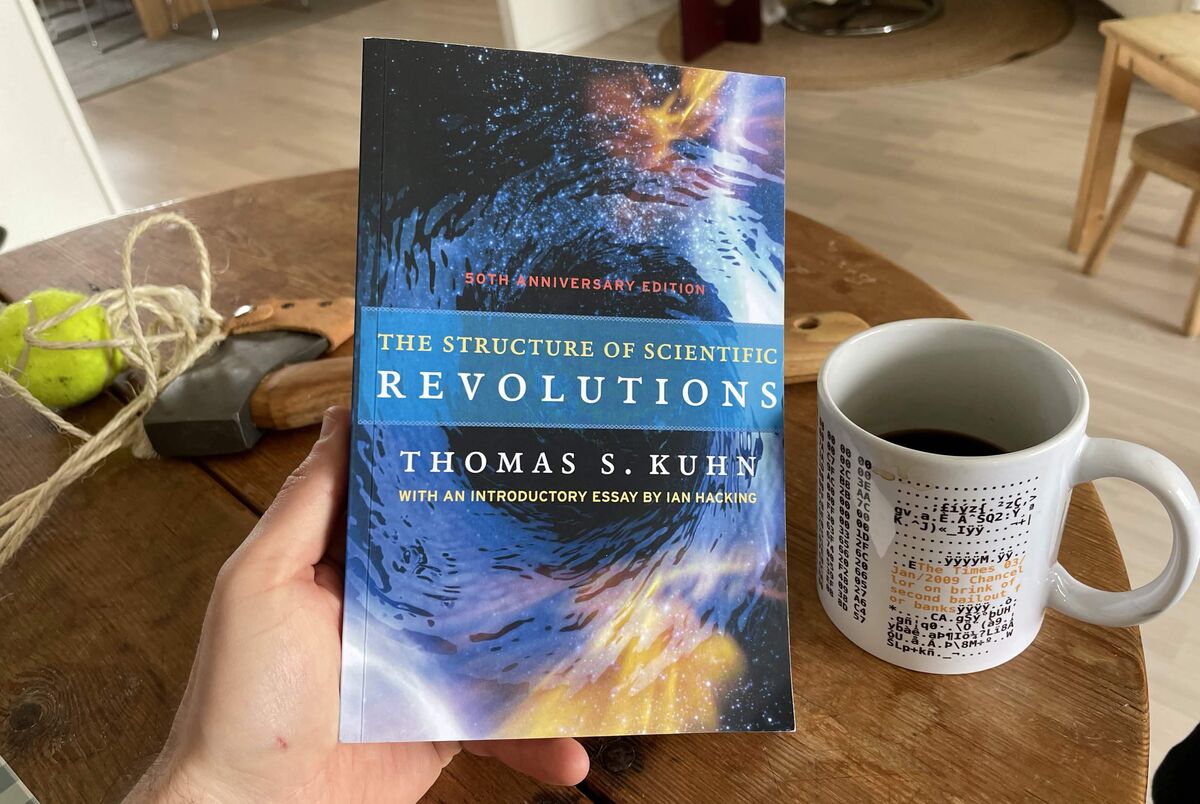
A Quiet Revolution
The Structure of Scientific Revolutions is one of those books that quietly changed how we think about knowledge itself. It was published in 1962 and it challenged the comforting idea that science and progress marches on in a steady pace towards truth. Instead, Kuhn argues that change in knowledge is attained in big, disruptive leaps.
If you're interested in how humans cling to old beliefs, how systems resist change, or why disruptive technologies feel so disruptive, then this is a book that is more relevant than ever.
The Context
When Kuhn first published this book in the early 60s, the world was deep in the Cold War, the Space Race, and rapid scientific expansion. Science was widely seen as purely rational and objective. Kuhn's ideas were controversial because they suggested that scientists were human first, shaped by culture, training, and group norms.
Paradigms and Normal Science
In this book, Kuhn introduced the concept of paradigm — a shared framework of assumptions, methods, and beliefs that a scientific community operates within. According to Kuhn, most science is what he calls normal science: basically scientists doing puzzle-solving within the existing framework or paradigm.
But with time, anomalies — things that the paradigm really can't explain — start to pile up. Eventually, a scientific revolution happens where a new set of ideas start to be able to explain those anomalies, and the old paradigm is replaced by a new one.
This process is not always smooth and fully logical. It's a messy deal. It's full of emotions and it often meets with resistance from the old guard who clings on to the old paradigm.
Key Ideas
Some examples of these shifts are the shift from Newtonian physics to Einstein's relativity, from the geocentric universe to the heliocentric universe, and what we see today with classical computing meeting the AI-driven approaches.
The key ideas in this book are that progress is not linear. Big breakthroughs often force you to abandon old ways of thinking. It's not just about adding new facts into the existing framework.
Experts will resist change. New paradigms often come from outsiders or young thinkers. An example of this is Einstein, who was once a brilliant young thinker — he came up with the relativity theory, but at an older age he could never come to terms with the new ideas of quantum mechanics.
"Science advances one funeral at a time."
A third key point from this book is that facts don't always speak for themselves. What we notice, measure, and value depends on the framework we are using. Even outside of science, frameworks shape facts. For example, if you believe that someone is lazy, then you see missed deadlines. But if you instead believe that they are overwhelmed, you see workload and stress levels. It's all shaped by the framework.
📺 Video Review
💡 Key Takeaway
My main takeaway from this book is about lenses. Kuhn doesn't say that truth doesn't exist. He says that our access to the truth is filtered through human systems — paradigms. They act like lenses: they highlight certain details, blur or exclude others, and define what even counts as a problem. That's why paradigm shifts feel so shocking in hindsight. Once the lens changes, it's hard to imagine how anyone could have ever seen the world in a different way.
Books have a tendency to do this for me. Every year I pick up a book or two that really changes and has me re-evaluate everything I know about a certain aspect of life, thinking, "My gosh, how could I ever have seen things otherwise?"
We are living in a time of massive disruption — and in order to make sense of it all, I needed to know more. Going to Kuhn was a good place to start. If you want to understand the AI revolution we're living through right now, understanding how paradigm shifts work is essential. The shift from classical computing to AI-driven approaches is one of the biggest paradigm shifts of our time.
⚖️ Verdict
I'm glad I read this book. Kuhn is a person that you definitely should be familiar with. But I can't say it's a page turner. It's very methodical and textbook-like, which left me yawning as I worked my way through it. I'm glad I'm familiar with his ideas and how he structures and sees the evolution of knowledge — but I don't know if this is really a book I would recommend for everyone unless you're very, very curious about this.
Understanding disruption is one of the key things to understand as we go into the 2030s. If you want a more accessible companion to Kuhn's ideas, I'd also recommend Energy and Civilization: A History by Vaclav Smil — one of the best books I've read, and key reading for understanding the foundations that drive paradigm shifts in the real world.