Spiral Dynamics: Mastering Values, Leadership and Change
A colour-coded map of human consciousness that explains why people keep talking past each other.
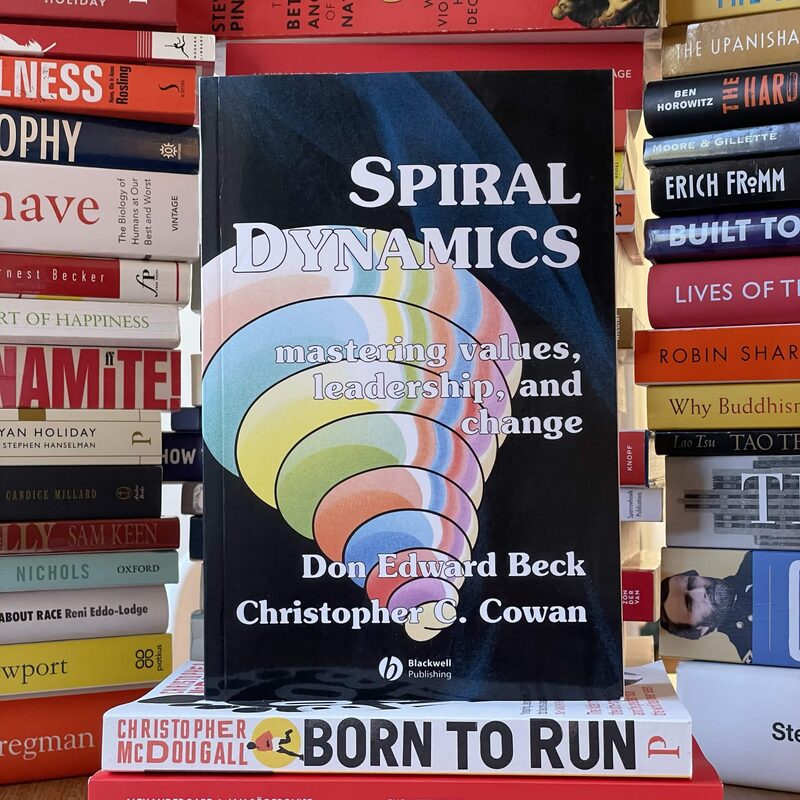
What Is It All About?
The theory is that human value systems evolve through a certain order of stages. One step at a time. It's a continuation of Maslow's "Hierarchy of Needs" and can be used on both a societal and individual level.
In Spiral Dynamics each stage is assigned a colour and separated into two tiers. From one stage to the next we see how the worldview changes back and forth from individualistic to collective — like a pendulum swaying.
The Colours of the Spiral
Tier 1
Instinct-driven. Small children, the very old, the gravely ill. Pure survival mode.
One for all, all for one. Animistic thinking: "The moon is full... the cow died... the cow died because the moon was full." Magical thinking.
Escape from rituals. "I want it all, I want it now." Impulsive, predatory, selfish. Lack of guilt.
Transcendency. "I'm part of something bigger." Sacrifice self for law, justice, fairness, dogma. Organised religion, nationalism.
Born from the Enlightenment. Success-driven, materialistic. "Make things better in this lifetime." The dominant system on Earth today.
Earthy, humanistic, non-materialistic. Less concerned with the external world, more interested in the inner world. "Profit is evil." The highest levels of green can be found in the Nordic countries.
Tier 2 — The Quantum Leap
Collective individuality. The first colour to recognise the needs of all other colours. Flexible, long-term thinking, embracing complexity. There is a mass migration into this system of thinking.
World-centric. Holistic thinking that integrates all previous levels into a unified whole.
Why Tier 2 Matters
Here's the key insight: all Tier 1 systems (Beige through Green) reject the previous systems. Conflict is almost inevitable when they interact. A good example is Orange — "act in your own self-interest by playing the game to win" — compared to the paradigm after it, Green — "empathising, sharing and caring, building community and embracing diversity."
That's why the jump from Green to Yellow is more of a quantum leap. Yellow is the first stage to recognise that each colour has its place, that none are bad or inferior — each is an essential step on the spiral.
Why This Matters in the Real World
The powerful implication of this way of thinking is that we can use this system to customise how problems are solved in different regions of the world. An Orange solution might work well in an area that is predominantly Orange — and then we scratch our heads when that solution fails in areas that are Blue.
The differences between individualistic and collective value systems — and the inability for first-tier systems to accept each other's differences — is the cause of much of the conflict the world faces today.
⚖️ Verdict
I'm aware that this might be too broad a generalisation and it smells a bit pseudosciency. But I'm a curious guy and I think there might be some truth here. I always love to receive a new tool in my belt that helps demonstrate patterns and bring structure to the human experience. One possibility among many...
And that's exactly what Spiral Dynamics delivers. Once you see the spiral, you start seeing it everywhere — in politics, in your workplace, in your family, in yourself. It's Maslow's hierarchy on steroids: a colour-coded map of how cultures and people evolve, and why they keep talking past each other.