The Righteous Mind
Why good people are divided by politics and religion — and what moral psychology reveals about the human animal.
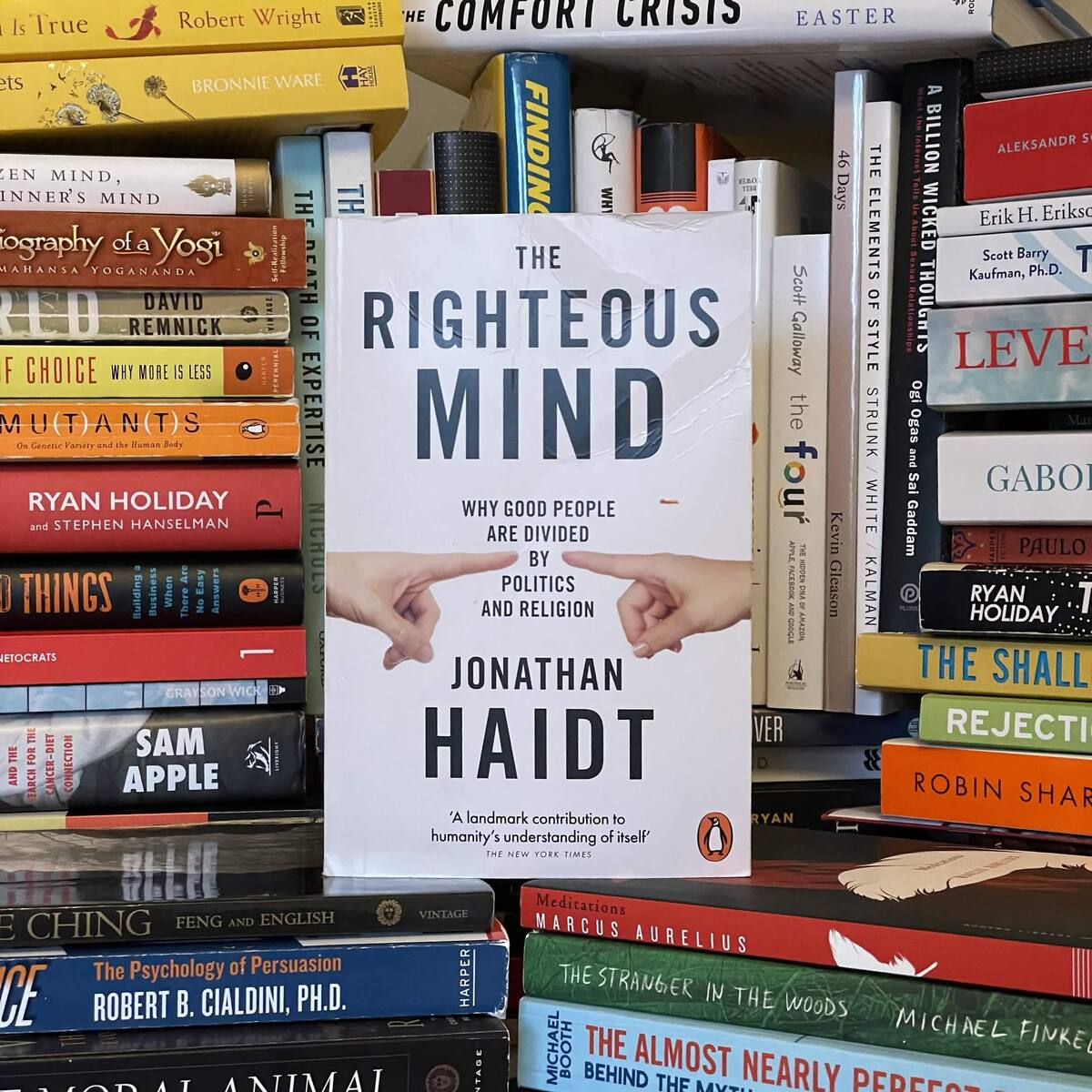
What Is This Book About?
Jonathan Haidt spent 25 years studying moral psychology, and this book is the distillation of all of it. It tackles one of the hardest questions in the social sciences: why do good, intelligent, well-meaning people look at the same world and reach completely opposite moral conclusions?
The book is organised around three big ideas. First: intuition comes before reason. Second: there is far more to morality than just harm and fairness. Third: humans are not merely selfish — we are groupish, and that changes everything about politics, religion, and culture.
If you have a book club, this is the one to read. It will spawn conversations you won't be able to stop.
Intuition First, Reasoning Second
We like to think of ourselves as rational creatures who weigh evidence and arrive at conclusions. Haidt dismantles this flattering self-image immediately. The brain forms moral judgments almost instantly — in the gut, before any reasoning kicks in. Rational thinking comes after the verdict, and its job is not to find the truth but to defend the position we've already taken.
Haidt's metaphor is the rider and the elephant. The elephant is your intuition — enormous, powerful, and mostly in charge. The rider is your conscious reasoning — small, clever, and convinced he's steering. He's not. He's a press secretary, constructing post-hoc justifications for wherever the elephant already decided to go.
"Moral thinking is more like a politician looking for votes than a scientist looking for truth."
This is uncomfortable but important. It means that almost every political argument you've ever had was two elephants bumping into each other while the riders told each other they were being irrational. You were both right — about each other.
The Moral Foundations — More Than You Think
Most research on morality has been done on WEIRD subjects: Western, Educated, Industrialized, Rich, Democratic. Haidt shows that this is a serious problem, because WEIRD people have a narrow moral palette — focused mainly on harm and fairness. But across cultures and throughout human history, morality draws on at least six foundations:
Left-leaning moral matrices tend to emphasise care and fairness almost exclusively. Right-leaning matrices use all six, though often with different emphases. This isn't a value judgment about who is right — it's a description of why each side finds the other incomprehensible. They are literally playing by different rules, using different parts of the moral keyboard.
📺 Video Review
We Are Groupish — Not Just Selfish
The third big idea is perhaps the most important. Evolutionary psychology used to focus heavily on individual selfishness — the selfish gene, rational actors, etc. Haidt argues this misses something crucial: humans are conditional hive creatures.
Under the right circumstances, we can subordinate our individual interests completely to the group. Think of soldiers who die for their comrades. The feeling of being swept up in a crowd chanting the same thing. The moment an American flag bumper sticker suddenly appeared on every car after 9/11 — even from people who had never liked the president, who found themselves supporting any position he took simply because the in-group was under threat.
Haidt calls this the "hive switch." It evolved because groups that could activate this collective mode outcompeted groups that couldn't. Being groupish isn't a flaw in our wiring — it's a feature. A very dangerous one when misdirected, but a feature nonetheless.
Why Religion Isn't Going Away
Haidt takes on the New Atheist argument that religion is simply a delusion — a costly, inefficient bug in human cognition that rational progress will eventually cure. He disagrees, and the evidence is on his side.
Religion is, among other things, a group-level adaptation. It creates the conditions for cooperation on a scale that secular institutions struggle to match. Religious communities are more generous — in the US, the least religious give about 1-2% of their income to charity; the most religious give closer to 7%. Religious people also volunteer more, report higher wellbeing, and build stronger social networks.
You don't have to believe in God to recognise that religion does something that secular communities have found very hard to replicate. When Haidt looks at why communes fail — and they usually do fail within a few years — it turns out that the best predictor of a commune's longevity is how many costly, irrational-seeming demands it makes of its members. The sacrifice is the point. It filters for commitment.
"To make a human hive, you want to make everyone feel like a family. Ramp up similarities, celebrate shared goals, make the in-group feel sacred."
The Diversity Paradox
One of the most striking findings in the book concerns diversity. Companies and institutions that embraced diversity initiatives — emphasising differences, calling attention to racial and ethnic identity — often found the opposite of what they intended. When you make people hyper-aware of their group differences, you activate the very tribal machinery that makes cooperation harder. The research suggests that what actually builds cooperation is emphasising similarities and common goals, not highlighting what divides people.
This is not an argument against diversity. It's an argument about how diversity is framed. Haidt is careful here, but the findings are genuinely challenging, and that's exactly what you want from a great book.
💡 Key Takeaway
You are not as rational as you think. Your moral intuitions come first; your reasoning comes second and exists mainly to justify what you already feel. Recognising this — in yourself as much as in your political opponents — is the beginning of actual wisdom about human nature. The Righteous Mind doesn't tell you who is right. It explains why you're both so certain that you are.
⚖️ Verdict
One of my all-time 5-star books. I finished it and thought about it for months. It completely changed how I think about politics, religion, and disagreement. If you want to understand why the world is the way it is — not who is wrong, but why the division keeps happening — this is the book. Haidt is a brilliant, fair-minded scientist who genuinely tries to understand all sides. That's rarer than it should be.