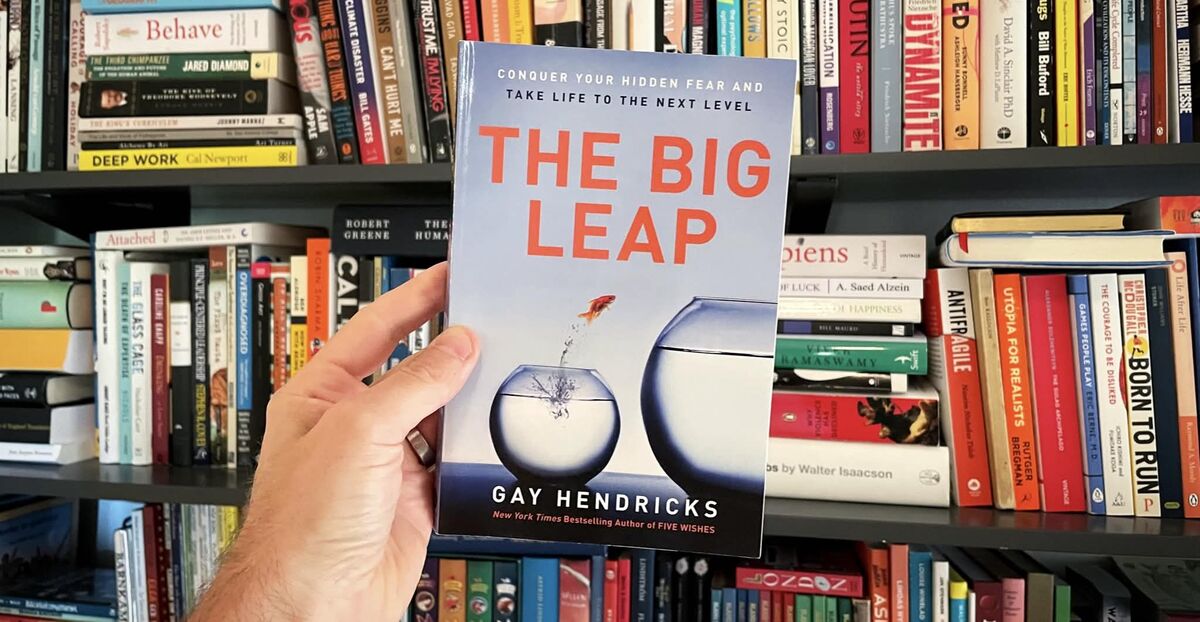
The Big Leap
Why we self-sabotage when things go well — and how to stop putting a stick in your own wheel.
The Upper Limit Problem
Have you ever experienced that as soon as you gain positive momentum in life, you cause a painful crash?
It's the equivalent of putting a wooden stick in the front wheel when you ride a bike.
This book is about letting the good times roll. Something that most of us can't tolerate.
When you self-sabotage you get what you think you deserve — proof that your limiting beliefs are true: you are fundamentally flawed, undeserving of success, or whatever story you invented about yourself.
The author calls it the Upper Limit Problem. The only problem you need to solve to achieve abundance, lasting success, and love.
The Stories We Tell Ourselves
Most people have a well-crafted story about why they can't take their big leap:
"I can't take my time to make a video, write, etc. because my family needs me."
"I can't do what I really want to do because I won't make as much money doing it."
"I can't get up early to work on my project because my work later that day will suffer."
There is a huge fear behind each and every complaint: What if my genius is not good enough?
The 3 Life Traps
The Incompetence Trap — Spending your energy doing things you are ill-suited for. Things you are not interested in learning or mastering.
The Competence Trap — Wasting your energy doing things you are competent at, but don't excel at. Many other people can do these things as well as you.
The Excellence Trap — Spending time on things you do really well. Things that make you highly valued at your company, but are not fully aligned with your genius.
📺 Video Review
The Zone of Genius
In your zone of genius you don't feel like you are working. Even if what you do is of great financial value, you don't feel like you are expending effort to produce it. Work doesn't feel like work. Time expands to support your activity.
This is how I feel when I talk about books and lifelong learning. I can do it all day and feel more energized afterwards.
Upper Limit Behaviors
Hendricks suggests staying in a mindset of playfulness and wonder while exploring your upper limit behaviors. You learn more with a spirit of play than with one of criticism. Some common ones:
⭐️ Takeaway
This book helped me re-evaluate some limiting stories I've been telling myself about the potential of my creative pursuits. I feel excited about what it will mean for the future of BookLab.
⚖️ Verdict
You need a high tolerance for cringy self-help jargon to appreciate this book. It's also a book with very little reference to scientific data to support its claims.
Using mental tricks, such as the ones this book provides, could be regarded as brainwashing. But in my experience, experimenting with different mindset tools tends to be both useful and eye-opening. Life is not life without some level of illusion. We might as well choose the most useful illusions we can find.
I wouldn't be surprised if this book ends up on my top 5 this year. I'm trying out the techniques now — time will tell if they reveal themselves as useful!