Deep Work
Everyone's getting more distracted — which creates a massive opportunity for those who resist the trend.
How I Found This Book
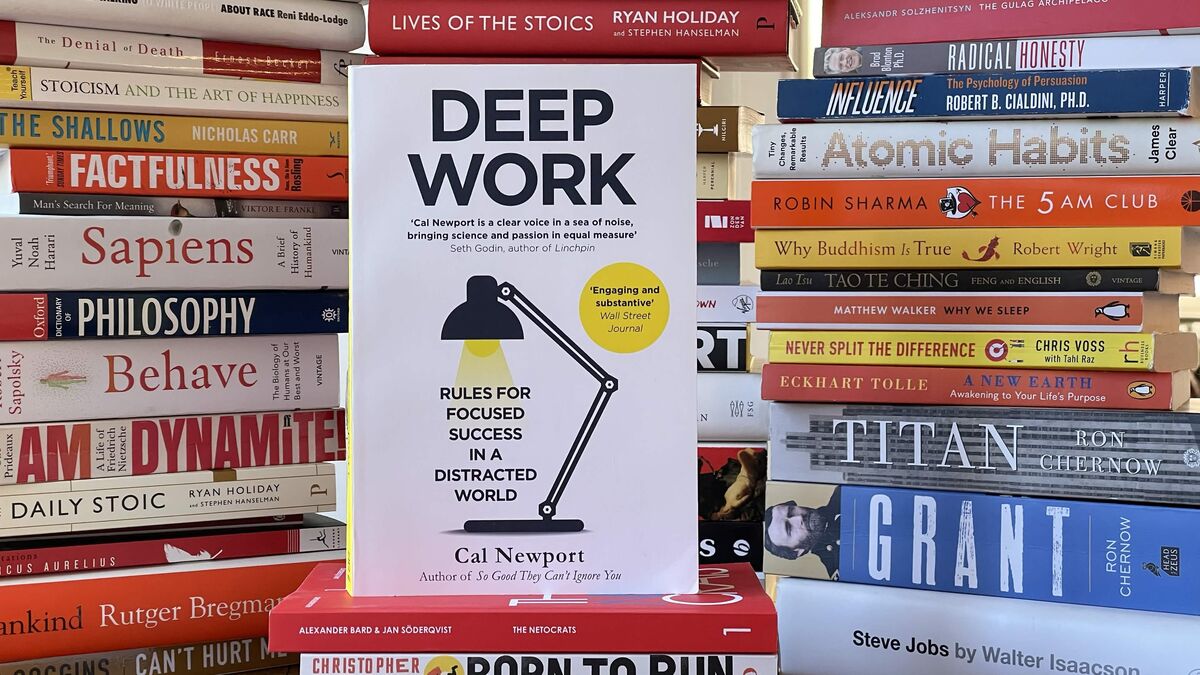
A friend mentioned Deep Work during a conversation about one of my favorite reads that year — The Shallows by Nicholas Carr. While Carr's book focuses on why distractions are destroying us and the neuroscience behind it, Cal Newport flips the coin: he focuses on the importance of deep, focused work and provides practical advice on how to achieve as much of it as humanly possible.
The Core Argument
Newport's thesis is simple but powerful: the fact that everyone is getting more and more distracted creates a personal and financial opportunity for the people who resist this trend by prioritizing depth. The average knowledge worker spends 60 percent of the work week engaged in electronic communication and internet searching. That's a staggering amount of shallow activity.
In the new economy, three groups will thrive: people who work well with machines, superstars in their profession, and the owners. To join the first two groups, you need two core abilities:
- The ability to quickly master hard things
- The ability to produce at an elite level — in both speed and quality
Both require deep work. There's no shortcut.
Why Deep Work Makes You Happier
If career advantage isn't reason enough, Newport points to evidence that deep work is a proven path toward a fulfilling life. And the flip side is equally compelling:
"When you lose focus, the mind tends to fixate on what is wrong with your life instead of what's right. A workday driven from the shallow, from a neurological viewpoint, is likely to be an upsetting and draining day."
This connects beautifully to Csikszentmihalyi's research in Flow — most people get it backwards. Work is actually easier to enjoy than free time. Flow states, which require deep concentration, are where satisfaction lives.
The Principle of Least Resistance
One of the most useful concepts in the book: in a business setting, without clear feedback on how certain behaviors impact the bottom line, we will tend toward whatever is easiest in the moment. Answering emails feels productive. Attending meetings feels like progress. But neither requires depth, and both eat your day alive.
Newport calls this "busyness as a proxy for productivity" — a metric black hole where looking busy replaces actually being effective.
Clarity about what matters gives clarity to what doesn't.
The Rules
Rule 1: Work Deeply
Newport outlines several philosophies for scheduling deep work:
- Bimodal: Split your time between shallow and deep — minimum one full day for deep work. Less is too short to count.
- Rhythmic: Schedule small chunks of deep work every day. Like Seinfeld's chain method — mark every day you write, then don't break the chain.
- Journalistic: Drop into deep work whenever a gap appears in your schedule. Requires practice.
The key insight: rituals work. Be creative like an artist, but work like an accountant. And sometimes a grand gesture — a big investment of effort or money — can increase the sense of importance of the task, making you less prone to procrastination. Think Bill Gates taking a "Think Week" at a lakeside cottage to read and think deep thoughts.
Rule 2: Embrace Boredom
If you can't tolerate boredom, you can't do deep work. Newport suggests productive meditation — doing something physical while focusing on a single problem you want to solve. Spending time in nature has also been proven again and again to restore concentration. On the flip side, attention fatigue from busy streets and constant stimulation depletes it.
Rule 3: Quit Social Media
Or at least apply the craftsman approach: be critical about which tools you adopt. Farmers are selective about their tools. Knowledge workers should be too. Apply the law of the vital few — the 80/20 rule — to your digital life.
Don't use the internet to entertain yourself. Put more thought into your leisure time. Some people who might not even like their work consider the day to be "over" after leaving the office — when there's actually a lot of time for meaningful activity. Plan your evenings and weekends before they begin. Structured hobbies provide great fodder for these hours.
Rule 4: Drain the Shallows
Schedule every hour of your day in blocks. To quantify depth, ask yourself: how long would it take a bright college graduate to learn how to do this task in my place? If the answer is "not long," it's shallow. Minimize it. And become hard to reach.
Shut Down Properly
Downtime aids insight. Newport is adamant: shut down after work. No mental recitation of conversations. No planning and scheming about the next day. No late night email checks. Let the subconscious do its work — it makes good decisions when you get out of its way.
Track your deep work hours on a scorecard. Long-term goals can be hard to measure day by day, but logging your hours of deep work creates a visible link between focus and results.
The Craftsman's Mindset
Perhaps my favorite passage in the book: the specifics of your work don't matter as much as how you approach it. Craftsmanship doesn't only apply to traditional jobs — it applies to knowledge work too.
"A wooden wheel is not sacred, but its shaping can be."
You don't need a rarified job. You need a rarified approach to your work. Design your life for deep work, and you're on a proven path toward satisfaction.
"I will live the focused life, because it is the best kind there is."
💡 Key Takeaway
Distractions — like email and social media — look small in isolation, but they add up and make deep work impossible. The people who resist this trend and protect their ability to focus deeply will have a massive advantage — not just in their careers, but in their overall life satisfaction. Design your life around depth, not convenience.
⚖️ Verdict
My recommendation is to put The Shallows and Deep Work on top of your reading stack. Together, they were the most impactful reads of that year for me. Carr gives you the terrifying "why" — Newport gives you the actionable "how." This book restructured how I think about my work schedule, and it pairs perfectly with Flow and Atomic Habits. Essential reading for anyone in the knowledge economy.