How to Grow Old
A 2,000-year-old guide to aging with grace — and it's still better advice than most modern self-help.
Who Was Cicero?
But first we need some context. Who was Cicero? And why should we listen to him about old age?
Cicero (Marcus Tullius Cicero) was an ancient Roman statesman, orator, and philosopher who lived from 106 BC to 43 BC. He is considered one of the most significant figures in Roman history for several reasons: he was a legendary orator, a master of rhetoric. He played a crucial role in the political life of the late Roman Republic. And he was a prolific writer on philosophy — known for his synthesis of Greek philosophical ideas into Roman thought. He introduced Greek philosophy to the Roman world and helped shape the intellectual landscape of his time.
Cicero was influenced by the philosophical schools of the Stoics and the Academy, and studied under the philosophers of his time — philosophers who represented different schools of thought.
📚 About the Book
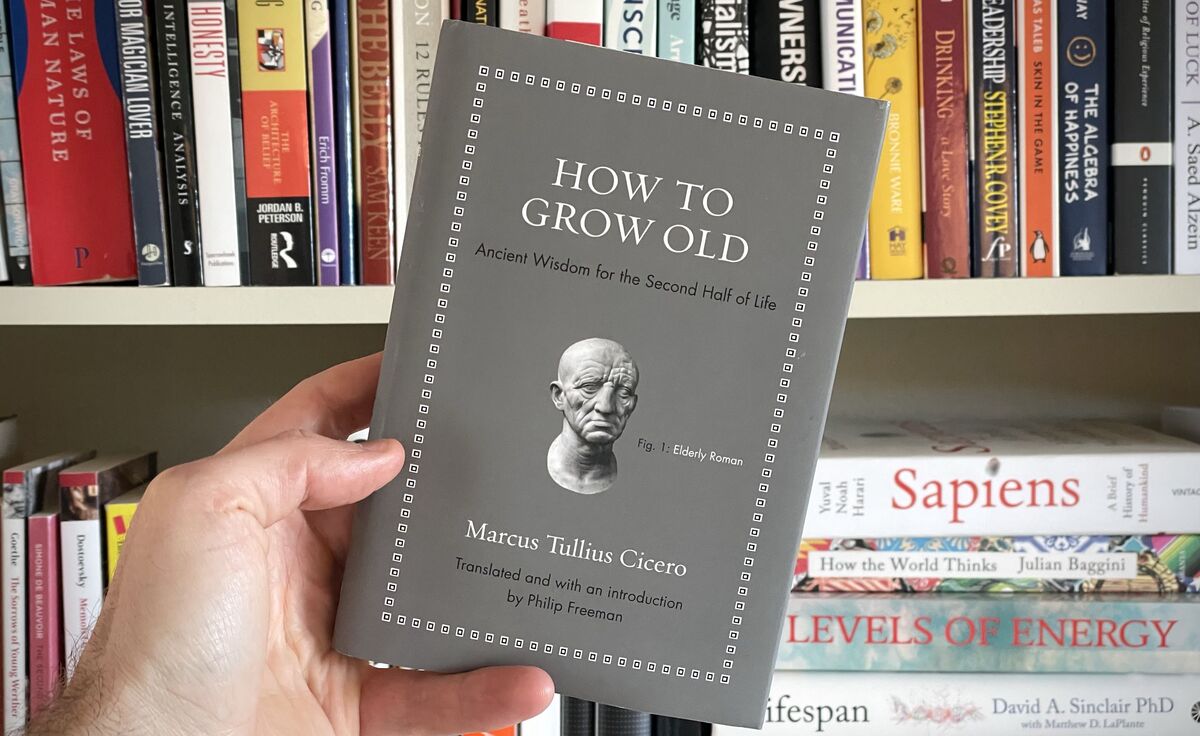
"Forty-five BC was a bad year for Marcus Tullius Cicero" reads the introduction by Philip Freeman. He was just divorced, again, and his beloved daughter Tullia had died earlier that year. The Roman Empire was in turmoil after Julius Caesar had crossed the Rubicon a few years earlier, and Cicero was no fan of Caesar.
Cicero had retired to the countryside when he wrote this book. Sixty-three years old.
As a style choice for his writing, Cicero puts his thoughts on old age in the mouth of Cato — who is supposed to be in his eighty-fourth year in the book. He is the guy you see on the cover. The original title Cato Maior de Senectute actually translates to something like "Cato the Elder on Old Age."
The discourse in the book is between this fictive version of Cato and a couple of youngsters who express their admiration at the wonderful ease with which he still bears the burden of life, despite his old age.
In the book Cicero gives a hopeful view of growing old. He admits the limitations it puts on the human body, but argues that old age is not worse than youth. Just like nature has its seasons, so is it with life. And each season has its fruits.
Throughout the ages, ever since the Middle Ages, people have been inspired by this book. The French essayist Montaigne remarked that the book made him look forward to old age. One of the founding fathers of the USA, John Adams, reread this book over and over again. Benjamin Franklin was so impressed by it that he printed a translation of it — one of the first classical books to be printed in America.
I want to share a few outstanding parts of the book to give a preview of the topics Cicero covers.
📝 A Good Old Age Starts in Youth
Cicero says that the values and qualities that make old age great need to be cultivated in youth.
"Miserable young people won't get any happier as they grow older."
Moderation, enjoyment of what life has to offer, and the clear thinking and wisdom — these are lifelong habits that need to be established early, because they will sustain us during our later years.
We might not be able to outrun twenty-something-year-olds in our second half of life. But there are plenty of joys to be had and to cultivate. Cicero himself studied the ancient Greek literature and was a key player in reintroducing the Greek works to Rome.
"There is no greater satisfaction to be had in life than a leisurely old age devoted to knowledge and learning."
📺 Video Review
📝 Cicero One-Ups the Youth
The book can also be humorous at times. Cicero points out that the old possess something that the youth desire.
"What youth longs for, old age has attained. A young person hopes to have a long life but an old man has already had one."
💡 Key Takeaway
Old age in itself is not a bad thing — even though many tend to blame age for all sorts of ailments.
"Foolish people blame old age for their own faults and shortcomings." — Cicero
We can all prepare for old age by cultivating a good character, being curious about the world, and taking up hobbies and projects. Age is not, in most cases, an obstacle for enjoyment and productive living. It's more of a dessert — a delicious and natural end to a great meal.
⚖️ Verdict
There is something soothing about reading old books that reflect on timeless questions. These questions that we all ponder — or at least I do — have been thought about for thousands of years.
"Books serve to show a man that those original thoughts of his aren't very new after all." — Abraham Lincoln
What is surprising is that the answers the ancients provide are quite in line with the most recent science and research. A positive outlook, healthy friendships, moderation in diet, continued challenges for mind and intellect — all solid strategies for reaching and enjoying old age. In Outlive by Peter Attia, the author comes to the same conclusion: key factors for a long life are to not be overnourished or undernourished.
It's a lovely little book! Even if Cicero spends a bit too much time talking about the delights of life on a farm. It gave me some Walden vibes.
📚 Further Reading
Another ancient Roman who reflected on these things was Seneca. But his angle was different. In his essay On the Shortness of Life he asks a different question: "Is life too short?" He concludes that life is long enough if we know how to use it. Unfortunately most people waste most of their lives only to wake up one day and wonder where all their time went.
It's a short, but delightful read. I've read it several times already, and I will read it again. It made it to my Great Books List, actually.
How to keep track of all these historical figures? Check out my video on creating your own historical timeline. One of the joys of life!
🏛️ Cicero and the Stoics
Cicero wasn't technically a Stoic — he identified more with the Academic Skeptics — but he was deeply influenced by Stoic philosophy and did more than almost anyone to bring Greek Stoic ideas into the Roman world. His writings on duty, virtue, and the good life carry unmistakable Stoic fingerprints. Without Cicero, much of what we know about early Stoicism would have been lost. If How to Grow Old resonated with you, you'll find even more wisdom in the broader Stoic tradition — from Seneca to Marcus Aurelius.
Explore the Best Stoicism Books →