The Shallows
The internet has turned into a network of interruption — and it's literally rewiring how we think.
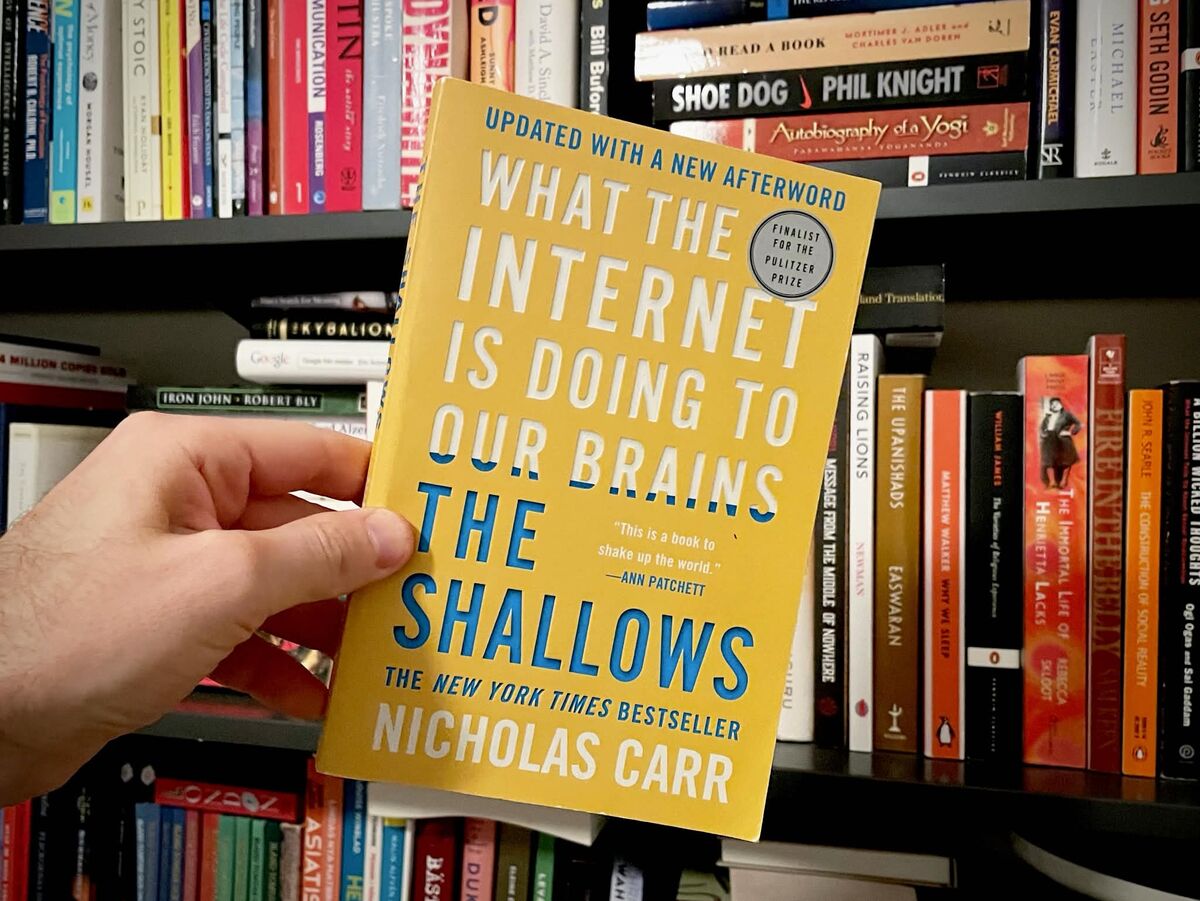
Why This Book?
Maybe you were supposed to do something important right now, but got distracted by a notification. Or you talked yourself into checking your social media — it's been ten minutes, something might have happened, right?
The Shallows is incredibly interesting and explains a lot of behavioral changes I've noticed in myself in recent years. It discusses the science around how internet browsing affects the way we think and learn. We also get a fascinating history of how, throughout time, the introduction of new media have changed the human perspective. Well researched and eye-opening.
The Medium Is the Message
A new medium is introduced and some praise it as the democratization of culture while skeptics call it the dumbing down of culture. Wasteland or eden? From the Gutenberg press to radio, the telephone, television, and now the internet — the pattern repeats. And Carr's central argument is compelling: the medium, more than the content, changes the way we think and act.
We change our brains through the tools we use, and our tools numb the parts they amplify. The GPS in our phones weakens our ability to map out areas in our minds. I'm guessing I'm not the only one who has noticed a quality decrease in my handwriting as I write more on computers.
The Plastic Brain
Descartes believed in dualism — the mind and the brain operating in two separate spheres, one material and one ethereal. That view held for centuries. But scientist Michael Merzenich did experiments on monkeys and found evidence for plasticity in the brain even in adult beings. This was contrary to the long-held belief that human brains were finished, static machines after reaching adulthood.
Nearly all of our neural circuits are subject to change. John Locke called the mind a blank slate — a tabula rasa — and the research increasingly supports the idea that we shape our brains through the way we live and the tools we use. Thinking differs between illiterate people and those who can read. It even differs between users of phonetic alphabets and languages like Chinese, activating different parts of the brain.
The Lost Art of Deep Reading
Back in the day, reading aloud was the norm. In his Confessions, Saint Augustine described how surprised he was to see his friend Ambrose reading silently to himself — this was around AD 380. There were no spaces between words. Deep reading, the kind that demands deep concentration, had to be learned.
What draws our attention is any sudden change in our surroundings. Our swiftness in shifting focus was once crucial to survival — a change in the environment might mean a new threat or opportunity. But the internet has hijacked this instinct. It has turned into a network of interruption, with notifications, hyperlinks, multimedia, and infinite searchability.
"To be everywhere is to be nowhere." — Seneca
📺 Video Review
The Unbundling of Everything
Carr describes how the internet unbundles content — breaking wholes into parts. Albums into separate songs. Radio programs into podcasts. Games into microtransactions. This fragmentation mirrors what's happening to our attention itself.
Our intelligence hinges on our ability to transfer information from short-term memory to long-term memory and weave it into conceptual schemas — complex concepts that form the architecture of understanding. People who read linear text comprehend more, remember more, and learn more than those reading text peppered with links. We skim more, looking for keywords. Our ability to read long articles has decreased and our ability to concentrate has diminished.
Memory and Attention
The number of synapses in the brain is not fixed — it changes with learning. Long-term memory persists as long as the anatomical changes are maintained. And the key to memory consolidation is attentiveness. Storing memories and building connections between them requires strong mental concentration, amplified by repetition or by intense intellectual or emotional engagement.
"It was once understood that the most effective filter of human thought was time." — Emerson
The internet filters for the new and popular instead of the tried and true — content that has survived the test of time. And spending time in rural areas has been proven to calm the mind. When we're not bombarded by external stimuli, the brain can relax, making it easier to control our attention and stay alert.
The Confirmation Bias Disclaimer
I have to make room here to consider confirmation bias: of course I'm going to appreciate a book that says reading books is great for deep learning and retaining knowledge. But even with that caveat, the neuroscience Carr presents is hard to argue with. Something that research increasingly supports is that the length of time you are exposed to an idea matters. Learning about 30 different topics for 30 minutes each — by reading articles and blogs — is less effective for accumulating knowledge than learning about one topic for 15 hours by reading a book.
💡 Key Takeaway
Deep reading demands deep concentration, and deep concentration has to be learned — and protected. The internet is rewiring our brains for distraction and shallow thinking at the expense of depth, memory, and contemplation. The tools we use don't just help us — they reshape how we think. Being aware of that trade-off is the first step to reclaiming your attention.
⚖️ Verdict
My recommendation is to put The Shallows and Deep Work on top of your reading stack. Together, they were the most impactful reads of that year for me. Carr gives you the terrifying "why" — the neuroscience of what the internet is doing to your brain. Newport gives you the actionable "how" — practical strategies to fight back and prioritize depth. Essential reading for anyone who has ever felt their attention slipping away.