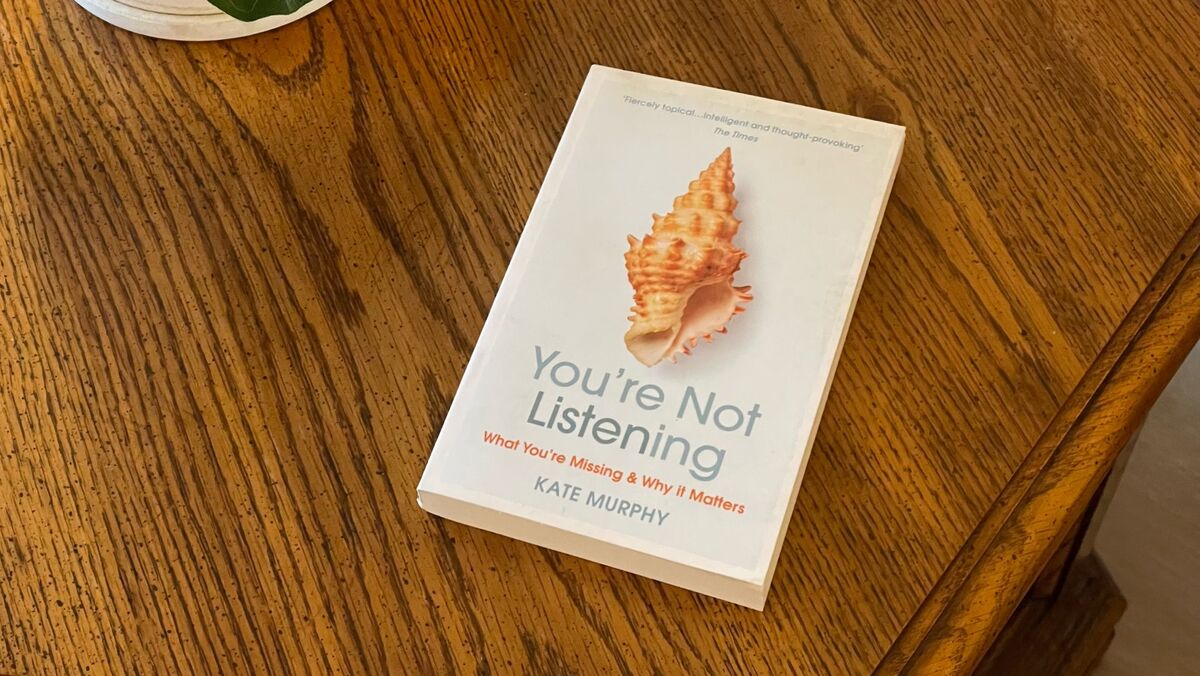
You're Not Listening
A full book dedicated to the one communication skill everyone talks about but nobody practices.
"The ancient Greek philosopher Epictetus said that nature had given men one tongue but two ears for a reason. That we might hear from another twice as much as we speak."
If you have read a few books about communication, negotiating and persuasion you know that these books often only touch the surface on the subject of listening, so when I found a book fully dedicated to the subject I knew I had to pick it up.
This book tackles questions about why we might overlook the art of listening in modern culture and what you can do to improve your listening skills.
"In modern life we are encouraged to listen to our hearts, listen to our inner voices, and listen to our guts but rarely are we encouraged to listen carefully and with intent."
Conditioning & Upbringing
"Bad listeners are not necessarily bad people."
Not everyone has the skill, and in some ways we have been conditioned not to listen. When a parent says, "Listen!", we are probably not going to like what comes next. When a coach shouts, "Listen up!", then what follows is often a list of rules and restrictions.
We also inherited the way we listen to some degree.
"We tend to listen as we were listened to as children."
Many caregivers ignore their children in favor of their phones. This impoverishes children's development. Which suggests that the so-called "screen generation" that is now coming of age might struggle to connect with other people.
Social Media
Social media might play a role in why listening only plays a supporting role in conversation. In social media you are "rewarded" with social proof for what you say, and you are often rewarded by the algorithm by how MUCH you say and how OFTEN you speak your mind. Listening is not even a thing in the quasi-dialogue that is happening on social media.
Coupling & Syncing of Brain Waves
Neuroscience shows that when you truly connect with another person your brain activities sync. The more overlap between the speaker's brain activity and the listener's brain activity the better the communication. The brains of really close friends react similarly when watching short video clips for instance.
Conversational Narcissism
The book describes two kinds of responses in conversations: a shift response and a support response. The first shifts attention back to yourself, and the second supports the other person's comment.
The Shift Response
Anne: I'm so busy right now.
Bill: Me, too. I'm totally overwhelmed.
The Support Response
Anne: I'm so busy right now.
Bill: Why? What do you have to get done?
Good listeners are all about the support response!
📺 Video Review
Ask Better Questions
"If a person is not interesting, then it's on you!"
When leaving a conversation ask yourself these questions:
"If you can't answer those questions then you probably need to work on your listening."
Hearing
Many people might be bad listeners because they truly can't hear well and their brains work in strange ways to make up for it.
"…hearing loss in the long run leads to a litany of poor emotional and societal outcomes including, but not limited to:
This is not solely due to lack of hearing, but the resulting loss of connection it can bring.
The Thought/Speech Differential
When you zone out of a conversation it's often due to the speech/thought differential which refers to the fact that we can think much faster than someone can talk. The average person talks at about 120–150 words a minute which takes up a tiny fraction of our mental bandwidth powered by some 86 billion brain cells.
So our mind wanders and we think about other things as we engage in conversation. We check out from time to time to think about other things like: "Do we have milk?", "Where did I put my phone?", "Do androids dream of electric sheep?" Sometimes we take these side trips for too long only to snap back as the speaker says something like "stock tip", "hemorrhoids" or "books".
"Having missed parts of the narrative we unconsciously, and often incorrectly, fill in the gaps."
This degrades the quality of the conversation.
Things Are Speeding Up
"Research suggests that, after people listen regularly to faster paced speech they have great difficulty maintaining attention when addressed by someone talking normally."
This might explain why I easily get irritated when I get interrupted when cooking and listening to audiobooks at 1.7x speed. And I find it hard to concentrate on what the person has to say in such situations. My wife or my children come off as slow…
💡 Key Takeaway
"The most valuable lesson I've learned as a journalist is that everybody is interesting if you ask the right questions. If someone is dull or uninteresting, it's on you!"
⚖️ Verdict
I got a bunch of practical ideas from this book that will definitely improve life if I practice them, but the book itself was not too memorable. Ask me about You're Not Listening in two years and I will probably not remember having read it. Good, but not extraordinary!