Never Split the Difference
If Atomic Habits is the definitive book on habit building, this is the definitive book on negotiation.
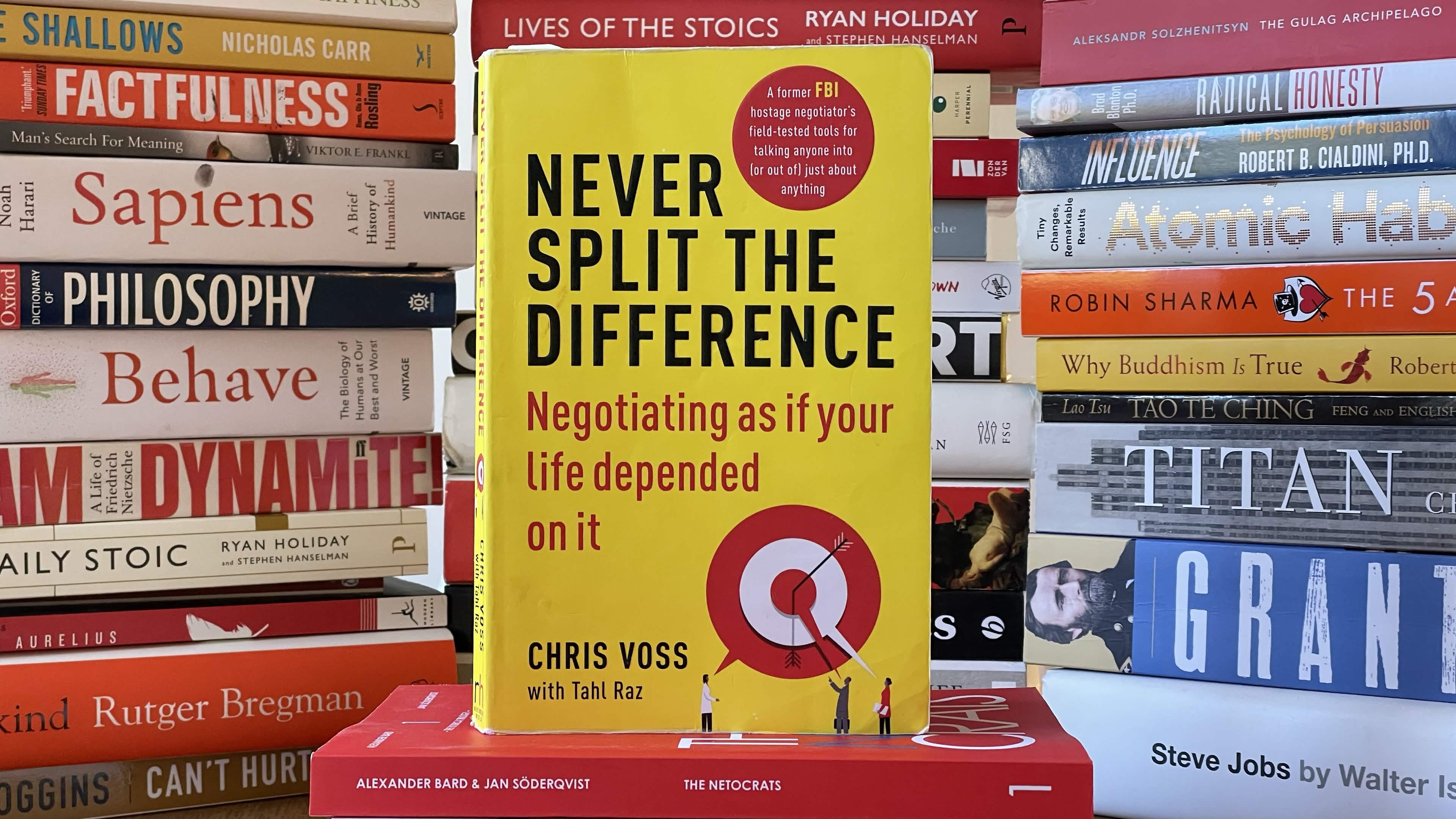
Why We Hate Negotiating
Except for a few naturals, most of us hate negotiation at first. We get nervous, our hands sweat, and our thinking breaks down.
But it's not really the person across the table that scares us — it's conflict itself. Humans are made for living in tribes and getting along with the group is a natural priority for most of us. I avoid conflict. I avoid negotiation. Or at least I used to.
"The first step to achieving a mastery of daily negotiation is to get over your aversion to negotiating."
This book changed my view of negotiation. I'm now in love with it. And that's mostly due to the fact that we created a Book Club and Implementation Group around this book where we really put the tactics into immediate use in real-life situations alongside our theoretical studies. I read it and implemented its ideas with my book club — twice.
Implementation Is Everything
Reading a book on negotiation is one thing. Actually using the techniques in your life is something else entirely. I had just started my video editing business and my Video Content Club, and for the first time in my life I needed to sell and negotiate as a business owner. The timing couldn't have been better.
That's the thing about this book — it's packed with actionable tools. Not abstract theory, not "be more confident" platitudes. Real techniques you can use tomorrow morning. And the best way to lock them in? Use them immediately. Make an effort to use the tools in this book in your life with no delay — and it might be one of the most valuable books you'll ever read.
"No" Is Where It Begins
One of the most counterintuitive ideas in the book is that negotiation starts with "no." Most of us hear "no" and think the conversation is over. Voss flips that completely.
The truth of this became clear to me when I paid attention to how I negotiated with my son. Once I had said "no" to one of his requests was usually the time when I would open myself to hearing him out. That's when I was ready to consider the possibilities and we could work something out together.
So what does "no" really mean? Voss breaks it down:
- I'm not yet ready to agree
- You are making me feel uncomfortable
- I do not understand
- I don't think I can afford it
- I want something else
- I need more information
- I want to talk it over with someone else
Saying "no" makes the speaker feel safe, secure, and in control — so trigger it. "Is now a bad time to talk?" is always better than "Do you have a few minutes to talk?" By saying what they don't want, your counterpart defines their space and gains the confidence and comfort to listen to you. You don't sound like a salesman that way.
📺 Video Review
The Pinocchio Effect
Here's a fascinating nugget: the number of words grows with lies. When people lie, they use more words. Voss calls it the Pinocchio Effect. It's one of those insights that, once you hear it, you can't unhear. You start noticing it everywhere — in meetings, in emails, in everyday conversations. Short and direct usually means honest. Long-winded and over-explained? That's where your antenna should go up.
The Accusation Audit
This is my favorite tool from the book, and the one I've used the most. The idea is simple: before a tough conversation, you make a list of every unreasonable, unfair, crazy, ridiculous accusation your gut instincts are picking up that the other side might say about you. Then you bring them up first.
When we acknowledge negatives, they lose their power. It sounds counterintuitive — why would you bring up the bad stuff yourself? But it works. It disarms the other person completely. Instead of building up resentment and throwing accusations at you, they end up saying "No, it's not that bad" and suddenly the whole dynamic shifts in your favor.
Deadlines Are the Boogeyman
Deadlines are the boogeyman of negotiation — scary, but mostly imaginary. Have you ever missed a deadline and had it result in truly terrible consequences? Probably not. Voss argues that most deadlines are arbitrary, and the panic they create clouds your judgment. When you stop treating every deadline as life-or-death, you negotiate from a place of calm rather than desperation.
💡 Key Takeaway
Real negotiation isn't about logic and compromise — it's about empathy, tone of voice, and understanding the emotional world on the other side of the table. The techniques in this book — mirroring, labeling, the accusation audit, getting to "no" — are tools you can use in every conversation, not just high-stakes deals. But the magic only happens when you implement them immediately.
⚖️ Verdict
If Atomic Habits is the definitive book on habit building, then this is the definitive book on negotiation. It can seem a bit manipulative, but if you see past that — and make an effort to use the tools in this book in everyday life with no delay — then it might be the most valuable reading you'll do this year. This was one of my favorites of the year, not because it was the most beautifully written or the most original, but because it changed my perspective, motivated me to improve, and gave me tools I still use today.