The Wealth of Nations
The 1776 classic that laid the foundation for modern capitalism — and still shapes how we think about markets, labor, and prosperity.
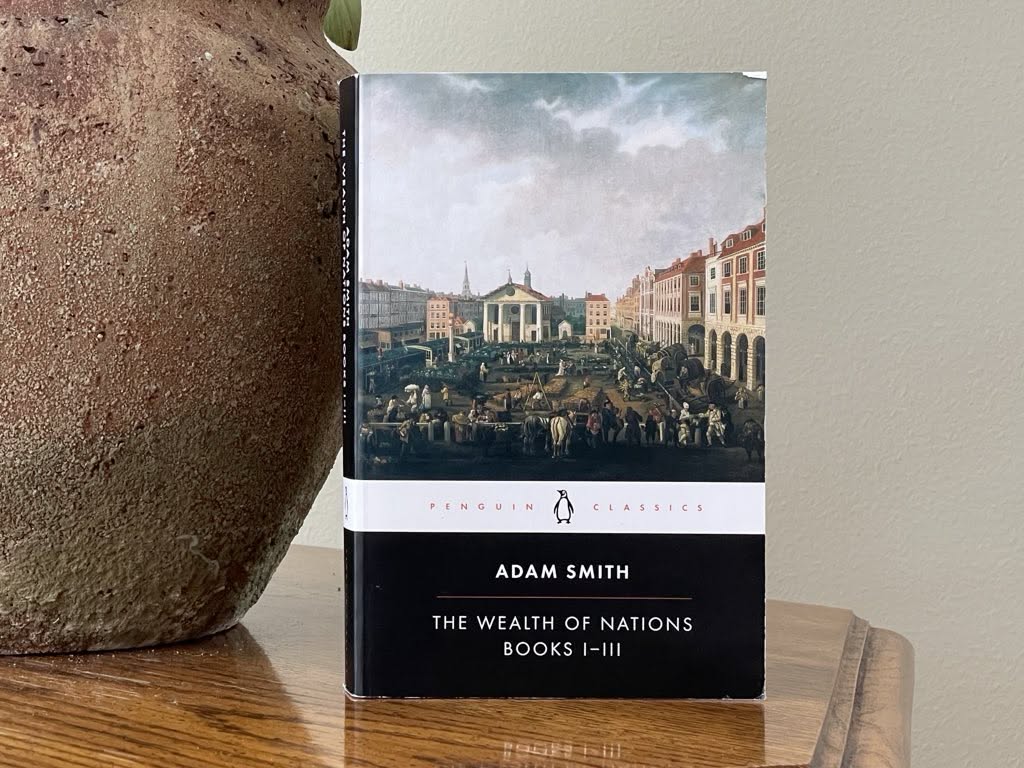
The Foundation of Modern Economics
The Wealth of Nations was first published in 1776 and it's regarded as one of the most influential works of classical economics. Adam Smith is a legend — a first principles thinker of the highest order. This book is a foundational part of classical economic theory and modern capitalism, and reading it gives you a deeper understanding of the machinery behind the world we live in.
Smith's central idea is that individuals pursuing their own self-interest can unintentionally benefit society as a whole. This is what he famously describes as the invisible hand. He argues that free markets, competition, and minimal government interference generally lead to greater productivity and more prosperity for all.
"The greatest improvement in the productive powers of labor, and the greater part of the skill, dexterity, and judgment with which it is anywhere directed or applied, seems to have been the effects of the division of labor."
The Pin Factory
One of the most memorable parts of the book is Smith's example of a pin factory when he discusses the division of labor. He describes how making a pin is not a simple single task — it can be broken down into many distinct operations: drawing out the wire, flattening it, cutting it, creating the point, attaching the head, and even packing the finished pins.
If one worker tries to do all these tasks alone, maybe he'll create a handful of pins per day. But if the work is split into individual tasks performed by different people, the result is mind-blowing — a factory like this might produce 40,000 pins in a single day. That's thousands of pins per worker instead of a handful.
This example illustrates how specialization dramatically increases efficiency. Not because the workers are smarter, but because repetition builds skill, time is saved from switching between tasks, and tools can be designed specifically for each step. From this simple observation, Smith builds a sweeping theory about productivity, trade, and economic growth.
📺 Video Review
Still Relevant After 250 Years
While the book is intellectually dense and not the easiest to follow for a modern reader — there's a lot of outdated terminology and historical comparisons we can't fully relate to today — it's still remarkably relevant. Smith explores taxation, wages, trade, public works, and the role of government. Many of these topics continue to shape political and economic debates right now.
I initially picked this book up because I wanted a better understanding of fundamental economics so I could think about the implications of a world run by AIs and robots. The division of labor concept alone — imagine robots creating other robots, von Neumann-style replicators, and the efficiency gains from that. The productivity boom would be like a meteor hitting the earth. The economy would expand enormously, and I have no idea how we'll handle it.
The big question becomes: how do we make sure billions of people who might lose their jobs aren't left behind? How do we include everyone and not just make the ones producing the robots extremely rich? Smith didn't anticipate AI, but his framework gives you the vocabulary to think about these disruptions.
💡 Key Takeaway
Specialization and free exchange are the engines of prosperity. Smith showed that wealth isn't a fixed pie — it grows when people are free to specialize, trade, and pursue their own interests. Understanding this 250-year-old insight is essential for navigating the economic disruptions ahead.
⚖️ Verdict
It's a good book, but I won't tell everyone to run out and buy it. It's intellectually impressive and daunting in equal measure — sometimes it really pulls you to sleep with all the examples and historical detail. If you're genuinely interested in the history of economics, it's a no-brainer. If you're only slightly curious, there are more accessible books on economics. I'm proud I made my way through it, and Smith's sober, deep understanding of how economies work is pretty brilliant. A classic for a reason — just know what you're getting into.