The Bitcoin Standard
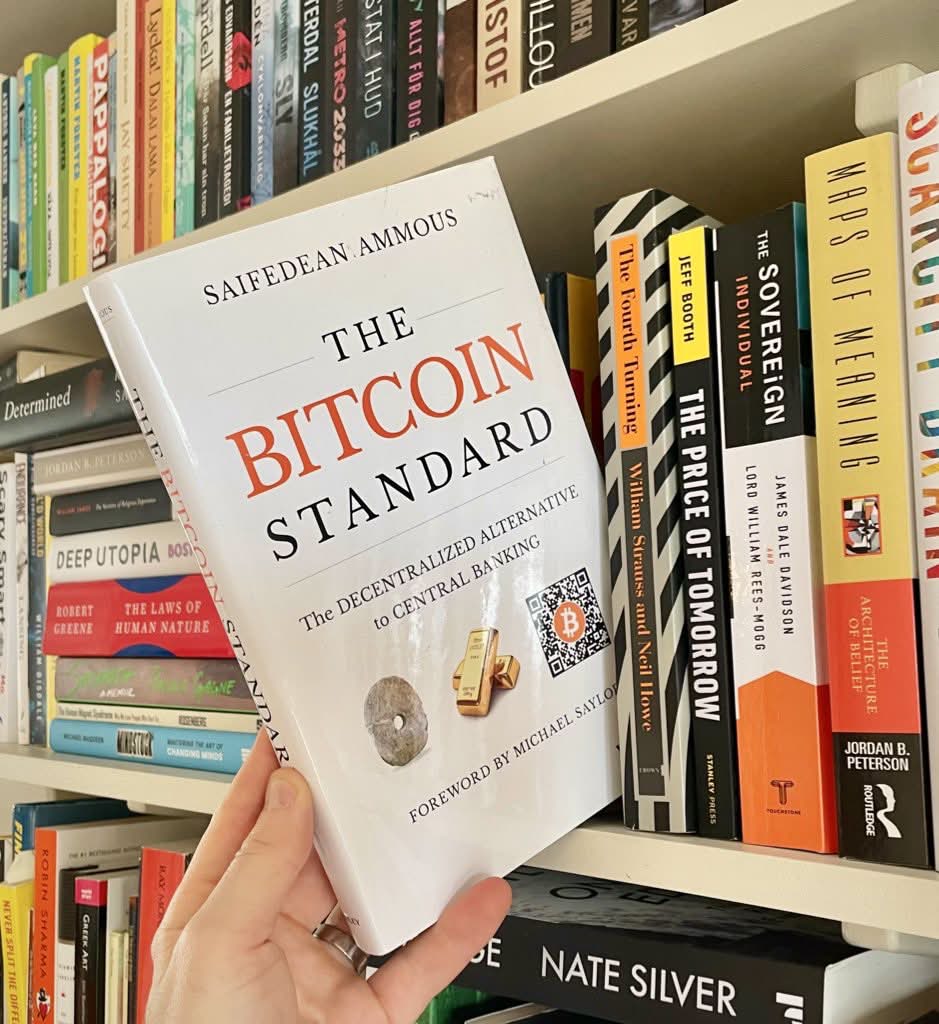
The Bitcoin Standard: The Decentralized Alternative to Central Banking by Saifedean Ammous might be the best starting point I've found for anyone interested in Bitcoin as a technology — or just curious why the current financial system feels so broken.
A short history of a strange invention
On November 1st, 2008, a programmer using the pseudonym Satoshi Nakamoto sent an email to a cryptography mailing list announcing an electronic cash system that was fully peer-to-peer and didn't depend on any trusted third party. He had designed a payment network with its own currency where members could verify all transactions without trusting any single member, and where the people spending their computer power on verification got rewarded in the currency. The new thing about this system, compared to the many earlier attempts, was that it actually worked.
The white paper landed in 2008. The first block was mined in 2009. In that same year, an internet exchange sold 5.05 BTC for $5.02 — the first time Bitcoin was traded for money. In 2010, someone bought two pizzas for 10,000 BTC, the first time it was used as a medium of exchange. In 2021, El Salvador became the first country to adopt it as legal tender. In January 2024, the spot Bitcoin ETFs were approved in the US, putting Bitcoin on roughly equal legal footing with gold and other commodities — and finally giving non-tech users an easy way in.
(A quick disclaimer: this is about Bitcoin specifically, not crypto in general. Bitcoin is crypto, but all crypto is not Bitcoin. And nothing here is financial advice.)
Why Bitcoin matters
The first thing that makes Bitcoin special is that nobody controls it. The creator vanished. There's no founder around, no company that owns it, no country that controls it. Even if Satoshi showed up tomorrow, half the world wouldn't believe it — and it wouldn't matter. Bitcoin just exists and does its thing.
Having a sovereign system like that — fully transparent code, can't easily be tinkered with, can't be stopped or banned — is enormously powerful. Ammous argues it solves a deep problem in our current financial system: governments keep printing money, debasing the value of the dollars, yens and euros that you work so hard for.
We used to live under a system where governments backed their currencies with gold. Gold is inconvenient for governments because it's scarce — getting it out of the ground is expensive, slow and energy-intensive. If you wanted a new program or a new war, you had to either find more gold or tax your citizens harder. That problem was "solved" in 1971 when the dollar went off the gold standard. After that, governments could print as much as they wanted. Great for governments, less great for the people whose savings were quietly evaporating. Living in Sweden, you feel it everywhere — house prices keep running away from you no matter how hard you save.
Scarcity in a digital world
Things in the world are very rarely scarce. Even gold isn't really scarce — there's plenty more in the ground, and if the price goes up enough, people will go find it. Digital things are almost never scarce, which is why they're rarely valuable. Copying a file is free.
And this is what makes Satoshi's invention so remarkable: he created digital scarcity for a commodity. That had never been done before — not in the digital world, not even in the physical one. There will never be more than 21 million Bitcoin. Ever.
"21 million isn't enough to build a financial system on," people sometimes say. But Bitcoin has another property of money: it's divisible. Each Bitcoin is made of 100 million Satoshis, which is plenty of room for micropayments and even buying coffee. While reading this book, I tried it myself using the Lightning Network — sending fractions of a cent to people on the other side of the world worked surprisingly well.
Trustless, permissionless, and surprisingly humane
Try sending $10 to a random person in Nigeria through the traditional system. Chances are you can't, or the fees would eat the entire amount, or you'd have to jump through enough hoops that you'd give up. With Bitcoin, anyone with a wallet can send and receive — no permission needed.
Yes, that includes criminals, and critics love to point that out. But it also includes a lot of people who get systematically excluded from the financial system: women in countries where they're not allowed to control their own money, people in remote villages with no bank branch and no internet. With Bitcoin you can even receive money over SMS — there are more cell phones in the world than there are bank accounts. The opportunities for new markets here are mind-blowing.
📝 Why this book is fascinating
- You get a full history of money — from shells and stones, to precious metals, to gold-backed currencies, to fiat — and every time humans have manipulated the supply of money, it has ended in disaster.
- You get a history of Bitcoin as a technology, and it's a punk-ass story. Genuinely entertaining.
- You get a clear breakdown of how Bitcoin actually works: mining, proof of work, hash rate, the difficulty adjustment, the halving — concepts you really do need in order to appreciate what Bitcoin is.
- You get the psychological cost of inflation, plus a nice tour of Keynesian vs. Austrian economics and the philosophy of money.
⚖️ Verdict
It's easy to dismiss Bitcoin because of the scams and noise on the surface of crypto. But I've yet to meet someone who actually read up on the technology, fully understood it, and stayed dismissive. You need to spend somewhere between 10 and 100 hours studying Bitcoin to really get it — not because it's complicated (it isn't), but because it's different. We've never had a finite, fungible asset like this before, digital or physical.
You owe it to yourself to understand it well enough to decide whether it's a giant ponzi or the most important invention since the internet. The Bitcoin Standard is a genuinely fun and entertaining way to do that work — and one of the best reading experiences I've had in a long time.
I recommend this book even if you don't care about Bitcoin, because it forces you to think critically and in new ways about money. That's always a good thing to do.
Video Review
📚 You Might Also Like
🔗 Another Take
Want a different perspective? Check out this review of The Bitcoin Standard from Purpose Focus Commitment.