The Sovereign Individual
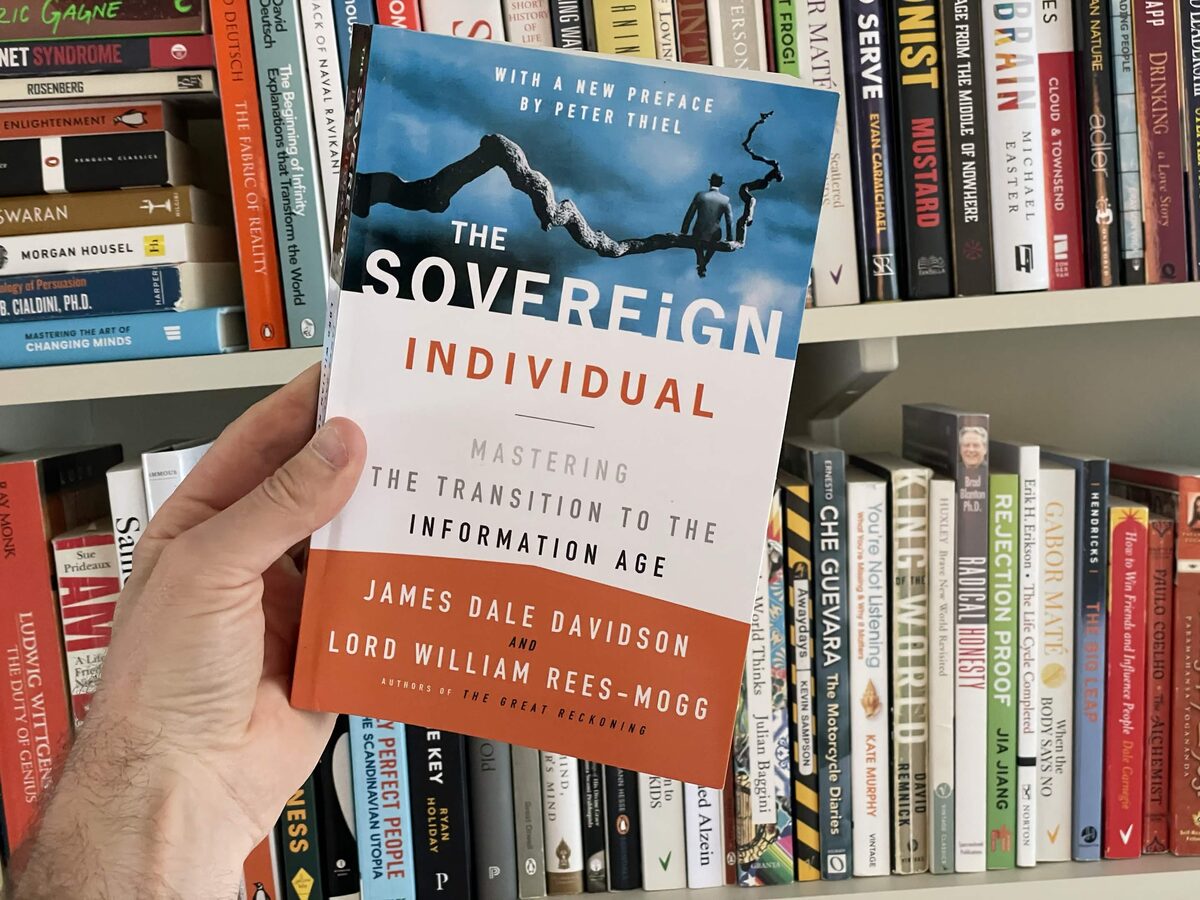
The Sovereign Individual: Mastering the Transition to the Information Age by James Dale Davidson and Lord William Rees-Mogg takes you along on an intellectual tour into the new economical age. The big casualty of the digital age, the authors argue, is the nation-state — and the book predicts its bloody demise and the rise of the sovereign individual.
The authors argue with chilling precision that the information age will dismantle traditional power structures. In the digital age, the incentives for rewards and punishment, as well as the nature of violence, will change — as they always do when there's a big societal paradigm shift. And this will usher in a new era where individuals will be able to escape the control of national governments.
Their prophecy is bold and harsh: the smart will thrive, the slow will perish, and the sovereign individual will emerge as a winner while the masses fight for breadcrumbs. Davidson and Rees-Mogg's vision is nothing short of apocalyptic. They dissect the dying corpse of the 20th-century state with surgical detail, inspecting every festering wound — bureaucratic bloat, fiscal irresponsibility, regulatory overreach. Their writing is as sharp as the guillotine's blade.
Two parallel worlds
You may have felt it too. I think many viewers of this channel are aware that society is changing rapidly, and it has done so for a long time. What got me to pick up this book was that I felt like people are now living in two parallel worlds at the same time: the era of exponential, world-changing technology, but at the same time some of our thinking and strategies are just made for the old industrial world.
Sometimes when I'm in discussions with people, I feel like there's such great cognitive dissonance. We talk about workers going on strike or what politicians say and do, like it matters. It actually doesn't, really, because technology dictates where we're heading. And oftentimes I hear people plan for the future like the future would look like the present does today. This makes me feel uneasy, because I know the world has changed. We have moved into a new era, and it's time to act accordingly. The old rules don't apply anymore.
Even transitions that are undeniably real in retrospect might not be acknowledged for decades — even centuries — after they happened. This book helped me deal with the unease of what I saw as two parallel worlds unfolding simultaneously. It helped me pinpoint how society is changing, because it goes into detail about what changes to expect in the age of microprocessing: how we will live and work, who will attain power in this era and who will lose it, and what type of chaos to expect as politics and nation-states fade away.
A digital underclass — and a tiny elite
I'll highlight three things I found especially interesting. The first is the emergence of a digital underclass that is against technology. The amount of people who can't be deployed effectively in the workforce will grow substantially — and at the same time, a smaller percentage of workers will be able to do the best-paid work. But those who possess the specialised skills required for that work will reap enormous rewards.
Charles Booth coined the term "the lowest limit of positive social usefulness," and this number was about 3% in the '40s and '50s — people who wouldn't be able to join the workforce because it wouldn't be efficient to have them working.
"Suppose that in the information age, the required score has risen 24% and has fallen under the level of social usefulness. Top jobs might fall from 32 to 5%."
These exact numbers might not land perfectly, but we know for sure the thresholds will rise.
Cyber money and the end of inflation
The second thing that blew me away is how the book predicts that cryptographically-based cyber money will undermine the nation-state — and it did so 12 years before we had our first cryptocurrencies.
"Inflation as a revenue option will be largely foreclosed by the emergence of cyber money."
The prediction is that technology will help us bypass the traditional gatekeepers of money.
"In the new millennium, cyber money controlled by private markets will supersede fiat money controlled by governments. Only the poor will be victims of inflation."
The authors predict that the most momentous consequence of digital money is the end of inflation. Re-read that with 2024's ETF-era Bitcoin in mind and tell me it doesn't make the hair on your neck stand up.
Why the nation-state will fail
The third point is about how and why nation-states will fail.
"Information technology facilitates dramatically increased competition between jurisdictions. When technology is mobile and transactions occur in cyberspace as they will increasingly do, governments will no longer be able to charge more for their services than they are worth to the people who pay them. Anyone with a portable computer and a satellite link will be able to conduct almost any information business anywhere, and that includes almost the whole of the world's multi-trillion-dollar financial transactions."
The nature of work has forever changed due to the internet. You're no longer bound to one location in order to do your work, and more and more work can be done fully digitally. If you're in a jurisdiction where you feel the taxes you pay don't give you the security and benefits that you should get, you can move to another jurisdiction.
One effect of this is that countries which don't treat their citizens correctly — that take out predatory taxes — will lose their best customers. Basically, the people who are able to earn the most in the digital age, and hence pay the most taxes. There will be a fight for skilled labour, and citizens will be able to shop for the country that offers the best benefits. This is a huge change, and the book goes into serious detail on it.
📝 Why this book still matters
- It was originally published in 1997, and the predictions hold up astonishingly well — especially on crypto, remote work, and jurisdictional competition.
- It's an older book, so you get to see (or feel, in your own lifetime) how the forecasts have actually played out.
- It forces you to ask brutal questions: Is your career path in line with where society is heading? Do you own the right assets for the digital age? Do you live in a country that will thrive in the digital era — or one that won't?
- It's not for the faint of heart. Once you see the facts it points to, they're hard to unsee.
⚖️ Verdict
This book has aged really well. It's a punch to the solar plexus, and it's books like these that make me believe reading is one of the most rewarding activities in life. It's a visionary blueprint for the brave new world we're heading into — a wake-up call. Ignore the warnings at your own peril, because it doesn't just predict a probable future, it predicts a future that is actually unfolding as we speak.
And I want to end on a more hopeful quote:
"For the first time, those who can motivate and educate themselves will be almost entirely free to invent their own work and realize the full benefits of their own productivity. Genius will be unleashed."
Video Review
📚 A Kit for Surviving the Transition
A few more books that helped me wrap my head around the digital economy: