The Price of Tomorrow
If technology makes everything cheaper, how come your life keeps getting more expensive?
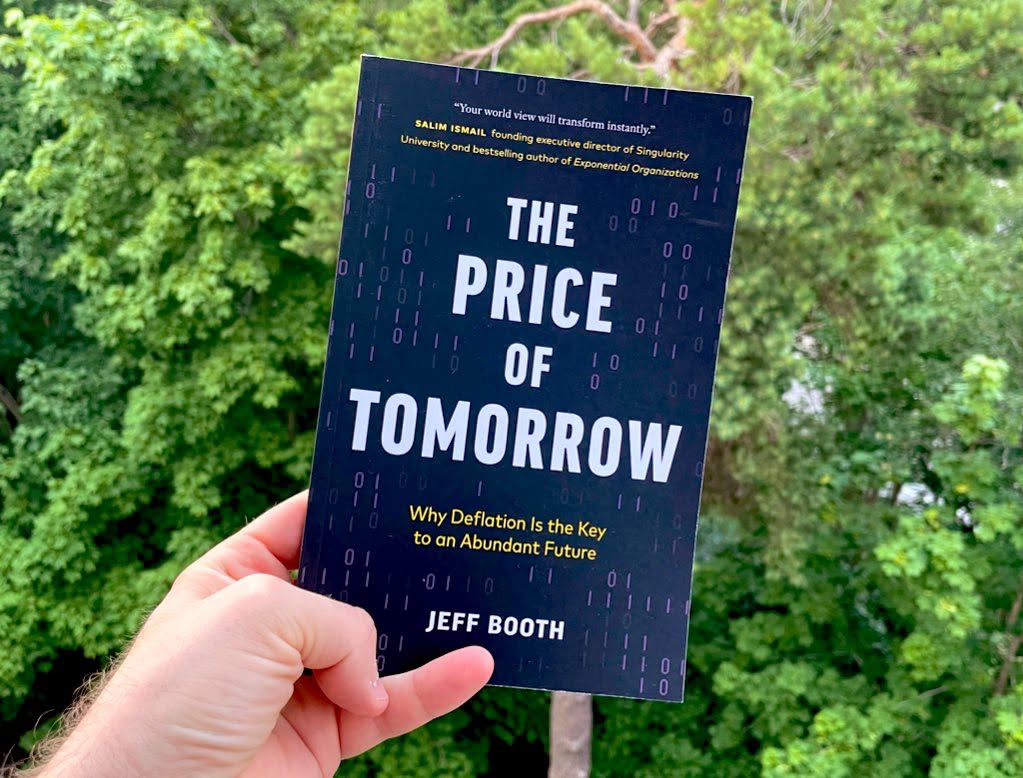
The natural state of the market is not inflation but deflation. Technology makes productivity growth exponential — and those gains should be flowing towards you and me, giving us more for less. Anything that prevents deflation is not an economic system or a political system, but a control system. That's the thesis of Jeff Booth's The Price of Tomorrow.
The deflation paradox
So what is deflation? It's when you get more for your money. Booth's argument is simple but powerful: market incentives force companies to seek out every productivity gain they can find, to make their products cheaper to produce. Companies that can produce cheap goods can offer more competitive pricing. In the end, the consumer gets more for less.
If this is the case — and we currently live in an extreme technological boom — then it's natural to ask: if technology is making everything cheaper, how come my life has become more expensive?
"On the one side we have this incredible deflationary force driven by technology, and on the other side we have a force trying to stop it. That force is the money printing machine."
Today the biggest movers in financial markets are not looking at the growth potential of companies but at the direction of central bankers and governments — and whether the money printer will go brrr. After the pandemic this was more obvious than ever. Just look at all the stimulus that was sent into the system.
The melting ice cube
The most reliable indicator of whether the stock market and housing market will go up is the global M2 — the Federal Reserve's assessment of the total money supply in the world. When more money is created, you can be almost certain that stocks and housing prices will rise. This newly minted currency needs a new home, because every person with half a brain understands that the worst thing you can hold is cash — especially when it's actively being debased. It's like holding a melting ice cube.
So money flows towards harder assets that at least have some scarcity — like housing and stocks — which adds a monetary premium on top of their utility value. In the end, numbers go up.
"We should ask ourselves whether those same assets would have gone up over the past 20 years if there hadn't been $185 trillion of new capital injected into the system."
📺 Video Review
A rude awakening
This book hit home because of a personal realization: the money saved over years of disciplined saving now buys roughly half the freedom and choice it would have five years ago. That's a rude awakening. And it's not just a personal story — there's a growing loss of hope among younger generations. People talk about not wanting to start families, and that decision is mostly fear-based. They're fearful they won't be able to provide. They're fearful of war and catastrophe. They have a growing conviction that life provides more suffering than joy.
That's what makes this book matter. It explains the underlying mechanics of the financial system that are driving these feelings of despair.
Beyond money printing
The book covers more than just currency debasement and the debt-based economy. It explores how the whole system leads to polarization, us-versus-them narratives, and can easily be hijacked by populist politicians. It talks about the future of job markets, equality, and wars.
"Most of the jobs today exist because of waste in the system due to information asymmetry. Once the waste is handled, there won't be many jobs for humans."
If the conclusion is that jobs are no longer needed, then the question becomes: how can we live in peace under those conditions? It's a question worth sitting with.
💡 Key Takeaway
Technology should be making your life cheaper and more abundant — but the money printing machine is stealing those gains from you. Understanding this dynamic between exponential technology and debt-based economics is the first step towards protecting yourself and making sense of the financial distress you see around you.
⚖️ Verdict
A great and insightful book that explains the dynamic relationship between the debt-based economy and exponential technology. It's frightening for sure, but also hopeful. Quite short and accessible to new readers — if you want to understand why the huge progress in technology hasn't trickled down to improve our lives as much as it should, this is your book. Highly recommended for anyone who feels something is off but can't quite put their finger on what it is.