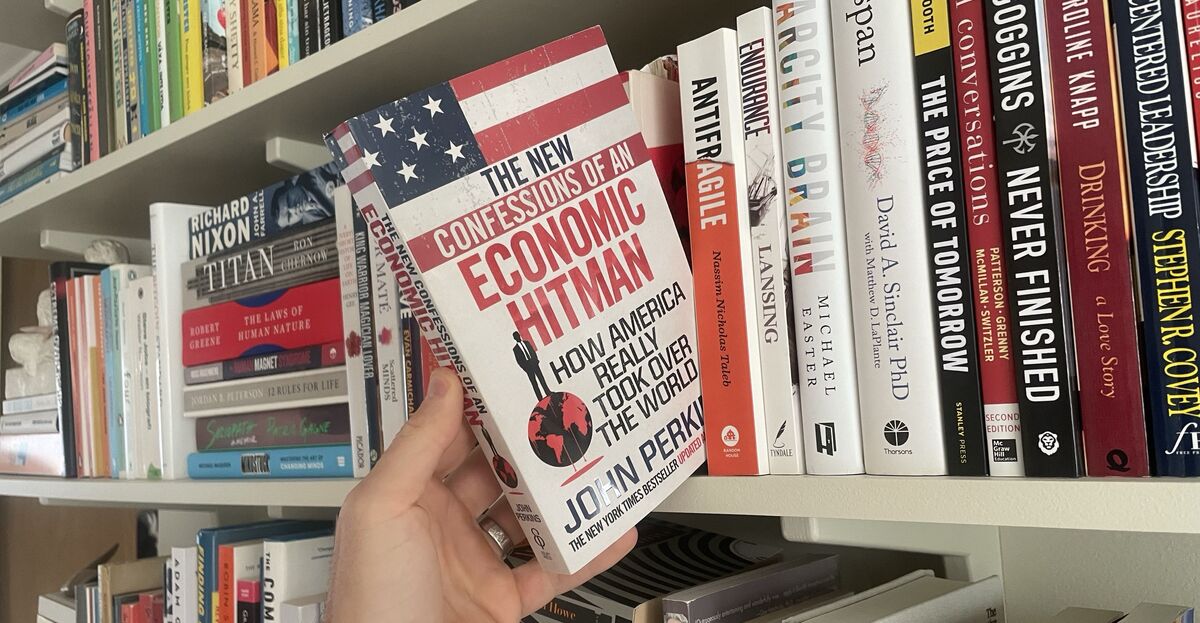
The New Confessions of an Economic Hit Man
A spy-novel opening that devolves into bitter self-congratulation and shamanic corporate advice.
A Leper, a Cab, and a Conspiracy
There's a scene early on where a leper throws his hand into the open window of a cab onto our author, John Perkins. Dirty, strange, a little bit cinematic. It feels like you walked right into a spy movie when you read this book.
John Perkins is an American author and activist who became famous for Confessions of an Economic Hit Man back in 2004. This is the updated version, with a big section arguing that the system he helped build has now spread even further.
The Economic Hit Man Playbook
In his telling, being an economic hit man means you go to a developing country, sell the leaders on a dream of prosperity - bridges, ports, highways. You dream up big numbers. The money comes as huge loans from places like the World Bank. The contracts for all these construction projects go to huge Western corporations. When the country can't repay its debts, you get the leverage - resources, policies, votes in the UN, whatever you need to further your interests.
These are the soft tools. But there's a next step if they fail. Perkins calls it "calling in the jackals" - coups, assassinations, or just the threat of them.
Debt first, resources later. That's the name of the game when you're an economic hit man and you want to extract as much as you can from a poor developing country.
The Corporatocracy
He calls the wider system a "corporatocracy" - not one secret meeting of villains, but a network of corporations, banks, colluding governments, and very wealthy people, all optimizing for short-term profit. He calls that model a "death economy" and spends the latter half of the book talking about what he wants installed instead: a "life economy."
One useful framework he offers is how countries changed their playbook after World War II. With the invention of the nuclear bomb, the business of running an empire became too expensive and too dangerous. So debt and fear took the place of standing armies. The web Perkins wants you to see - the interconnection between NGOs, big corporations, the World Bank, secret services, and states - is the whole point of the book. It's all connected, according to John. And not in a clean way that press releases might suggest.
📺 Video Review
Where It Falls Apart
Here's one of his sharper points: a lot of development, he says, only does the hopelessly poor a disservice. And there's a rationalization people tell themselves - that the poor are better paid $1 a day than no dollar at all. Sure, that sounds like a rationalization, but there's some truth to it too. Many people would rather work in a sweatshop for $1 than as a sex worker for 50 cents. It might be more nuanced than Perkins admits.
But the real problem is that the book totally derails. The end turns into what he frames as the fix: love-based companies, recycling, community, a conscious shift from the death economy to the life economy, shamanic approaches to corporations. I actually wanted to turn it off. I didn't read the last pages because it was just too much.
And it's not only the hippy-dippy stuff. It's the tone. This guy is so negative. He feels so bitter, so remorseful. He might have good reasons, but I just get dragged down by the negative energy. He paints the world as the worst place ever, and it's only getting worse. It sucked so much energy out of me reading this book.
Perkins is also incredibly self-congratulatory about his post-hit man work. He has this environmentally friendly energy business that he praises endlessly. It's a strange book. It feels like it wasn't meant to be updated, and the updates actually made it worse.
💡 Key Takeaway
The playbook for modern empire is debt, not armies. Developing countries get sold on prosperity, loaded with loans they can't repay, and then squeezed for resources and political leverage. It's a framework worth understanding - even if the messenger undermines his own message with bitter energy and shamanic corporate solutions.
⚖️ Verdict
The first half reads like a spy novel and gives you a genuine peek behind the curtain of international power games. The second half is bitter, preachy, and self-congratulatory to the point of being unreadable. If you want the good stuff - the shady hotel meetings, the back-alley conspiracies, the fly-on-the-wall sensation - you should probably read the older 2004 version instead. This update undermines the original. I'm looking for another book of this type that scratches the itch this one didn't quite fill - maybe Covert Regime Change.