The Grid
Worried about AI? Here is an unexpected antidote: the history of the last technology that changed everything.
The Last Technology That Changed Everything
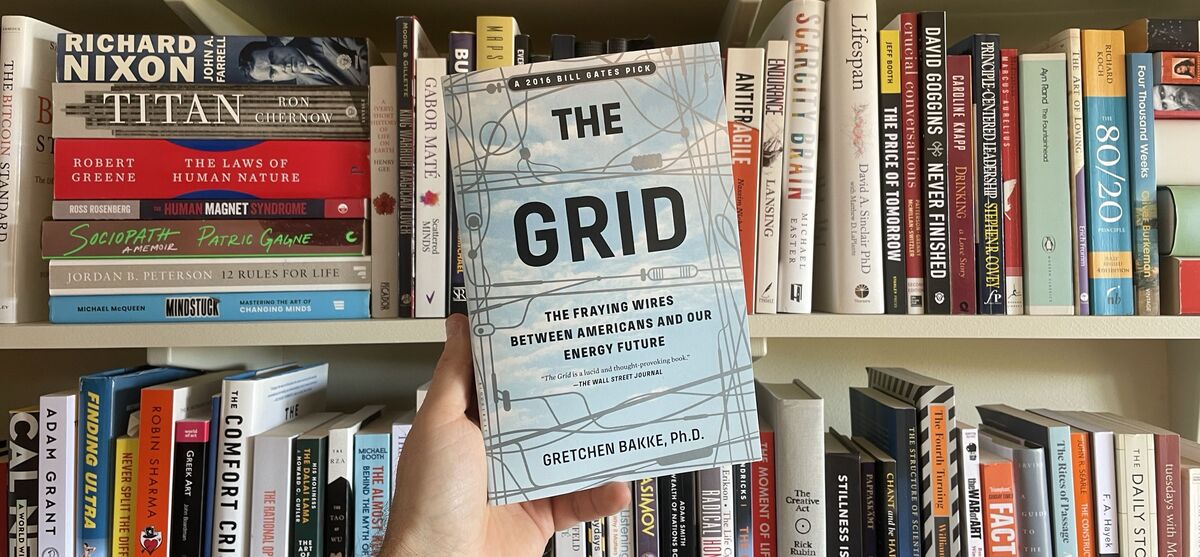
A lot of people are worried about AI right now. If you're one of them, then here is an unexpected antidote: read about the last technology that changed everything. I spent about a month reading and listening to The Grid by Gretchen Bakke, a history of the American power grid. And the further I got into it, the more it sounded like today's AI debate, just set in the 1880s.
Because electricity at its infancy was a mess. Rival standards, fires, people getting electrocuted left and right, companies going bust, a PR war so ugly that one side staged demonstrations about the other side's current killing innocent animals. And in the end, it all worked out. Not quickly, not cleanly, but it worked out.
I picked up this book because a friend recommended it and because I'm currently studying the technologies and engineering that build civilization.
History and Culture, Not Physics
Bakke isn't an engineer. She is a cultural anthropologist, and it shows. The book reads more like history and culture than it reads like physics. It came out in 2016, and it's almost entirely about the US grid.
"The grid is the world's largest machine, and we are remarkably oblivious about it."
And she has a point. We are experts at unseeing the wires and stations that connect us. In 2000, America's National Academy of Engineering ranked electrification as the greatest engineering achievement of the 20th century. Ahead of the car, ahead of the airplane. And yet, most of us only think about it once the lights go off.
The Grid Needs to Be Balanced Every Second
One of the ideas I keep getting back to in my notes is the simplest one, and people don't really think enough about it: the grid needs to be balanced every second. What goes in has to match what comes out.
When you plug in a toaster, nobody planned for it. The system just finds the electrons needed for it, and it just feeds it. Utilities guess what everyone will use, and power plants chase that number all day long. And here's the part that wind advocates rarely mention: too much power is as bad as too little. Wind turbines aren't easy to switch off. On a windy day, there can be a flood on the grid that doesn't need that power. That is as valid a reason for blackouts as too little electricity.
We see this in Sweden right now. In some regions in Sweden, we had almost 700 hours of negative electricity prices in 2025. That's also the most in Europe, by the way. It means that producers are paying people to get rid of power. So you actually get paid to use energy. And in April 2025, Spain and Portugal went dark. It was Europe's worst blackout in 20 years, and it was caused by too much voltage, not too little.
Electricity vs. AI: Three Patterns That Rhyme
Building out the grid was off to a messy start, and I can see parallels with the electrical buildout and the AI buildout that we see right now. Some patterns could be the same.
⚡ The famous name doesn't always win - Edison was famous for his light bulb and was in the headlines everywhere, but his grid ran on direct current, which couldn't really change its voltage. A power station could only reach customers about a mile away. Alternating current won because of the transformer. It allowed the grid to step the voltage up to travel further and step it down again when it came near your house.
🏭 The real money is in keeping expensive machines busy - This was Samuel Insull's insight, and it's why he is the unsung hero of the American grid. A power plant costs about the same idle as it does running. So he sold to factories by day, homes in the evening and trams during rush hour. Swap power plants for data centers full of AI chips, and it's the same problem. GPUs cost a lot and depreciate in value with time, so they need to be put to work. Tech companies spent over $400 billion on AI infrastructure last year. Every hour those chips sit idle, they burn money.
💸 The money men overreach - Insull stacked his empires on layers upon layers of borrowed money. In the Depression, it all collapsed. He had to flee the country, was extradited, tried for fraud and acquitted. But here is the part that matters: Insull fell. The grid didn't. The plants and the wires kept running. So next time someone tells you exactly how the AI race will end, remember Insull. The companies might not survive. The infrastructure likely will.
📺 Video Review
What Actually Threatens the Grid?
You might think the biggest threat to the grid is hackers, but according to Bakke, in the US it's actually trees, squirrels and copper thieves.
The 2003 blackout that hit almost 50 million people in the US and Canada started with overloaded lines in Ohio sagging into trees nobody had trimmed. And then we have the squirrels. Squirrels have taken down the NASDAQ, not once but twice. This was in 1987 and 1994.
And then there are the copper thieves. When I got to this part, I wondered whether this kind of theft actually followed the copper price. And it does. Researchers have found that theft rises with the prices a few months behind. So it's a lagging indicator, but copper hit record highs in 2025 and again this year in 2026. And AT&T is now offering a bounty of $10,000 for people that observe thieves in action. There is an irony in that: the more we build out the grid, the more its own wires become worth stealing.
Storage Is Key (and What Happened Since 2016)
Bakke's book came out in 2016, and a lot of things have changed since then. One of the things she speculates about is batteries. Since electricity needs to be generated and consumed at the same time, the big dream has always been to be able to store excess energy for when we need it. Bakke's big point is that storage is key. And when the book was written, battery solutions were speculative at best. Tesla had lithium-ion batteries that existed, but they were mostly hyped and barely used.
So I checked what actually happened next. Tesla deployed about 3 gigawatt-hours of storage in 2020. In 2025, it was 46.7. That's a steep curve upwards, and an interesting move we'll keep an eye on.
The most interesting idea in this chapter is how we can use electric cars as grid batteries. The car follows you from work to home, so storage is always where you need it the most. A car battery can charge at night when there's very low demand on energy, and it can power your toaster in the evening when the demand is high. That way it can help balance the grid and hopefully help us avoid blackouts in the future.
💡 Key Takeaway
I knew so little about the grid, so this was a great introduction. My biggest takeaway is the idea of the grid having to be in balance and how it actually works. That really lit up a light bulb in my head, as it's very different from how other utilities work, like water or how we get fuel into our cars. Electricity is very different from other utilities, and it's worth knowing about it. Especially in a day and age where AI is being built out everywhere. It demands a lot of power, and it's at the top of the agenda on a local level and in geopolitics as well.
⚖️ Verdict
I really enjoyed this book. It's a little bit too dry at times, and it's very American-centric, but I didn't mind that too much. I have a much better grasp of the problems we're facing when we talk about grid balancing, renewable energy sources and how we connect them to the grid. It's a really great introduction, even though it's dry at times.
Energy, the grid and the AI buildout all tie back into this little sweet book. I think it's a three out of five book, but I'm very happy that I made it through it, because it elevated my thinking on these topics.
If you want a broader look at energy, I really think Vaclav Smil's Energy and Civilization: A History is a really powerful read. My key takeaway from that book is the correlation between access and how we harness energy. How good you are at that and how much energy you have determines a lot about the welfare, wealth and prosperity of the society that you live in.