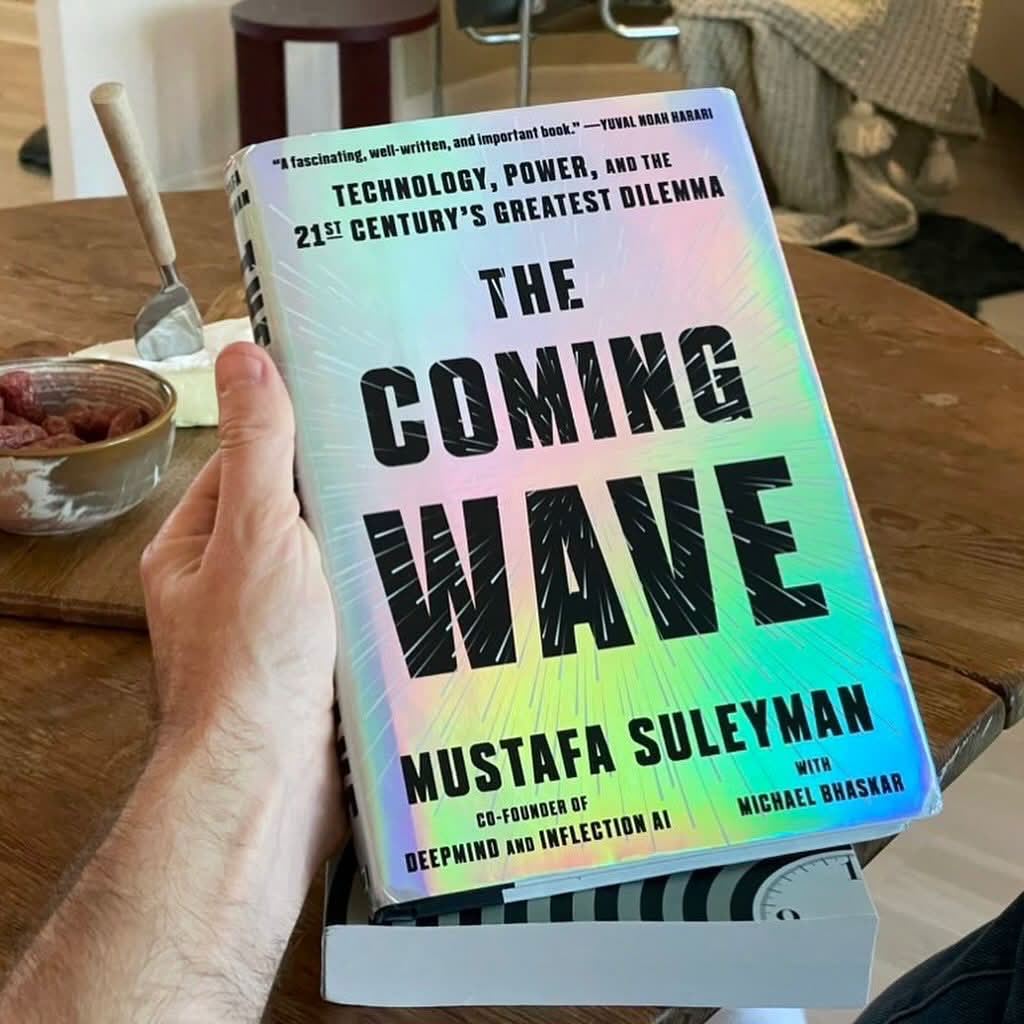
The Coming Wave
We are approaching a threshold in human history where everything is about to change — and none of us are prepared.
A General Purpose Technology
AI is a big deal because it's a general purpose technology — and there haven't been that many of those throughout human history. Only about 24 or so. Farming. The factory system. The processing of materials like iron and bronze. The printing press. The internet. And now AI.
Mustafa Suleyman, co-founder of the groundbreaking AI company DeepMind (now under Google's umbrella), has been at the forefront of AI development for a long time. In The Coming Wave, he argues that the next decade will be shaped by exponential technologies — and he presents us with a dilemma that has no easy answer.
"For the first time, core components of our technological ecosystem directly address two fundamental properties of our world: intelligence and life."
What he's talking about is AI and synthetic biology. Technology is going to rival and eventually surpass our intelligence — and it's going to engineer life. We have entered a new phase of humanity.
The Dilemma
On the one hand, we see the potential for vast prosperity. These technologies could solve world hunger, resource problems, climate change — some of the biggest issues humanity faces. On the other hand, if we try to control them too much, we end up in a society of constant surveillance and monitoring of every citizen.
How do we navigate the narrow road in front of us without falling off the cliff?
Take quantum computing. The instant it's available, all the cybersecurity efforts we've ever come up with are compromised within seconds. Synthetic biology and altering human DNA could introduce entirely new species of humans. Biological experiments could leak from labs and cause the next pandemic. And imagine unmanned autonomous weaponized drones and what they'll do to warfare.
These technologies are not far in the future. They are just around the corner — or they're already here.
The Containment Problem
Suleyman argues for containment — the ability to stop, slow down, or even forbid certain technologies we deem dangerous. But here's the problem: we've tried before, and we've barely succeeded.
"The worrying truth about this fearsome technology is that humanity has tried to say no, but only partially succeeded."
The only truly successful containment of technology has been nuclear weapons — and even there we just barely pulled it off. And creating a nuclear bomb isn't something an individual or small group can just do. It demands extremely rare materials and specialized expertise.
AI and synthetic biology are different. People can have them as hobby projects in their basement, and the outcome could still be world-changing. As demand goes up, prices go down, barriers to entry drop — and suddenly these potentially dangerous technologies are democratized and available to anyone, including bad actors.
Power Democratized — And So Is Risk
Today, no matter how rich you are, you can't buy a better smartphone than what's already available to billions of people. That's remarkable. Never in history has such advanced technology been so widely available.
The internet gave you access to information. The coming wave will give you the power to take action. That's where the real shift lies. Not just finding the best man speech on the internet to take inspiration from — AI will write it for you, customized to your exact situation. You'll have access to the best legal advice, the best negotiator, the best business strategist, the best dietitian — the best everything.
This is a massive democratization of power. But it's also a democratization of the risks that come with it.
AI and the Job Market: A Personal Story
Technology has displaced labor before, and those jobs were replaced by new ones. But the question now is different: what says that AI couldn't do the new jobs as well?
Take my own job. I work as a video game developer, and most disciplines within game development are already being impacted by AI. Concept artists are being replaced by generative AI. Coders work together with AI to ship code faster. Animation tasks are being automated. 3D artists like myself are seeing text-to-3D model tools where you enter a prompt and get a model you can place in the game world. We've started using AI voice actors instead of real actors for most of our production — it's faster, cheaper, and good enough that we only hire professional voice actors toward the tail end.
All in all, we're able to do much more with fewer people. AI and robotics will revolutionize work at a pace that society will have a hard time keeping up with.
📺 Video Review
💡 Key Takeaway
The coming wave of AI and synthetic biology isn't a distant future scenario — it's happening now. These technologies democratize power in ways we've never seen, but they democratize risk just as broadly. The challenge of our generation is containment: steering this wave without either drowning in its risks or missing out on its extraordinary potential.
⚖️ Verdict
This is a paradoxical book. It tries to be hopeful, but I'll be honest — I felt a bit hopeless while reading it. The wave of technology coming at us is overwhelming, and there's no scenario where it won't produce some negative outcomes alongside the good ones.
But Suleyman manages to end on a positive note. What I thought would be impossible throughout the book actually turned into hope toward the end, with practical advice on how we can at least start tackling the containment problem. What fascinated me most was the section on synthetic biology — a field I knew less about, and it's absolutely wild.
This is the best book on AI I've read. It trumped Scary Smart, which I still think is a great beginner's book on AI, but The Coming Wave goes deeper. An absolute must-read if you want to prepare yourself for what's coming.