Energy and Civilization
Everything you've ever built, eaten, or driven runs on energy — this book shows you how that single thread connects all of human history.
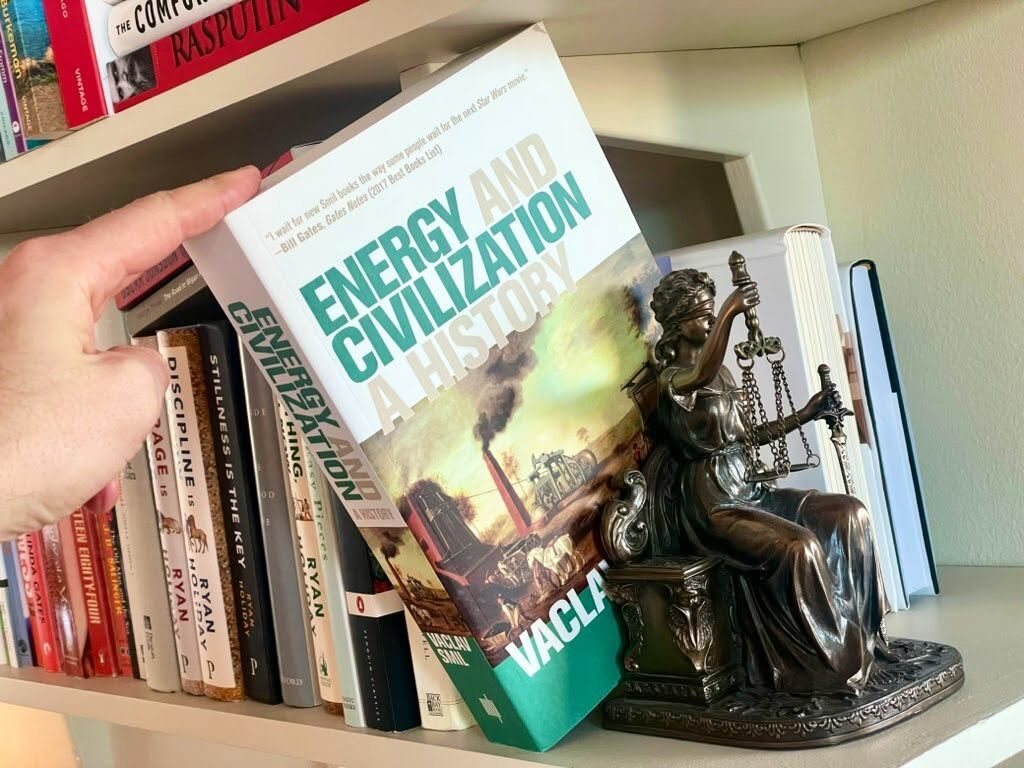
Energy Is the Universal Currency
Energy, in one of its many forms, must be transformed to get anything done. That's the opening premise of Vaclav Smil's Energy and Civilization, and it reframes everything that follows. Every major shift in human civilization — from the rise of agriculture to the industrial revolution — has been driven by the way we harness and use energy.
Smil meticulously traces this relationship, showing how our ability to extract energy from the world has shaped everything from how we live to how we work and how societies organize themselves.
"From a fundamental biophysical perspective, both prehistoric human evolution and the course of history can be seen as the quest for controlling greater stores and flows of more concentrated, more versatile forms of energy and converting them in more affordable ways, lower costs, and with higher efficiencies into heat, light, and motion."
The Energetic Imperative
Agriculture became possible because we learned how to capture and redirect solar energy into crops. Cities and empires rose because we figured out how to store and distribute food — which is just another type of energy. The Industrial Revolution exploded when we tapped into fossil fuels, allowing us to expand what we could build, move, and create radically.
This brought me back to Wilhelm Ostwald's energetic imperative, which is mentioned in this book: "Do not waste any energy — make it useful." Inspired by the laws of thermodynamics, Ostwald argued that societies should strive to minimize energy waste in both life and in industry and everyday human action.
📺 Video Review
No Oversimplification
One of the book's strengths is how Smil refuses to oversimplify history. He doesn't fall into the trap of technological determinism — energy doesn't cause political or social change, but it enables it. And each energy transition also brought with it its own unintended consequences. The move from wood to coal didn't just bring us industrialization — it also fueled imperial expansion, wealth inequality, and environmental destruction.
Smil's book is rigorous. It's packed with data, historical context, and comparisons. He is also skeptical of grand predictions, whether they come from techno-optimists who promise limitless clean energy or doomers who see collapse as inevitable. Instead, he sticks to the facts.
"The availability of power sources determines the amount of work activity that can exist, and the control of these power flows determines the power in man's affairs and his relative influence on nature."
From Muscle to Machine
My favorite part of this book was the story of how we got to where we are today — how human muscle was replaced by animal power, and then eventually replaced by machinery. It was also super interesting to read about how adoption of new energy sources has played out throughout history. Adoption is usually pretty slow, and it's not until a new technology hits a critical mass that mass adoption actually happens. It can take years, a generation, before an old technique is replaced by a new way of harnessing power.
I find this very interesting as we move into this new age of humanoid robots and everything that is just close by in the future. The robotic revolution is going to be a spectacle to live through — it's exciting times.
💡 Key Takeaway
Human history is, at its core, an energy story. Every leap in civilization — agriculture, industry, electrification — came from finding new ways to capture, convert, and control energy. Understanding this thread gives you a fundamentally different lens through which to see the world.
⚖️ Verdict
This is not the easiest read in the world. It has a lot of nice graphs and it's very detailed — but it doesn't get boring. It provided me with a new lens through which to see the world: the lens of how we use energy. I find this an important book and probably the most powerful book I've read this year so far. If you're ready to take on a more demanding book, Energy and Civilization belongs on your reading list.