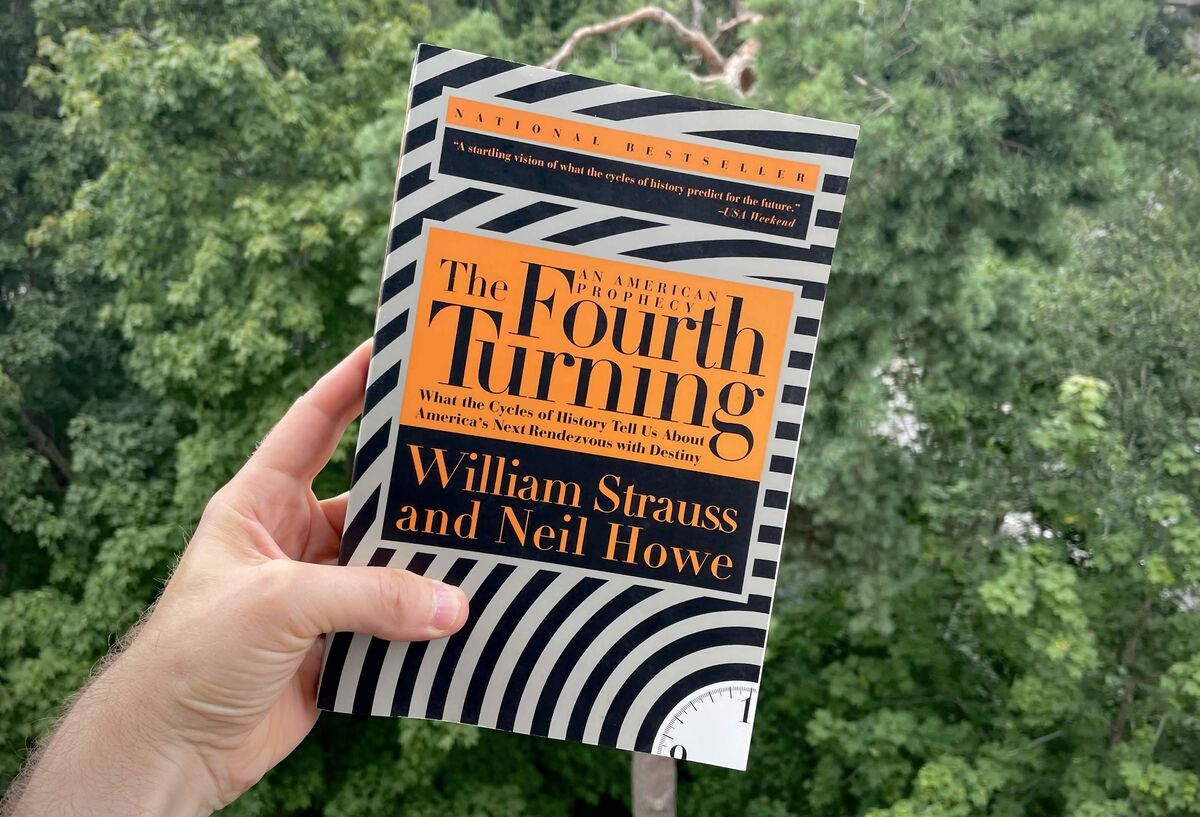
The Fourth Turning
History is seasonal — and winter is coming.
All Human Things Are a Circle
In the temple of Athena in Athens, an ancient epigram declared: all human things are a circle. In The Fourth Turning, William Strauss and Neil Howe take that idea and run with it — presenting a bold cyclical theory of history that challenges the traditional linear view of progress.
Published in 1997, the book examines patterns in Anglo-American history and argues that every 80 to 100 years, society undergoes a period of crisis followed by a renewal — which they term the Fourth Turning. According to the authors, the United States (and since the world is so connected now, probably other countries as well) is heading toward one of these periods of upheaval. Understanding these historical cycles, they argue, can help us better prepare for the future.
The Four Turnings
Strauss and Howe's key thesis is that history follows a predictable cycle of four generational turnings that repeat across centuries. Each turning lasts about 20 to 25 years and has its own unique characteristics:
- The High — a period of renewal and institutional confidence after a crisis
- The Awakening — a spiritual and cultural rebellion against established order
- The Unraveling — institutions weaken and individualism strengthens
- The Crisis (Fourth Turning) — a period of profound upheaval, war, revolution, or major structural collapse, followed by rebirth
The theory suggests that major societal changes are not random — they are driven by generational personalities shaped by each turning. The authors identify these four phases as a reoccurring pattern since the 15th century. The Fourth Turning, the crisis, is always followed by a rebirth or a new High.
Generational Archetypes
The book introduces generational archetypes — the Nomad, the Artist, the Prophet, the Hero — and their descriptions of how each generation interacts with each other is fascinating. But it can be quite hard to follow at times, especially as an audiobook (which is how I consumed it).
The book's predictive nature makes it feel like a road map, and it's one of the reasons this book still has such a big following. Strauss and Howe argue that understanding these cycles equips us with the tools we need to deal with the uncertainties of the present and the future. And that's how they tap into our deep human desire to find patterns within history. It feels so nice and orderly, right? To have such a predictable pattern that keeps things in order.
📺 Video Review
Eerily Familiar Scenarios
What gives the book its spine-chilling quality are the scenarios Strauss and Howe describe for how a Fourth Turning could start. Here are some examples straight from the book:
"A global terrorist group blows up an aircraft and announces that it possesses portable nuclear weapons."
"The Center for Disease Control and Prevention announces the spread of a new communicable virus. The disease reaches densely populated areas, killing some, and mandatory quarantine actions are required."
"A nationwide strike is declared. Foreign capital flees the US."
We all recognize at least one of those. The authors admit it's unlikely that the scenarios will play out exactly like this, but they all follow the same basic dynamic: a spark triggers a chain reaction of further emergencies. Neglected areas of the civic fabric are exposed. Anger at past mistakes translates into calls to action.
"Even if the dire consequences are temporarily averted, America will have entered a Fourth Turning. Civic confidence will have declined. People will become more distrustful of institutions — and then eventually distrust even more things: their own job security, their ability to pay for themselves at older age, their pensions."
The Criticism
And that's also where one of my main criticisms comes in. The cyclical framework can feel overly deterministic. The authors' reliance on these patterns to predict the future seems speculative at times. Critics argue that the theory fails to account for the complexities and nuances of historical events that fall outside this pattern. It also raises the question: can societal change really be so formulaic when influenced by unpredictable factors such as technology, globalization, and individual agency?
I wouldn't be surprised if people in any time or any era could find signs in society around them to claim that they are in a Fourth Turning, or in an upheaval, or in a High. That said, the descriptions these guys have for the Fourth Turning bring a lot of thought to things we see throughout the world today.
Some readers might also find this book very American-centric. As a Swede, I had some trouble following certain ideas because I'm not as well versed in American history. The book takes for granted that you have at least some background in the basics of American history, which made it kind of hard to follow at times. It also largely leaves out the rest of the world.
💡 Key Takeaway
History may not repeat, but it rhymes — in roughly 80-year cycles. The Fourth Turning's power lies not in its predictions but in its framework: understanding that generational dynamics shape culture, institutions, and crises in ways that feel eerily familiar when you start paying attention.
⚖️ Verdict
Despite its limitations, The Fourth Turning is a provocative and stimulating read for anyone interested in history, sociology, and the future of society. It's particularly interesting if you like to think about grand historical narratives and the cyclical nature of everything we experience. The book didn't hit as hard as I hoped it would — I expected more given the buzz it's been getting lately, probably due to the global situations and potential conflicts in the world. I don't regret reading it, though. It was worth my time, and it'll especially resonate if you're American or deeply interested in American history.
It actually reminds me of Same As Ever by Morgan Housel — they're not alike at all, but the theme of looking backward to understand what never changes about human nature connects them. If you want a more accessible book with a similar spirit, that's where I'd point you.