Same As Ever
Want to understand an ever-changing world? Start with what stays the same.
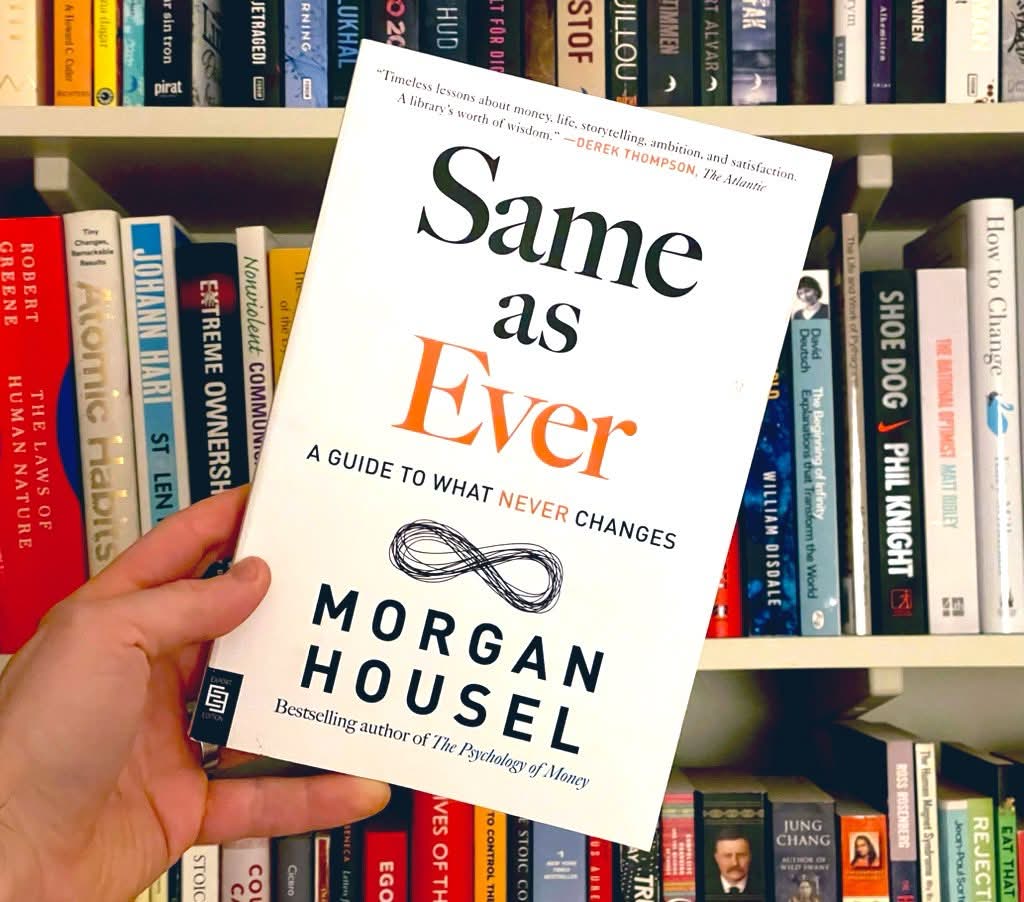
The Snickers Principle
The book opens with a brilliant anecdote. One of Housel's friends went to dinner with Warren Buffett in 2009. The economy had ground to a halt — businesses boarded up, everything in freefall. The friend asked: "How will the economy ever bounce back from this?" Buffett's reply? "Do you know what the best-selling candy bar was in 1962? Snickers. And do you know what the best-selling candy bar is today? Snickers."
End of discussion. That story captures the entire thesis of the book: the difference between focusing on what changes and focusing on what stays the same.
Amazon founder Jeff Bezos made a similar point:
"I very frequently get the question: 'What's going to change in the next 10 years?' I almost never get the question: 'What is not going to change in the next 10 years?' And I submit to you that the second question is actually the more important of the two."
Things that never change are important because you can put real confidence behind how they will shape the future. It's impossible to imagine a world where customers don't want cheap prices and fast shipping — and that's exactly why Bezos doubled down on those two things.
Stability Is Destabilizing
One of the most interesting ideas in the book is the financial instability hypothesis. It describes a psychological pattern we've all seen play out:
"When an economy is stable, people get optimistic. When people get optimistic, they go into debt. When they go into debt, the economy becomes unstable."
The gist? Stability itself causes instability. Stability is destabilizing. It's a beautiful paradox — and once you see it, you can't unsee it.
I've experienced this firsthand. We've had very low interest rates in Sweden, which has completely distorted the housing market. People took on enormous amounts of debt because we were paying almost no interest. I did the same — took on a bunch of loans for my apartment. And now the interest rate is up to 4.5%, and it hurts. I knew the historical average was around 4%. I knew this. And I still did it. That's the human element — knowing the lesson and ignoring it anyway.
Risk Is What You Don't See
Housel makes a sharp point about risk: it can never truly be mastered, because risk is by definition what you don't see coming.
"The biggest risk and the most important news story of the next 10 years will be something that nobody is talking about today."
We're very good at predicting the future — except for the surprises, which tend to be all that matters. No one predicted the war in Ukraine a few months before it happened. No one predicted the pandemic. No one foresaw the Great Depression. The 9/11 attacks felt like they came out of nowhere. That's what risk is: it's what's left when you thought you'd thought about everything.
The Happiness Equation
Housel has a deceptively simple insight about happiness:
"The first rule of happiness is low expectations."
It's when we start comparing ourselves to others that we get unhappy. The goalpost never stops moving — you desire something, you get it, and then you just want the next thing. On and on, trying to keep up with the Joneses. The key is getting that goalpost to stop moving.
When I Ignored History vs. When I Listened
On the other hand, another lesson from economics paid off for me. You should buy stocks and funds when people are scared — that's when they pull their money out, and that's when you can make your move. During Corona, I went all in on different stocks and funds. After one year, it gave me 100% return.
Both lessons came from history. The interest rate one I knew about and ignored — which was bad. Going all in during the pandemic was terrifying — but it paid off enormously. It's often easy to put yourself in a bad situation because it's hard to do the thing you know you should do.
Read More History
The main point of the book is that we should spend more time studying history and less time consuming temporary information. That's where the timeless patterns of human behavior reveal themselves. This book actually inspired me to continue my journey through Will Durant's The Story of Civilization — I'm on book four, each one is about a thousand pages, but the amount I learn from them is staggering.
"The ones who thrive long term are those who understand that the real world is a never-ending chain of absurdity, confusion, messy relationships, and imperfect people."
📺 Video Review
💡 Key Takeaway
Stop trying to predict what will change — study what never does. The timeless patterns of human behavior — greed, fear, optimism, the moving goalpost of happiness — have been the same for thousands of years. Understanding these patterns is worth more than any prediction about next quarter's earnings or next year's trends.
⚖️ Verdict
If I had to choose between The Psychology of Money and Same As Ever, I'd pick this one. It contains the lessons from its predecessor but casts a much wider net — economics, risk, history, happiness, human nature. Housel keeps it light with personal anecdotes woven between the facts, making it an easy yet deeply rewarding read. I reread this one immediately after finishing it. That tells you everything you need to know.