The Big Print
A no-nonsense guide to how money printing broke America — and what sound money could do to fix it.
The problem with your money
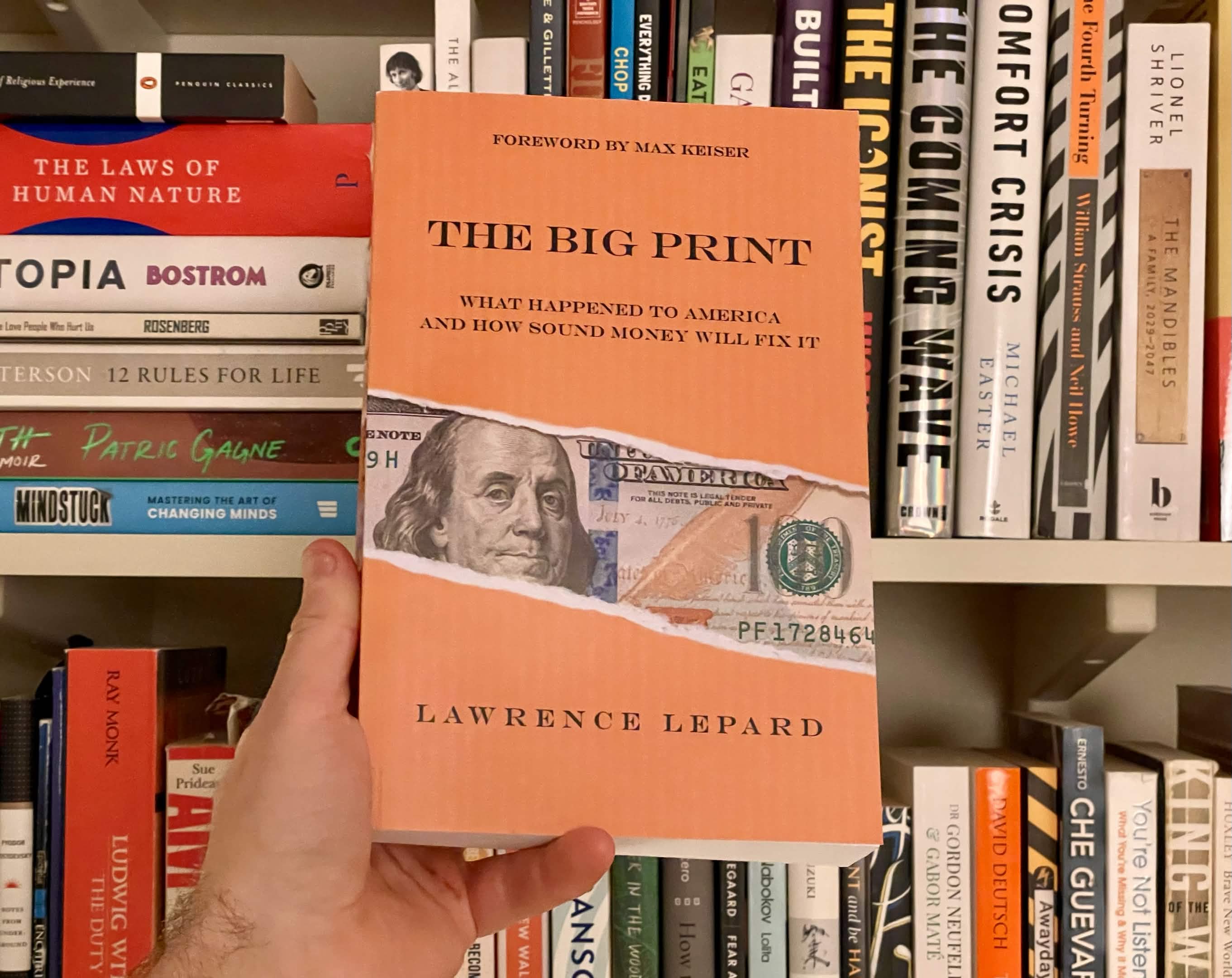
The Big Print: What Happened to America and How Sound Money Will Fix It by Lawrence Lepard is a no-nonsense dive into America's broken monetary system and a passionate case for sound money as a path towards economic salvation. The book is split into two parts — the problem and the solution — and Lepard masterfully unpacks the relentless money printing that has been going on for decades in the US, something that was kicked into high gear in 1971 when Nixon decoupled the dollar from gold.
"The great issue of our time is the broken monetary system which leads to enormous wealth inequality because it gives one group of citizens an unfair advantage. It also grants undue power to government, which has led to a lot of bad policies, including perpetual war."
The core problem with fiat money — government-backed currency with no commodity backing — is that it's poorly understood by the general public. Fiat tends to trend toward zero when compared to hard assets, because of the temptation to print more of it for those who have the power to do so. Since fiat is basically just pieces of paper, it takes really nothing to make more of them.
And then there's the spending problem. Fiat money is perfect if you want to go to war, because you can use those newly printed dollars to pay off your soldiers. It's much more convenient to print debt than to actually convince the populace that going to war is a good idea and that they have to pay for it. If you want to tax your citizens to go to war, you actually have to have them on your side — otherwise they will revolt. Printing new money is much more convenient for perpetual war.
Lepard emphasizes that the debt of the US is ballooning — over $37 trillion and climbing. When debt is issued like this, we steal the time and energy of future generations to afford things we can't afford in the present. Many countries now find themselves in a doom loop where they have to issue more debt just to repay the debt that has already been accumulated.
Central banks and fake cycles
Central banks set interest rates — basically the price of money. Lepard argues that these very centralized, sometimes private entities have a lot of undue power because they can create fake boom-and-bust cycles at their whim, and that interest rates should be set by the market. Having central banks setting the rates is basically central planning.
The consequences? We lose the cleansing failures of an open market. When banks misbehave, the government steps in and bails them out. Too-big-to-fail banks won't fail, so they can take risks that would otherwise be unwise. What should happen is that failed businesses should die so that capital could be reallocated to more productive endeavors.
"Inflation is the shrewdest way to fertilize a rich man's field with the sweat of a poor man's brow."
And the rich get richer. When more money is printed, asset prices go up. If you own land, real estate, stocks, or gold, prices rise as the monetary supply expands. People without hard assets can expect their purchasing power to be eroded — paying more and getting less. Many of us felt this after COVID, when the money printer went really hot and prices jumped 50% on everyday goods.
📺 Video Review
The case for sound money
"No one should work for what another man can print."
As a solution, Lepard proposes a return to sound money principles: stable, predictable, limited supply money — not created out of debt, with clear rules for everyone that aren't easily changed or manipulated. Historically, gold and the gold standard embodied these ideas. Having a hard instrument of a set quantity to back each dollar has been a fairly good solution for stabilizing the value of currency.
Bitcoin is the other example of sound money the book explores. Lepard argues that this digital gold is in many aspects superior to gold as a commodity to be used as money. Its most important property is perfect inelasticity — there will never be more than 21 million coins. Unlike rice, gold, silver, oil, or copper, regardless of how much demand there is, it doesn't affect supply at all. The Bitcoin protocol is programmed to issue a set amount of bitcoins according to immutable mathematical rules until the last coin is mined.
This predictability is the exact opposite of the fiat system, where reckless money printing can vaporize your life savings at the push of a button. The dollar supply has increased around 40% in just the last couple of years — and we wonder why the grocery store feels so expensive.
There are predicted secondary effects too. When you have money that isn't a melting ice cube, you can plan more long-term. You don't have to feel like you have to spend money today or start that company today. You get time to reflect. And returning to sound money would, at least in theory, make it too expensive to fight the meaningless perpetual wars that never end — because then you actually have to pay for them for real.
💡 Key Takeaway
The current debt-based monetary system is a hidden tax on every individual. Understanding the cycle of money printing, the business cycle, and the debt cycle will help you understand so much of what's going on in politics around the world today. Once you start to understand how money works, how debt works, and how fiat works, the world becomes much more clear.
⚖️ Verdict
Books about debt and monetary policy can be intimidating for newcomers. This book succeeds in making a complicated topic accessible to the layman. Lepard does this by sharing concrete examples and personal anecdotes that anchor the theory to something relatable.
Two things might throw some readers off. First, the foreword by Max Keiser — if you don't know who he is, his often evangelical style might make you put the book down before reaching chapter one. Second, the Bitcoin angle. It's a sensitive topic that many people have prematurely dismissed, often because scams in the broader crypto space have rubbed off on people's perception of Bitcoin itself.
But don't let either of those things stop you. The Big Print is a superb, accessible starting point for understanding debt, money printing, and what's really going on in the macro economy. Highly recommended for anyone who wants to understand the world a little better.