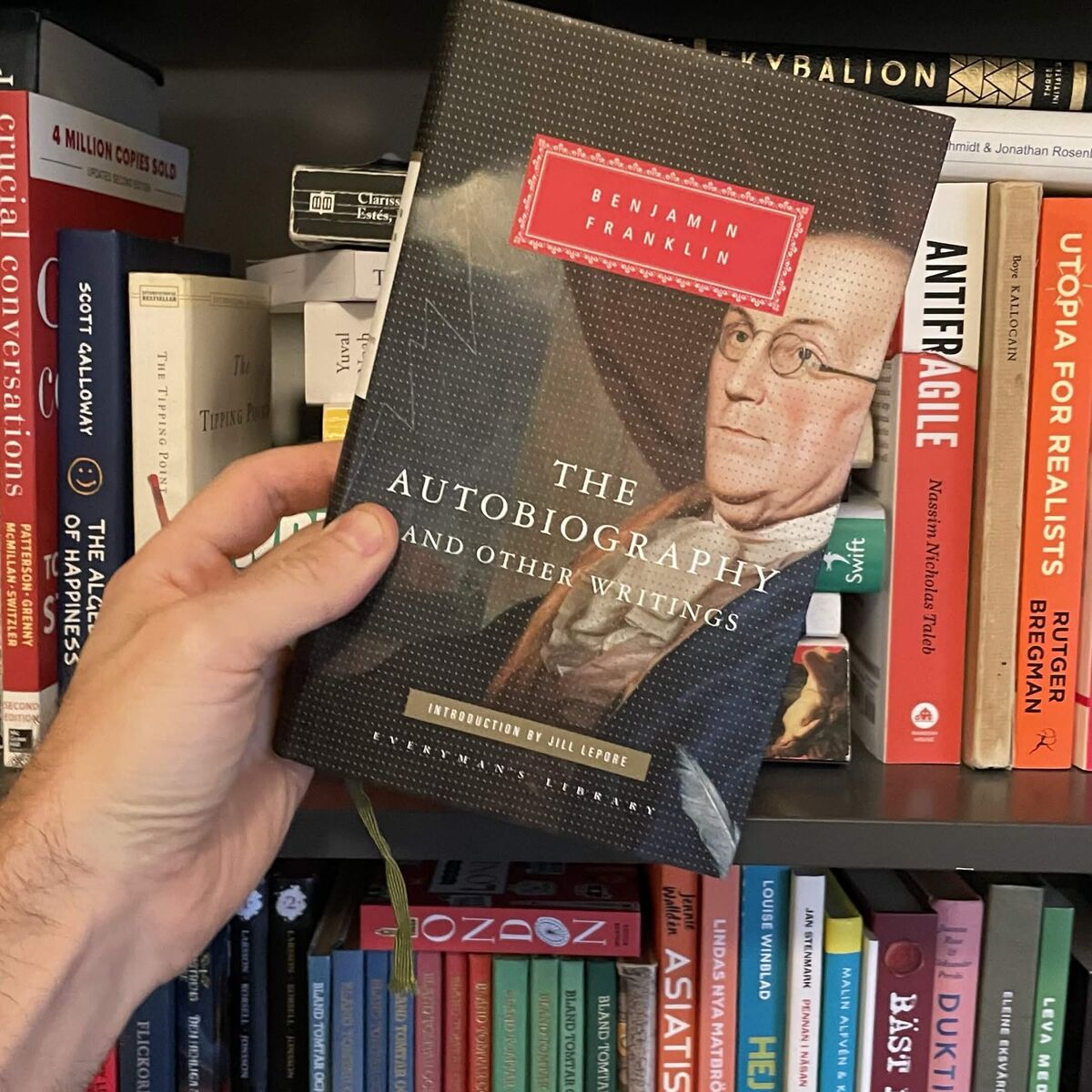
The Autobiography of Benjamin Franklin
The original self-help book — written by the man who invented the genre before it existed.
The Ultimate Renaissance Man
Benjamin Franklin was probably the most prominent character of the American Enlightenment. He was a scientist, politician, civic activist, inventor, postmaster, and one of the founding fathers of the United States of America. The reason I like Franklin so much is because of his sense of wonder — his curiosity about life and learning. That, combined with being a great observer of the world around him, allowed him to come up with all types of inventions and experiments, both in life and in work.
Did you know the name "Poor Bjorn" actually originates from Poor Richard's Almanack, an almanac that Benjamin Franklin published back in 1732? The almanac became wildly popular for its aphorisms and wordplay — gems like "Three may keep a secret, if two of them are dead" and "Lost time is never found again." Charlie Munger, Warren Buffett's legendary sidekick, also paid tribute to Franklin with his own Poor Charlie's Almanack.
Straight from Franklin's Own Pen
There's something very special about reading this autobiography, because it comes straight from Franklin's own pen. It's a very readable and honest account of his life. If you want a more full picture of the man, I'd suggest reading Walter Isaacson's brilliant biography about Franklin before — or after — you pick up this one. But there's something irreplaceable about hearing the story in Franklin's own voice.
I really enjoy how he shares his processes — the way he thought, experimented, and iterated through life. This guy invented the lightning rod, the water harmonica, the Franklin stove. He also did a lot of experiments about self-improvement, which I found super interesting.
📺 Video Review
The 13 Virtues — Franklin's Bold Experiment
One of the most fascinating parts of the book is Franklin's bold attempt at moral perfection. He developed a list of 13 virtues — things like temperance, silence, order, resolution, frugality, industry, sincerity, justice, moderation, cleanliness, tranquility, chastity, and humility. You can Google "Benjamin Franklin's 13 virtues" to see them all.
The idea was that he would get rid of all his vices by focusing on one virtue at a time. He quickly realized that quitting all of these at once was really hard, so he split them up and focused on one each week. In a 13-week interval, he focused on one of these virtues, and if he fell short and didn't live up to that virtue — the virtue of the week — he put a dot in his special notebook. The goal was to go 13 weeks without having a single dot in that notebook.
I have tried it out myself. It's pretty hard, actually — there are even apps for it now. But the concept is fascinating. Google Benjamin Franklin's 13 virtues and try it out yourself.
"If a man empties his purse into his head, no man can take it from him. An investment in knowledge pays the best interest." — Benjamin Franklin
Input, Output, and Going Out There
My main takeaway from this book is this guy's industry — and how he balanced his input and output. It's so easy these days to just indulge in information and think that you're doing great. But we also have to go out there and do things in the world. Don't be a passive consumer. Like Franklin, we need to go out and experiment in life — and that's what I take away from the autobiography of Benjamin Franklin.
💡 Key Takeaway
Franklin didn't just read and think — he did. He experimented constantly, tracked his own behavior, and treated life as a laboratory. His 13 virtues experiment is one of the earliest documented systems for deliberate self-improvement, and his balance of input (learning) and output (doing) is a lesson most of us still need to hear.
⚖️ Verdict
Should you read it? Yes — especially if you're into self-improvement, biographies, or American history. It's short, honest, and written in Franklin's characteristic plain style. It doesn't cover his entire life (he never finished it), so pair it with Isaacson's biography for the full picture. But as a window into the mind of one of history's greatest polymaths, it's hard to beat.