American Prometheus
"Now I am become death, the destroyer of worlds." — and the man who said it paid for it.
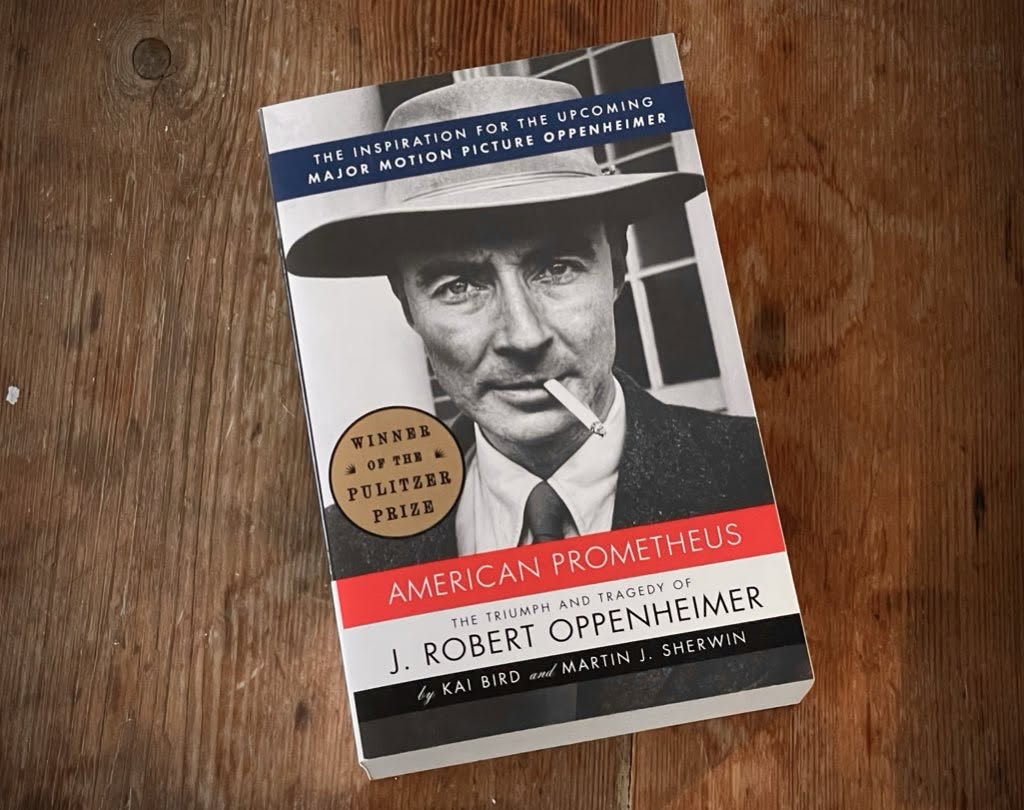
The Man Behind the Bomb
J. Robert Oppenheimer was the physicist who led the Manhattan Project — the secret wartime effort that developed the atomic bomb. American Prometheus chronicles this extraordinary man's life from childhood to death, and it's a biography that feels especially relevant right now.
I didn't realize how much I missed reading great biographies until I picked this one up. There's just such a joy in leaning back and being taken to another place, another time. And Oppenheimer's life is a rich source of inspiration and insight for anyone who wants to live the good life — or at least understand what it costs.
The Boy Who Read Everything
Oppenheimer's childhood was characterized by a deep curiosity about the world. He was a ferocious reader who devoured everything he could find — philosophy, scientific texts, poetry, history. One of the books that had a huge impact on his life was the Bhagavad Gita, the ancient Hindu scripture, which he actually read in its original Sanskrit.
He was also fascinated by rocks and minerals. At age 12, he attended a conference in New York where he captured the attention of an audience of professional geologists and mineralogists. Twelve years old.
This wide range of knowledge across different disciplines made Oppenheimer stand out in the scientific community. It helped him become the synthesizer of ideas that he was — someone who could see connections others couldn't and provide a broader perspective on his work.
📺 Video Review
The Genie and the Bottle
The discovery of nuclear fission made the atomic bomb inevitable. Once scientists realized that fission was possible and that a weapon could be built from it, the race was on — because they knew someone would try. The current rapid developments within AI have some eerie similarities to this nuclear arms race. Once the genie is out of the bottle, it's hard to put it back.
Similarly, deep learning — the use of neural networks to analyze huge sets of data — has initiated an arms race toward superintelligence. Everyone knows that the smartest machines, and the ones who control them, will have the upper hand in the global power struggle. As Max Tegmark put it: "They can't stop. No company can pause alone because they're just going to have their lunch eaten by the competition and get killed by the shareholders."
The Price of Innovation
Galileo was prosecuted for his heliocentric worldview because it threatened theological dogma. Alan Turing cracked the Nazi code and was rewarded with chemical castration because of his sexual orientation. Oppenheimer built the bomb that ended the war with Japan — and what did he get? He was humiliated in a trial and deemed a security risk for the country that he loved.
"Galileo, Oppenheimer, Turing — reminders that innovation is not always easy or safe for those who push the boundaries of knowledge. For them, it comes with real personal risk."
Innovation takes courage. You're potentially playing with fire. Let's hope that how society treated its innovators in the past won't deter new visionaries from searching out the truth.
Three More Biographies Worth Your Time
In the video I also recommend three biographies close to my heart: Steve Jobs by Walter Isaacson (possibly my favorite biography of all time), The Immortal Life of Henrietta Lacks (the untold story behind the HeLa cells that changed medical science), and The Autobiography of Mahatma Gandhi — which, unlike this book, truly makes you feel like you know the person.
💡 Key Takeaway
Oppenheimer's commitment to ethical reflection, intellectual curiosity, and interdisciplinary thinking — along with his humility despite enormous success — are qualities we can all learn from. His story is also a powerful warning: when technology outpaces our ability to think ethically about it, everyone pays the price.
⚖️ Verdict
A great biography that's especially relevant now, given the parallels between the nuclear arms race and AI development. The sections about Oppenheimer growing up and his work on the bomb are captivating. That said, I have to be honest — the later parts about his political persecution dragged a bit, and after reading it I felt like I knew a lot about Oppenheimer without truly knowing him. It doesn't get as personal as the best biographies do. But it's a sweeping, important read — and if you've seen Christopher Nolan's film, this is the book that inspired it.