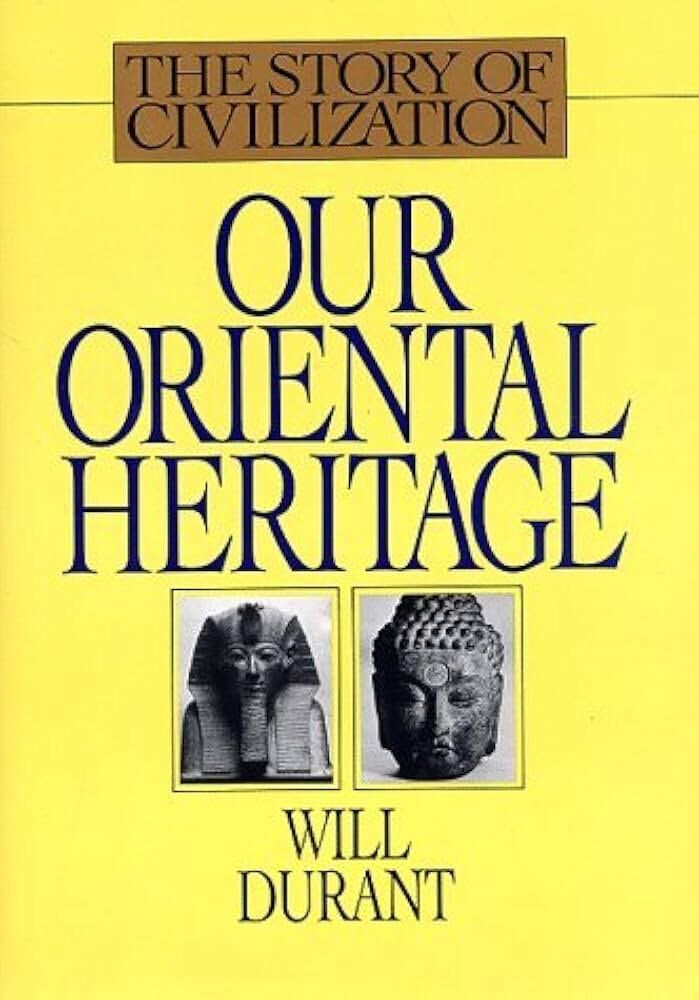
Our Oriental Heritage
1,184 pages on how civilization began — and it's worth every single one.
Why History?
Why should you know history? It tells you how we got where we are today. Why we believe what we believe, why we do what we do. By learning about the past you can also avoid repeating its mistakes — and it's f***ing fascinating!
This book is ambitious in scope, the series (11 volumes) even more so; trying to summarize the history of civilization itself. This first book alone is 1,184 pages. One of many reasons to break this book down to several micro reviews!
My focus for this year will be Ancient Greece, but first I want to read up on the history leading up to it.
The Foundations of Civilization
The first part of the book talks about the economic, political, mental and moral elements needed for the establishment of civilization. Durant defines civilization as "social order promoting cultural creation" — and he argues it begins where chaos and insecurity ends.
Agriculture is the first form of culture. When man settles down, it's the first time he finds time and reason to be civilized. He builds tools, temples and schools. Educates himself.
"Man differs from the beast only by education."
"Civilization is not imperishable. It must be required anew by each generation."
The Primitive World
There's something striking about primitive life. An Eskimo guide put it perfectly:
"I do not have to think. I have plenty of meat."
Not planning for more than today had its advantages. When planning for the future you pave the way for property and greed.
Savages shared everything and were gentle with each other. Communism appears most commonly in the beginning of civilization — in times of dearth. Fear of starvation fuses the individual into the group. The dream of communism lurks in every modern society as a memory of a simpler and more equal life.
"We remember its equality but forget the poverty!"
But the pyramid of ability begins once more, and the more able men again take the lion's share. Division of labor allows some to take more than their share, and for each level of civilization inequality increases — until reaching a breaking point where the poor have nothing but violence to set against the wealth of the few. The chaos of violent revolution levels the society again. And the cycle repeats.
Power, Sex, and Social Order
On taxation, Durant is characteristically sharp:
"It was better to pay bribe to one magnificent robber than to bribe them all."
Women have always been seen as lesser creatures than men — treated and valued as animals and slaves. Women not bearing children are shamed by men in societies that rely on high birth rates to compensate for high death rates.
In simple days, men married for cheap labor and regular meals. In primitive society the delay between desire and fulfillment is not very long, and therefore there is no need to idealize passion. The kiss is quite unknown to primitive people. Marriage was transactional, not based on temporary sexual desire.
So much is social conditioning. Is it good to be a virgin or not upon marriage? It depends on the culture. What is shameful is totally dictated by culture.
"Where food is dear, life is cheap."
From Magic to Science
Religion begins as the worship of supernatural forces. Polynesians recognized an ocean of magic power, called mana. But here's the thing:
Magic becomes science. Magicians needed to give the supernatural a push by using natural means. Stuff that actually works. 👩🔬
Without common nouns, human thought was limited to individual objects or experiences. Words are to thought what tools are to work. Writing was the most important transition into civilization — the invention that almost created civilization with its power to transfer knowledge and accumulate science.
History begins with writing.
What Hasn't Changed
Ornamentation of the body might be the first form of art. Scars, tattoos and ornaments — it's existed forever. Both men and women have always done it. Civilized women scorn at these "primitive" ways while they paint their lips, put on makeup, fix and paint their nails. Same same but different.
We owe almost everything to primitive man. The stone in the fist was the first tool. The dog was the most ancient pet. Agriculture was the biggest invention of man. And copper was the first metal to be used.
📺 Why You Should Read History
💡 Key Takeaway
Civilization is not a given — it's a fragile achievement that must be earned again by every generation. Understanding how we got here is the first step to making sure we don't lose what we've built.
⚖️ Verdict
I'm excited to be a student of history again. The world I see every day makes more and more sense after each chapter I read. 👨🎓
Durant wrote in 1935 that "the probability of error increases with the scope of the undertaking" — and yet the scope is exactly what makes this series extraordinary. This is not a dry textbook. It's a man trying to understand everything, and bringing you along for the ride. At 1,184 pages this is a commitment, but it earns every page. The first of eleven volumes, and I'm already hooked.