Ishmael
A Socratic dialogue between a stubborn student and a wise gorilla about the fate of humanity.
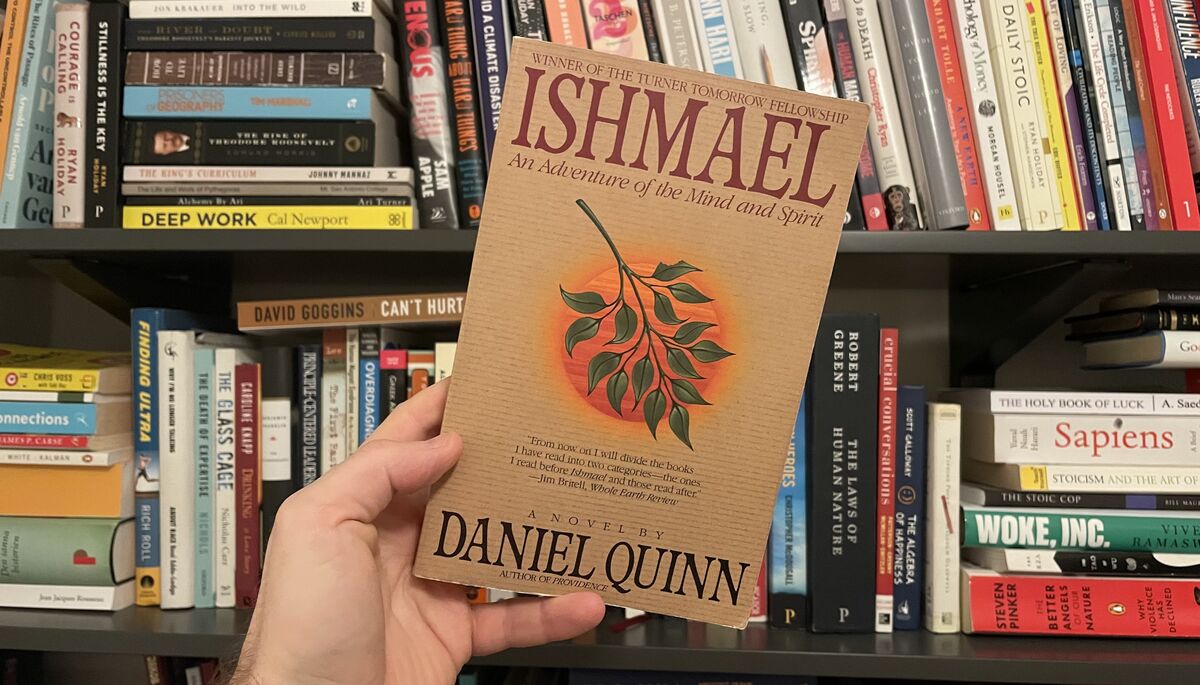
About the Book
An ad in the newspaper reads: "A mentor seeks a student with an earnest desire to save the world." At first our protagonist becomes annoyed by the pretentious wording — desire to change the world?! He has been disillusioned by the world, and the text reminds him of his youth's idealism growing up in the counterculture of the 1960s.
He also becomes curious, because a teacher like this is what he so desperately sought in his youth. Not being able to shake off the idea, he decides to seek out the "guru". To his surprise, the teacher is Ishmael, a giant gorilla.
Ishmael by Daniel Quinn is a Socratic dialogue between a stubborn student and a wise primate discussing the state of humanity and how we can course correct before everything goes to shit, bringing all other species down along with us. Why a gorilla?! It's not actually explained, but it works with the story!
Humanity is Doomed
Civilized man is doomed because we don't play by the laws of life. Instead of man living like "Man belongs to the world," in the manner all other animals live, civilized man has inverted the law into "The world belongs to man."
As a result, humans have been overreaching, created an unsustainable way of living, and as a consequence signed our own death sentence.
Notes and Highlights
"The disaster occurred when, ten thousand years ago, the people of your culture said, we're as wise as the gods and can rule the world as well as they."
Agriculture is to blame, according to Ishmael. Agriculture leads to population growth. Population growth to increased food production. Increased food production to population growth — as a result of this endless loop we see deforestation, pollution and extinct wildlife.
The Nature of Mother Culture
The story our culture tells us is that humans are special, yet imperfect. We are meant to create paradise on earth but we repeatedly screw it up because we humans are inherently flawed. And we can't fix ourselves because we believe knowing how to live is unknowable for us.
Takers and Leavers
The bulk of the story revolves around the concept of Taker Culture and Leaver Culture. These are the names given to two distinct styles of living in human societies. Leavers are people who never adopted agriculture and live like hunter-gatherers.
Takers are people who took on agricultural practices, that eventually led to the idea of property, and they built the civilized world. These were the people who broke the natural order of things, and like they were gods, decided that they could rule over themselves, other people, and other species.
"What will happen if you feed the starving millions?" Ishmael asks rhetorically. They will reproduce! Creating more starving people.
Would You Turn Back the Clock?
One question Ishmael asks his student is: if he could teleport back to a Leaver existence, would he do it?
I'm not sure I would, and my ambiguity about this question baffles me. I know agriculture probably was the biggest mistake in history, and that a "natural" life is better for us mentally and physically. So why do I hesitate?
Video Review
⚖️ Verdict
Is Ishmael worth reading still? Given it came out in 1992? It is! And it's absolutely beginner-friendly since it's philosophy dressed in a fictional disguise.
I never really read anything that talks about population restrictions before. It does a good job of slowly opening you up to the topic — a topic that can be quite controversial if not handled with care.