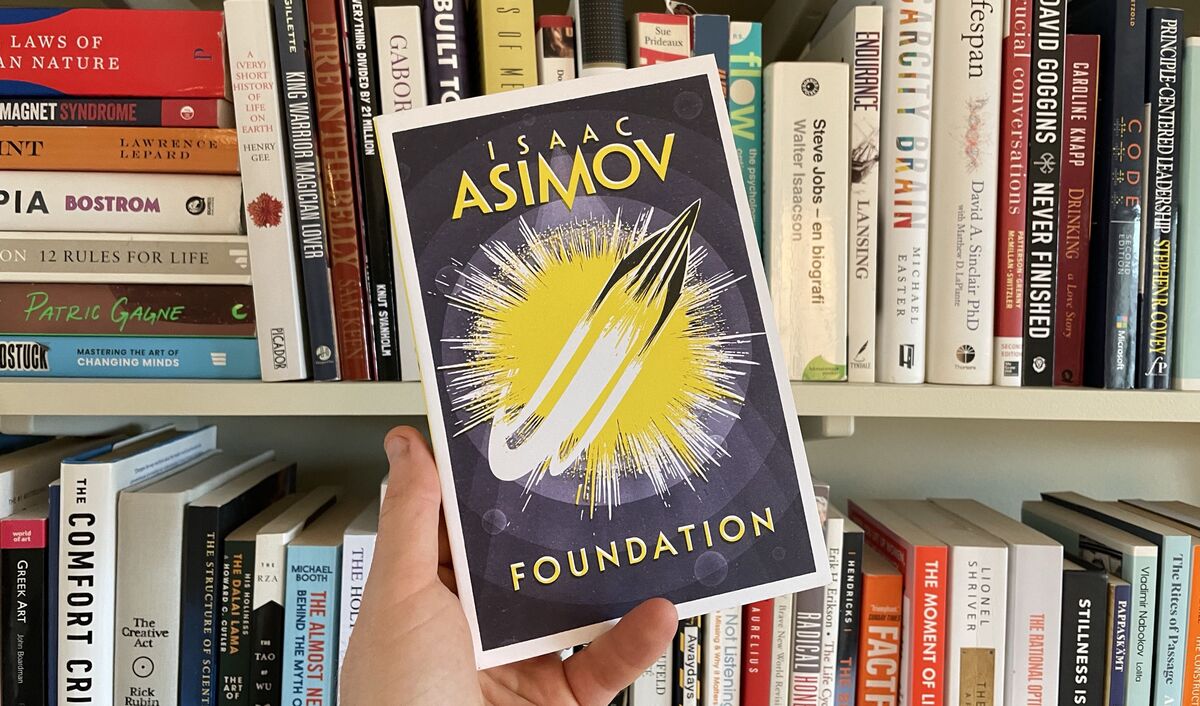
Foundation
A big-idea sci-fi novel disguised as a story about people on distant planets — really a book about how civilizations rise, fall, and might be saved.
Psychohistory
Foundation asks a fascinating question: Can you predict the rise and fall of civilizations? And if you can… can you actually do anything about it?
The story begins with Hari Seldon, a mathematician who has developed a science called psychohistory. The idea is wild: you can't predict what one person will do. But if you have billions of people, individual randomness starts to disappear into statistics. With enough data, you can predict where an entire civilization is heading.
And Seldon has made a terrifying prediction. The Galactic Empire is going to collapse. Not in thousands of years. But soon. After it falls, humanity will enter roughly 30,000 years of darkness. But Seldon believes he can reduce that to just 1,000 years.
And this is where the real story begins.
The Encyclopedia Is a Decoy
Seldon sends around 100,000 people to Terminus, a remote planet at the edge of the galaxy, supposedly to create the Encyclopedia Galactica — a giant collection of humanity's knowledge. The idea is that when civilization collapses, science shouldn't disappear with it.
"If we now prepare a giant summary of all knowledge, it will never be lost. Coming generations will build on it, and will not have to rediscover it for themselves. One millennium will do the work of thirty thousand."
The knowledge of an entire species is simply too much for one person to absorb. It has to be collected, organized and passed on.
But here's the really interesting part: the Encyclopedia isn't actually the main point. It's the cover story.
Seldon's real plan is to create a Foundation that can preserve civilization and eventually rebuild the Empire after the collapse. If people know what is going to happen, they can change their behavior — and then the prediction might become wrong. That's why Seldon's plan has to be kept secret.
He doesn't tell the Foundation exactly what will happen. Instead, he creates a series of crises that force the Foundation toward the path he has calculated. These become known as Seldon Crises.
The book's scope is vast — each part describes one Seldon Crisis, decades and light years apart. This makes the whole thing feel epic as hell.
Institutions Become Their Own Worst Enemy
Seldon knows the Empire cannot be saved.
"The fall of Empire, gentlemen, is a massive thing, however, and it's not easily fought."
And his diagnosis is brutal:
"A rise of bureaucracy, a reversing of initiative, a freezing of caste, a damning of curiosity."
That last one really stuck with me. And it's one of my main takeaways: a civilization doesn't necessarily collapse because it becomes weak. It can collapse because it becomes incapable of changing.
The Empire has become so enormous, bureaucratic and comfortable that it has lost the ability to adapt.
"Interstellar trade will decay, population will decline…"
The Empire will simply stop working. And nobody at the center seems capable — or interested — in doing anything about it.
This reminds me of what is happening in Europe right now. The bureaucracy is deep, people are set in their ways, there is an expectation that the future will be like the past.
The same thing happens to the encyclopedists. They become so obsessed with their mission that they fail to see the world changing around them. They are supposed to preserve civilization. But they're too busy writing about civilization to actually defend it.
That's the irony. Institutions can preserve knowledge. But they can also preserve old assumptions. And once an institution becomes more concerned with following its procedures than adapting to reality, it starts becoming a liability.
Power Doesn't Always Look Like Power
One of the things I really enjoyed about Foundation is how the Foundation becomes powerful without simply conquering everyone with overwhelming violence.
First, it uses its superior technology. Then it turns that technology into religion — because the barbarians on the other planets can't distinguish the tech from magic, and the Foundation uses that belief to influence them. And when religion fades in power, they use trade. The Foundation makes other planets economically dependent on its technology.
And suddenly you don't need to invade someone.
I found this fascinating because Asimov is basically showing different forms of power evolving. And if you've ever played the Sid Meier's classic video game series Civilization, you'll recognize this — apart from military victory, you can win by dominating through science, economics, or culture.
The mechanism of influence changes as civilization changes.
📺 Video Review
Constraints Create Innovation
There's another smaller idea in the book that I really liked. Terminus has almost no metal. And that limitation forces the Foundation to develop incredibly compact technology.
The constraint becomes an advantage.
This is something we see over and over again in technology. When resources are scarce, you have to become clever. And sometimes the limitation produces the better solution.
In my years as a game developer I've seen this over and over again. Hardware limitations are a constant chain around our ambitions, but over and over again we are able to pull off what was thought impossible at the beginning of a hardware cycle, and in that way push technology forward.
💡 Key Takeaway
Civilizations don't necessarily fail because people are stupid. They can fail because intelligent people become trapped inside systems that no longer work. The future belongs to civilizations that can adapt faster than their environment changes.
⚖️ Verdict
Foundation is a classic for a reason. It isn't really a book about spaceships, aliens or futuristic technology. It's a book about civilization.
This is why I think reading classics is so valuable. A great classic doesn't just tell you something about the time in which it was written. It gives you a model for thinking about problems that keep appearing throughout history.
Foundation is ultimately asking: What makes a civilization resilient? Is it knowledge? Technology? Trade? Institutions? The ability to adapt? Or the individuals who know when the old rules no longer work?
If you want to understand how civilizations work — and how they fail — this is a book worth reading.