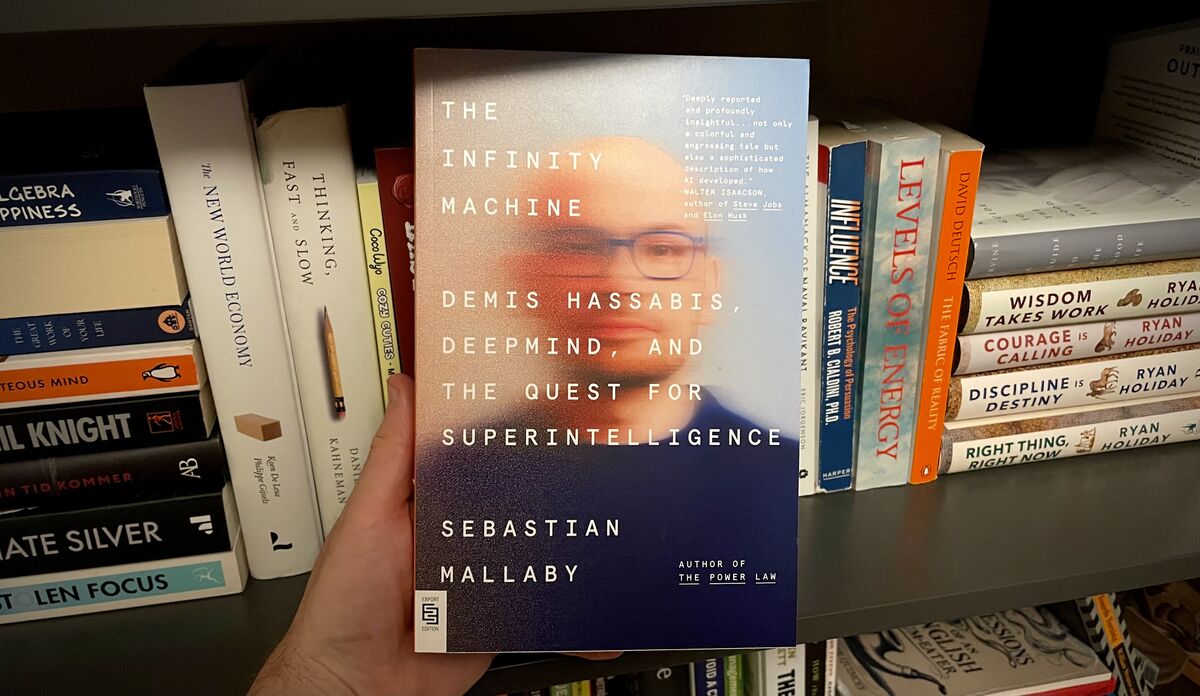
The Infinity Machine
A chess prodigy, a Nobel laureate, a polymathic thinker — and the machine he's building that might change everything.
A Man I Should Have Known About
This book is about intelligence. On the one hand, it's a portrait of a remarkable man — a chess prodigy, a Nobel laureate, a polymathic thinker. On the other hand, it tells the story of his quest to build remarkable machines.
I thought I had a good grasp of the big names behind AI and their stories. Altman, Elon, Jensen, Dario, Suleyman — I've read about them all. But for some reason, this guy had escaped my line of sight. Demis Hassabis.
My interest in artificial intelligence started back in 2015 when I read Surviving AI and Superintelligence by Nick Bostrom. Since then, DeepMind has been a company I follow. I remember when their chess AI, AlphaZero, came out and how legendary world champion Garry Kasparov remarked that AlphaZero's play "shook chess to its roots." I understood that we were entering a new era.
My interest in AI and DeepMind intensified even more a few years later when they developed AlphaGo — the AI that beat the grandmaster of Go, Lee Sedol. Go is a game that was deemed impossible for computers to beat humans in because of the astronomical — literally astronomical — number of possible game states. That was a landmark moment for AI.
So I knew a lot about DeepMind as a company, but much less about the man behind it. When I saw this book, I jumped on it.
From Theme Park to Nobel Prize
Here's something that blew my mind. If you ever played the game Theme Park — a game that's probably a contributing factor to why I chose game development as a career path — and looked at the credits, you'd see the name of a future Nobel Prize winner. Demis Hassabis. At just 17 years old, he served as co-designer and lead programmer at Bullfrog Productions, working alongside industry legend Peter Molyneux.
It was a highly successful simulation game. You were controlling a theme park, making sure the rides weren't too tame so that people got bored, and not too thrilling so that people started to puke. You were basically managing the emotions of these small NPC characters that could express a lot of wants and needs. When you read about it, it doesn't come as a surprise that someone who became a leading figure in AI was behind that game.
In this book, we get to follow Hassabis from his childhood onwards. He decided to work on AI early in life. He wanted to understand consciousness — and what better way to understand consciousness than to build it yourself? One key thing to remember: when Hassabis dedicated his life to AI, AI wasn't even a thing. If you talked about AI, you were deemed a crazy person.
You get to follow his early years as a chess prodigy, his years in game development, the early days and the start of DeepMind, and later his path towards receiving the Nobel Prize in 2024 for chemistry — for his groundbreaking work using artificial intelligence to predict the complex 3D structures of proteins.
📺 Video Review
The Sweetness of Discovery
The elephant in the room when we talk about AI and developing a superintelligence: if there is a nonzero chance that this will actually be a civilizational threat, then why do we rush to do it?
The answer from the people in this book is that it's a fundamental human urge to invent things.
"The very act of creating new technology is intrinsic to being human. Technology is what makes us us."
"The thrill of discovery is too sweet."
And this feeling isn't unique to the AI race. It's also an echo from the past — from Oppenheimer and the invention of the atomic bomb:
"When you see something that is technically sweet, you go ahead and do it. You argue what to do about it only after you have had your technical success."
After reading this book, I think halting or slowing down the AI race is just a pipe dream. I don't think there's any way that will ever happen. So hopefully we're all good and going the right direction — but who knows?
Find Your Flock
Around the age of 10, Hassabis skipped classes entirely for a year just to focus on chess. To keep up with the curriculum, he read textbooks on his bed. He was isolating himself — and that isolation might have fueled his drive.
His isolated childhood flipped at 15 when he entered a class of elite math students. Finally, he found like-minded people. People who were open-minded, people who were curious, people who found it fun to just discuss the problems of physics and the universe. He had found his flock.
In this environment, mental abstract play was not a route to isolation but a way to build bonds. A key thread that runs through this book is that you need to find like-minded people — peers who challenge you and encourage you. And you also need to find those people on the investing side. That's how Hassabis got DeepMind off the ground.
Read Widely, Think Deeply
Of course I'm biased — I'm running BookLab — but there's a common theme that keeps coming back in all these memoirs of the AI founders. They all read textbooks like they were fiction. They studied the old sci-fi classics. They studied engineering and science and built a really great foundation.
That first-principles way of thinking and relating to the world matters. Because when you have ideas that are revolutionary — like building superintelligence — you need to have great foundations on which you can build your arguments. You don't get swayed by people who call you crazy. Until you're not.
This book, along with highlights like The Curious Mind of Elon Musk, is full of great book recommendations. The Culture series by Iain M. Banks, Asimov's Foundation series, Feynman's works, Karl Popper, David Deutsch — these are the books that shaped the minds building our future. They're influencing my reading list a lot right now.
The world is changing very rapidly, and for us to navigate this new and uncertain world — where there's no well-trodden path — it's important to have that foundation. To have a brain that is developed to make your own decisions and stand by them on good reasons. Because then you can stand your ground, make your own decisions, and use your own judgment.
The Kindergarten Problem
My last takeaway was a chilling reminder — a thought experiment I first heard about 15 years ago in Bostrom's book about AI that put shivers down my spine.
There aren't any examples of more intelligent things being controlled by less intelligent things. Imagine a kindergarten full of three-year-olds that are in control, and you as an adult are supposed to work for them. How long would it really take before you're in control? Just promise them candy for a week and you're done.
💡 Key Takeaway
The thrill of discovery is too sweet to stop. The AI race isn't something we can pause — it's driven by the same human urge that split the atom. What we can do is build strong foundations: read widely, find your flock, think from first principles, and develop the judgment to navigate what's coming.
⚖️ Verdict
This is the story of a mission-driven life. It's about grit, persistence, and relentless passion for one goal. If you have any interest in AI at all, this is for you. If you're interested in people who pull off incredible endeavors against all odds, this is for you.
It actually holds up very well throughout the whole book. Usually biographies like this tend to get less exciting towards the end, but since we're in the middle of this AI arms race, the ending is as intense as the beginning. There's a slight dip in the middle, but nothing that breaks the momentum.
This is one of my favorite books I've read this year. Unless you're totally uninterested in AI or completely fed up on the topic, I urge you to pick this up. I've added it to my AI Founders reading list — it's earned its spot alongside books like The Coming Wave by Mustafa Suleyman. If you want to understand how this big AI revolution came about, this is a great place to start.