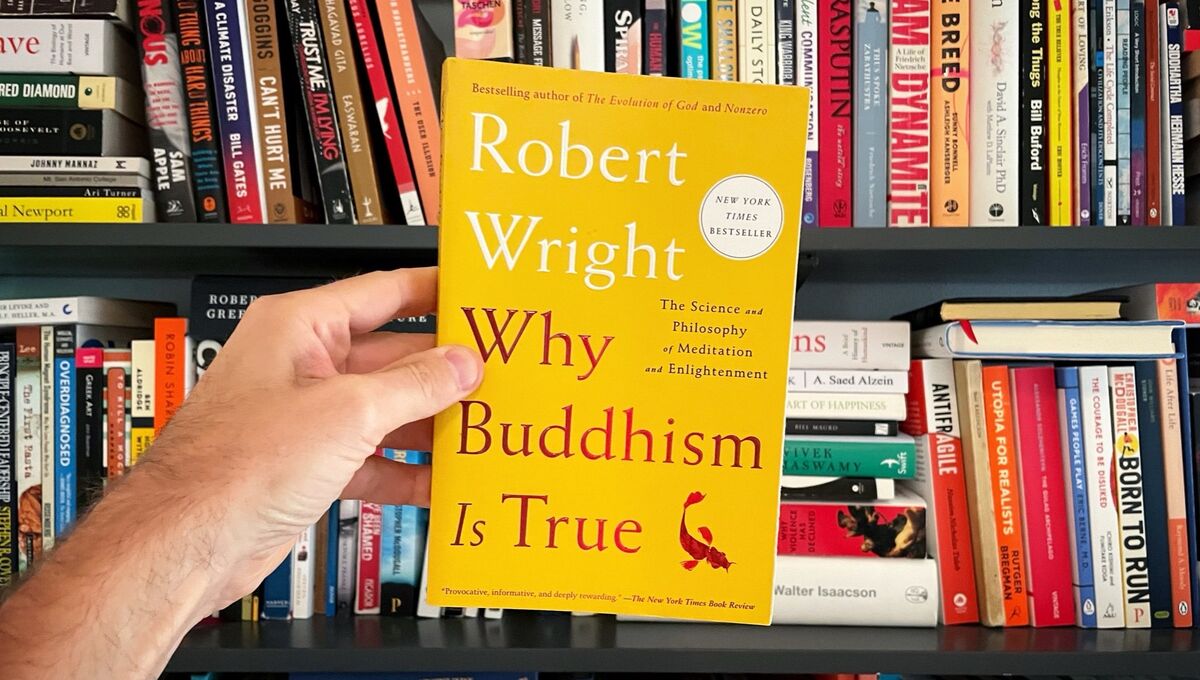
Why Buddhism Is True
Buddha vs. Darwin — or maybe Buddha AND Darwin.
Natural Selection Doesn't Want Us to Be Happy
Why do we give in to delusions? Why can't enough be enough? Why do we let our feelings run the show?
This book takes a scientific look at the Buddha's teachings through the lens of evolutionary psychology — and the picture it paints is both humbling and liberating.
The Pleasure Trap
It makes sense that we would want to pursue pleasure. It also makes evolutionary sense that once we attain it, it won't last — otherwise "our first meal would be our last."
We are also designed not to realize this fact. Because if we understood that the pleasure would subside soon after attainment, we would stop seeking it out and become philosophers.
The Hedonic Treadmill
We overestimate how much satisfaction we will get from things:
We spend more time visualizing the perks of something that will come in the future than the possible burdens it will put on us — a promotion means more duties, not just more status.
The Buddha saw the Hedonic Treadmill before we saw it.
Evolution doesn't care about our happiness. It cares about us spreading our genes. It wants us to be productive in a narrow sense of the word. This is done by making the desire for pleasure strong, but the pleasure itself not long-lasting.
"Natural selection doesn't want us to be happy."
📺 Video Review
The Illusion of Essence
A ring worn by a president is considered more valuable — to some — than the same ring worn by no one in particular. We assign "essence" to things and people based on our feelings.
Now imagine the face of someone getting the news that his precious Nixon ring actually never was worn by Nixon. The essence evaporates!
What's going on here? Our assignment of essence warps reality and can create emotional backlashes. A few small delusions and illusions might not be too bad, but it all adds up to a considerable warp of reality.
Not-Self and the Modules
The not-self is one of the trickiest concepts in Buddhist thought. Are we really in control? Wright draws on split-brain experiments and modern psychology to argue that there is no conscious CEO running the show — rather, there seems to be a series of selves that take turns running the show. Like the Pixar movie.
Jealous rage is a good example of one module seizing control of consciousness. Observing feelings without attachment is the way you keep modules from seizing control — easier said than done.
"If you don't feed a stray cat, it quits coming to your door."
Thoughts think themselves, and you are not your thoughts. Don't feed thoughts that don't serve you.
Mindfulness as Rebellion
The Buddhist path is, in Wright's framing, a rebellion against natural selection. Natural selection put the delusions in our heads — it's the Matrix — and mindfulness is how you start to see through it.
Mindfulness meditation is often thought of as warm and fuzzy, even anti-rational. But the point isn't to abandon your rational faculties — it's to broaden them. You can stay close to your feelings without being lost in them. You can subject them to reasoned analysis and decide which ones are good guiding lights.
What "not making judgments" ultimately means is not letting your feelings make judgments for you. And what "getting in touch with your feelings" ultimately means is not being so oblivious to them that you get pushed around by them.
💡 Key Takeaway
"If you don't feed a stray cat, it quits coming to your door." Thoughts think themselves, and you are not your thoughts. Don't feed thoughts that don't serve you.
⚖️ Verdict
I highly recommend this book to anyone who's interested in the Buddhist ideas but wants a scientific approach to the subject. One of my favorite books this year so far!