The Selfish Gene
Groundbreaking ideas about gene-level natural selection — held back by dry, condescending prose.
The Gene's-Eye View
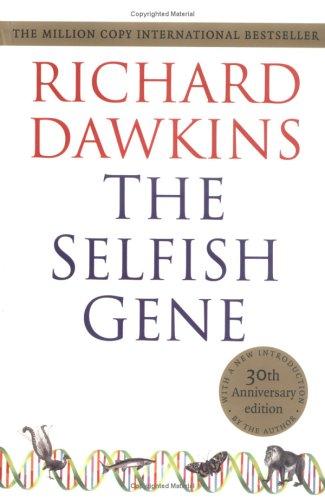
A lot of times we look at Darwinian survival on the level of the organism. Richard Dawkins suggests that we should instead look at the survival of the individual gene as the driving force of natural selection. The organism — whether a fish or a human body — is just a vessel. A survival machine for protecting and reproducing DNA.
Why Does This Shift in Perspective Matter?
DNA molecules are replicators, the fundamental unit of natural selection, and taking the viewpoint of the gene rather than the organism helps when looking at behaviors in nature that seem to contradict the survival instinct.
"There are other times when the implicit interests of the vehicle and replicator are in conflict, such as the genes behind certain male spiders' instinctive mating behaviour, which increase the organism's inclusive fitness by allowing it to reproduce, but shorten its life by exposing it to the risk of being eaten by the cannibalistic female."
A deadly gene could survive in the gene pool by inflicting its damage only after a person reaches old age, where the victim has already produced offspring. Like cancer. Many of us carry lethal recessive genes — but since you need two of the same to trigger them, it's not much to worry about. Unless the mating is incestuous.
Mothers are more caring for their offspring than fathers since they can be sure that the offspring is theirs. The sex cells — gametes — of females are larger than those of males in animals and plants. That's what defines sex and is the fundamental difference.
The Birth of the Meme
Dawkins coins the word "meme" — the cultural gene that spreads from brain to brain through ideas. Just as genes replicate through biological reproduction, memes replicate through communication, imitation, and cultural transmission. It's a concept that has, ironically, become one of the most successful memes of all time.
💡 Key Takeaway
The ideas in this book are groundbreaking. Originally written in 1976 and updated three times since, it fundamentally reframes how we think about evolution, cooperation, and competition. By shifting the lens from the organism to the gene, behaviors that seem puzzling — self-sacrifice, altruism, even spite — suddenly make sense.
⚖️ Verdict
The issue is that Dawkins has a condescending, snobbish way of writing and is very confrontational towards his critics. The writing is dry and repetitious at times, making the subject less exciting than it ought to be. The ideas deserve five stars — the delivery brings it down. If you want a more accessible take on the same evolutionary ideas applied to human behavior, try Robert Wright's The Moral Animal instead.