Think Again
The art of rethinking — a solid idea, but too basic for anyone already doing it.
What's It About?
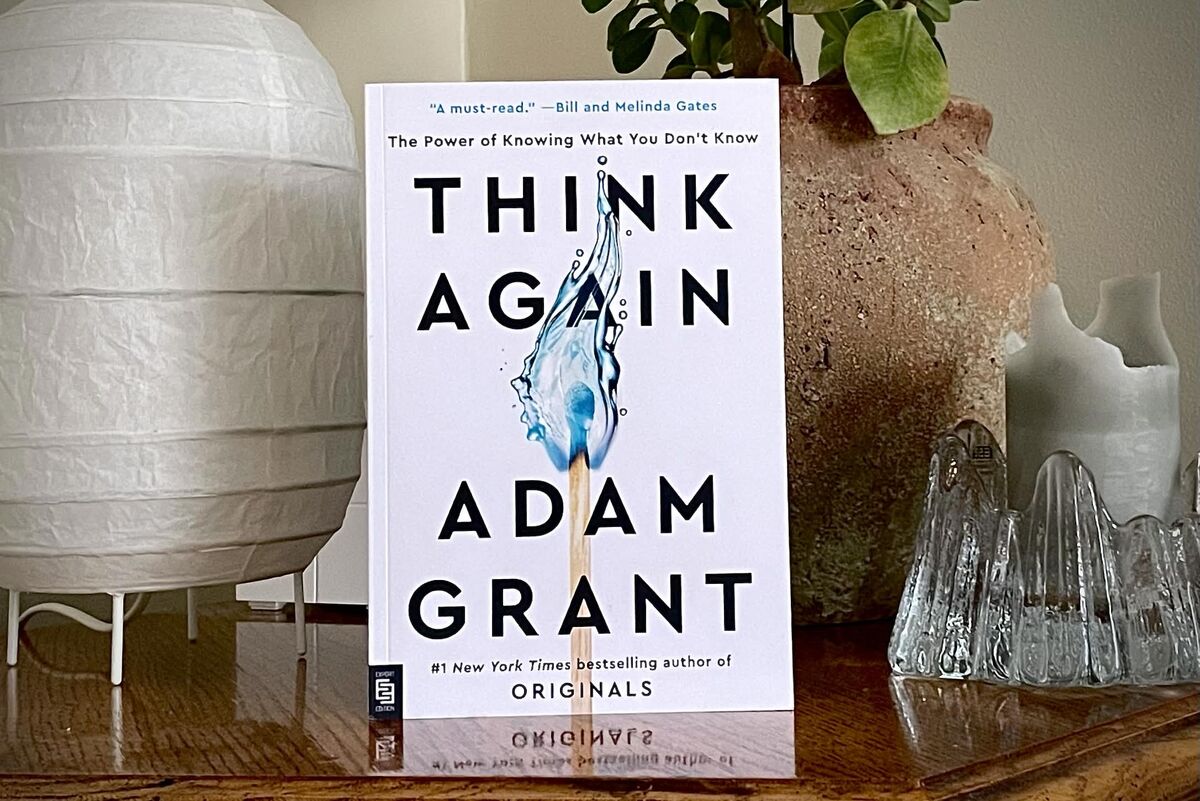
Adam Grant is a professor at the Wharton School of the University of Pennsylvania, specializing in organizational psychology. He's the author of popular science books like Originals, Hidden Potential, and Give and Take — and Think Again was actually the first one I read.
The book explores the benefits of rethinking the way we do things, challenging our preconceptions, and the value of constructive feedback. It covers this ground on three levels: in our private lives and relationships, at work in companies and organizations, and on a broader societal scale.
"In our daily lives, too many of us favor the comfort of conviction over the discomfort of doubt. We listen to opinions that make us feel good instead of ideas that make us think hard."
Motivational Interviewing
One of the more interesting sections is about motivational interviewing. If you've ever tried to persuade someone who's stubborn or stuck in a certain way of thinking, you've probably noticed that sound arguments alone rarely work. Grant introduces a technique where instead of arguing, you ask open-ended questions about why people think the way they do — because the answers to those questions might motivate them to open up to new ideas on their own.
He illustrates this with a brilliant Hogwarts example: imagine your uncle is a Voldemort fan. Instead of arguing, you ask him what he likes, what he dislikes, and what principles matter deeply enough to take a risk. By the end, the person has essentially talked themselves into doubt — without you ever attacking their position.
Teaching Others to Rethink
Another section that stood out was about how we can teach others to be more open to rethinking and iteration. As a parent, this hit home — if you encourage your kids to do several drafts of a drawing, they'll often find that the third or fourth version is the one they're happiest with. They learn to iterate and rethink naturally.
It's also about being specific in your critique: critique the work, not the person. And if you're in a leadership position, the best way to create an environment where people feel safe enough to put their work up for criticism is to show your own work first and share your learning goals.
📺 Video Review
Tested in Reality
This reminded me of something from my own work as a game developer. On a big project, the art department was flagged as the biggest risk — the publisher wasn't sure we could deliver the quality they were aiming for. So we set up hour-long critique sessions every week where everyone showed their work and the whole team could criticize it.
What happened was exactly what Grant describes: as we got into it, we became more open with showing our work, but we also became extremely more skilled. The art that was the biggest risk for the project became the lowest risk, because we accelerated our skills massively. And we actually had a lot of fun doing it.
The Rethinking Problem
Here's where I started to struggle with the book. When I read it, I asked myself: when do I change my opinion? When did I last change my mind? And I think for those of us who read a lot, we have our opinions and preconceptions challenged all the time. I recently read Determined by Robert Sapolsky, and that book literally had me reevaluating most of my approach to life.
For many of us, the idea of rethinking is not that revolutionary — maybe it's even obvious. And that's the fundamental issue with this book.
We shouldn't form our personalities based on opinions or allow ourselves to rely on the opinions we have. We should base them on values — truth, honesty, gratitude, security. Having your sense of self built on values rather than opinions will allow you to change your mind without straying from who you are. That's a genuinely good insight — but it's one insight stretched across an entire book.
💡 Key Takeaway
Build your identity on values, not opinions. When your sense of self comes from truth, honesty, and curiosity rather than from being right, changing your mind stops feeling like a threat — and starts feeling like growth.
⚖️ Verdict
I had real trouble figuring out who this book is for. For the bookish crowd — people who already read widely and challenge their thinking regularly — it's too basic and even a bit of a waste of time. The idea of rethinking is obvious if you're already doing it.
If you really want to understand why we should doubt ourselves, why human reasoning is flawed, and why we have all these cognitive biases, there are much better books out there. Nassim Taleb's Antifragile explores why we're terrible at predicting things. Daniel Kahneman's Thinking, Fast and Slow goes deep into the cognitive biases that lead to human misjudgment. And Robert Cialdini's Influence covers both sides of the persuasion coin — how you're being manipulated and how you can influence others.
It's a passable book. If you find the idea of rethinking revolutionary and exciting, pick it up. But if you're already a reader who questions your assumptions? Skip it and browse the Great Books List instead — there are dozens of books on there that will challenge your thinking far more deeply.