The Third Chimpanzee
We share 98.4% of our DNA with chimpanzees. So what exactly makes us human — and what doesn't?
The Gift from Charlie Munger's Reading List
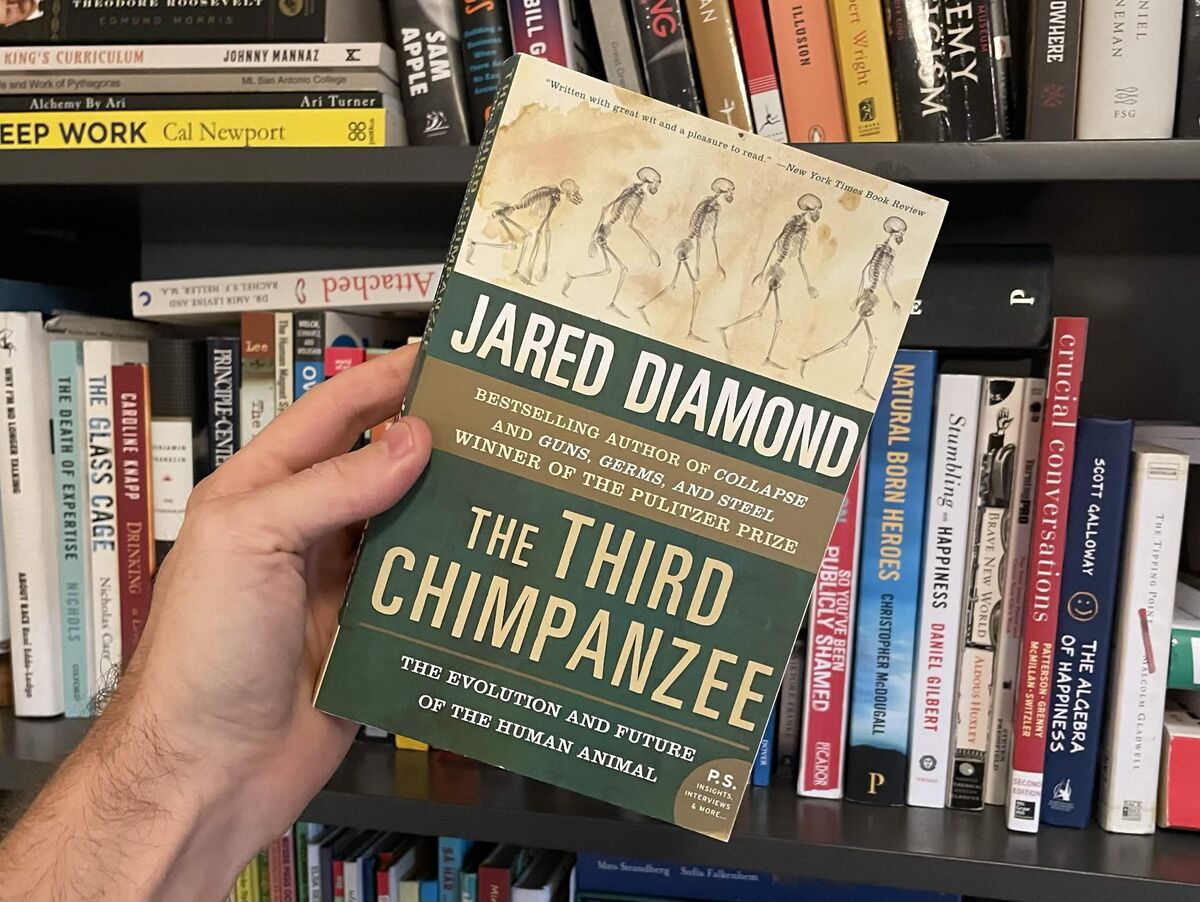
I picked this one up from Charlie Munger's reading list — the man who was Warren Buffett's right-hand for decades and arguably one of the most well-read people to ever walk the planet. When someone like that tells you to read a book, you read the book. And I'm glad I did, because The Third Chimpanzee totally blew my mind.
Jared Diamond is the Pulitzer Prize-winning author behind Guns, Germs, and Steel and Collapse — and this is the book that launched his career. It came before all of that, and in many ways it's the foundation for everything that followed. Diamond is one of those rare scientists who can range across evolutionary biology, anthropology, history, and linguistics and somehow tie it all together into something that feels completely coherent.
The 1.6% That Changes Everything
Here's the number that frames the whole book: there is only a 1.6% difference in DNA between a chimpanzee and a human. That's less than the genetic gap between two species of gibbons. An alien zoologist arriving on Earth would look at that data and immediately classify us as the third species of chimpanzee — right alongside the common chimp and the bonobo.
And yet we fly into space. We build weapons capable of annihilating the entire planet. We write symphonies, wage genocide, fall in love, and tell each other stories. So the question Diamond is really asking is: what happened? When did that leap occur? What was the catalyst that turned just another great ape into the rulers of the Earth?
That question drives the entire book. And Diamond approaches it from every angle imaginable.
Five Parts, Dozens of Rabbit Holes
The book is split into five parts covering the relationship between humans and other apes, sexual selection, the rise and spread of humans across the globe, and finally the environmental destruction we've left in our wake. Each section drops fascinating observations that stick with you.
For instance — did you know that you can tell a lot about a species' mating system just from the body size ratio between males and females? In highly polygamous species, males are much bigger than females. In monogamous ones, they're roughly the same size. Humans fall somewhere in the middle, which suggests we're a mildly polygamous species — not truly monogamous, but not running a harem either. Diamond makes this point by looking at, among other things, human testicle size relative to chimps and gorillas. Yes, that's in there. And no, I'm not going to elaborate. Read the book.
There's also a fascinating section on language. One thing that gets debunked quickly: the idea that complex language means complex society. Research shows there's essentially no correlation between linguistic complexity and social complexity. Some of the most "primitive" societies have languages more complex than English. Language turns out to be very old — older than we thought — and surprisingly decoupled from technological development.
The Dark Turn at the End
Here's something I wasn't expecting: this book gets genuinely dark toward the end. Once Diamond has taken you through the evolutionary story of how we got here, he turns the camera on where we're headed — and it's not a comfortable view.
He sees the continuous homogenization of human culture as one of the potential solutions to our environmental crisis. The logic is uncomfortable but interesting: if humanity is going to act as a single unit to deal with shared global threats — pollution, resource depletion, climate — then a shared value system becomes a prerequisite. Cultural variety, as beautiful as it is, might be a price we pay for survival. It's the kind of idea that makes you sit with it for a while, because you can see both sides, and neither feels entirely right.
That tension is what makes Diamond's writing so interesting. He's not cheerleading for humanity. He takes the long view, and the long view isn't always flattering.
💡 Key Takeaway
The tiny genetic gap between us and other apes makes the question of what makes us human even more fascinating — and harder to answer. Diamond shows that the "leap" happened surprisingly recently and may be as fragile as it is remarkable. We're not as separate from nature as we like to think, and our biggest threats come not from outside, but from the consequences of our own unique abilities.
⚖️ Verdict
If you've read Sapiens and want to go deeper — this is your next book. It came before Harari and covers much of the same territory with more scientific rigor and a harder edge. Diamond is one of those writers who makes you feel smarter just for having read him. This is the book that launched one of the most important scientific writing careers of the 20th century, and it shows. Absolutely essential reading if you care about human nature, evolutionary biology, or where we came from and where we're going.