Straw Dogs
A brutal philosophical assault on the myth of human progress — and a book that will keep you up at night.
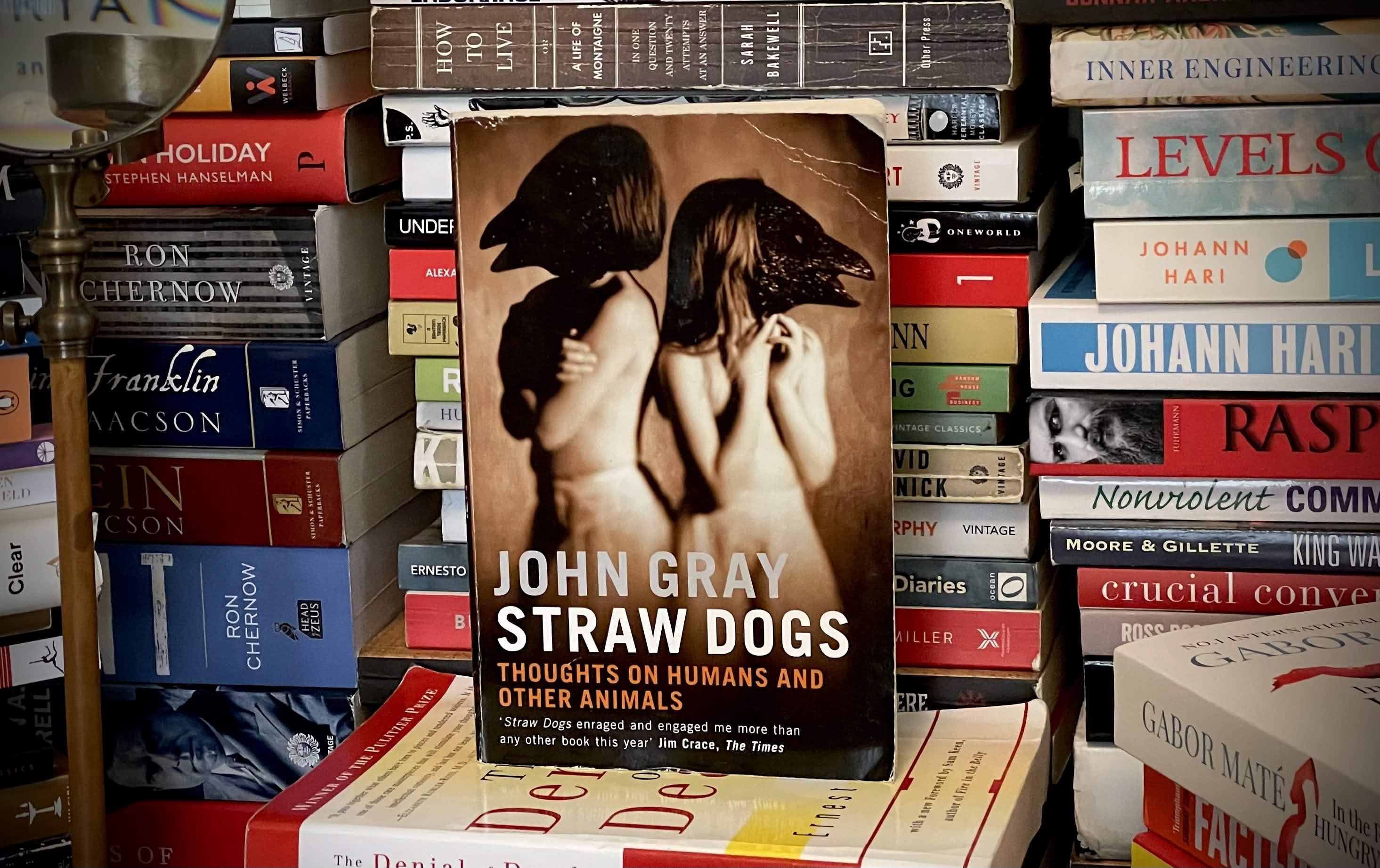
The Myth of Progress
In Straw Dogs, John Gray makes a brutal attack on humanists' belief in human progress. The idea that with the power of scientific knowledge, combined with technology, humans can free themselves from the limits that frame the lives of other animals, and that we can be masters of our own destiny.
Gray argues that this is not the case. We are just like other animals, and we are driven by Darwinistic forces that only care about the reproduction of our genes. On top of that he adds that faith in progress and humanity is just a secular version of the Christian Faith — that salvation is possible for each and all.
"Darwin showed that humans are like other animals, humanists claim they are not. Humanists insist that by using our knowledge we can control our environment and flourish as never before. In affirming this, they renew one of Christianity's most dubious promises — that salvation is open to all. The humanist belief in progress is only a secular version of this Christian faith."
"Humanism is not science, but religion — The post-Christian faith that humans can make a world better than any in which they have so far lived."
The book is divided into short essays on different topics and it is a book that kept me up at night with its uncomfortable, provocative and harsh pessimism. I couldn't put it down.
"Humans cannot live without illusion. For the men and women of today, an irrational faith in progress may be the only antidote to nihilism."
The More Things Change, the More They Stay the Same
Reading Straw Dogs got me thinking about how "progress" and "technical advancements" have actually impacted my life. One recent event came to mind:
I work with building worlds for video games and one of the main restrictions we have as game artists is maxing out how much we can show on the screen at the same time before the computer hardware reaches its limits. We spend a lot of our time figuring out how to build stuff that not only looks nice but is also friendly for the graphics cards and processors to compute. It's a lot of work.
Recently a technological advancement — a huge leap in software and hardware capabilities — made it possible for us to have almost infinite detail in the environments we construct. Which meant almost all work we usually put into optimizing our 3D content disappeared overnight. That was almost 50% of the work. Finally, algorithms and machines had lessened the load of our labor! Life got easier, right?
No. What happened instead was that the bar for visual quality within the games industry went up a few notches — new expectations were born overnight. Just like any tool that helps us become more productive, the more we expect to get done in a day. So what is progress? What is its ultimate aim? Sometimes it feels like we want progress for progress' own sake, but it also feels like the more things change, the more they stay the same.
📺 Video Review
"Modern humanism is the faith that through science humankind can know the truth and so be free. But if Darwin's theory of natural selection is true this is impossible. The human mind serves evolutionary success, not truth."
💡 Key Takeaway
If progress is a myth, and man is just an animal among other animals in an indifferent world — are we doomed to be nihilists? I'm getting more and more convinced that the truth about the human condition is in line with what Gray describes. And if that's the harsh truth, I'm much more inclined to make up my own meaning. I'd rather find an illusion strong enough to sustain me than live a cynical and nihilistic truth.
"Human knowledge is one thing, human well-being another. There is no predetermined harmony between the two. The examined life may not be worth living."
Maybe what we have to do is choose a level of delusion that works for us. One that sustains us and is strong enough to keep us from despair in the face of the terrible truth.
⚖️ Verdict
This is a book I both love and hate. It will probably be the most impactful and memorable book of the year. Yet, I'm not sure anyone is better off by reading it — unless what you look for is sleepless nights and existential angst. We might be doomed on a collective basis in the end, but I still like to believe that on an individual basis it still makes sense to strive for the good.