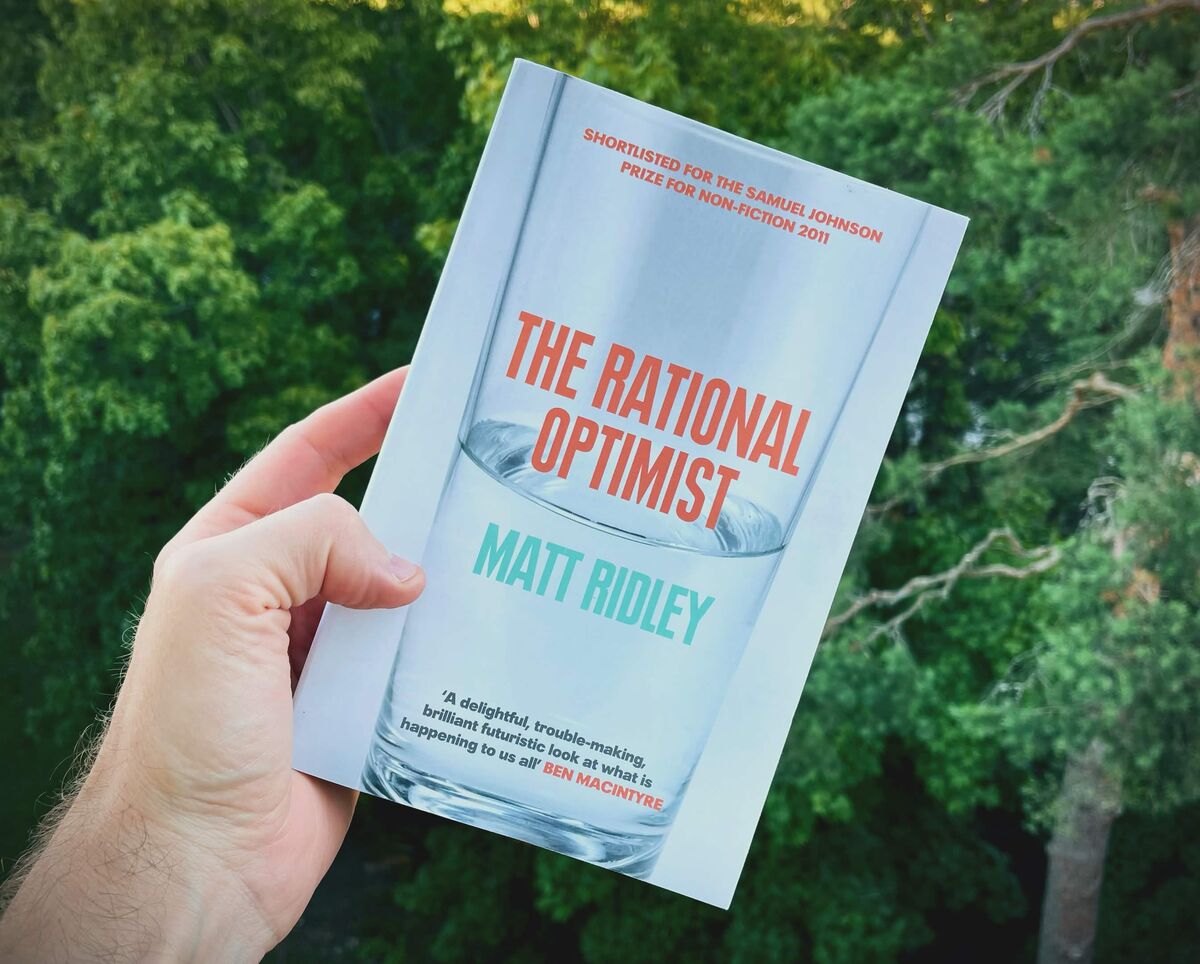
The Rational Optimist
The antidote to doom-scrolling — a data-driven case for why humanity's best days are still ahead.
The Birth of Progress
During his travels, Charles Darwin came in contact with a tribe of hunter-gatherers. He gave one man a large nail, without making any sign for a return — but the man immediately picked out two fish and handed them up on the point of his spear. No common language was needed. They both understood the bargain they were agreeing to.
That instinct for exchange, Ridley argues, is the spark that separated Homo sapiens from every other animal. At some point in history, humans started to exchange services and goods with each other — and that was the birth of progress.
Matt Ridley is a British journalist, author, and scientist. Before The Rational Optimist, he wrote several other books including The Red Queen, Genome, and The Agile Gene. In this book he presents an optimistic view of human progress and prosperity throughout history. The main thesis: human civilization has continuously improved over time due to the exchange of ideas, the specialization of labor, and the accumulation of knowledge.
Collective Intelligence and the Division of Labor
Ridley argues that progress is driven by what he calls collective intelligence — something that arises from human interaction, trade, and collaboration. He challenges the prevailing notion of pessimism by presenting evidence that demonstrates how life has consistently improved for the majority of people throughout history. Increased specialization and trade have led to greater innovation, higher living standards, and improved well-being for individuals across the globe.
Let's turn to Adam Smith for an example. When a production process is divided into a series of tasks and each laborer focuses only on one of those tasks, we can produce more, to a higher quality, and at a lower cost. Doing only one task in the chain — say, shaping a nail — might not be as fun and fulfilling as doing the whole thing yourself. But when one person hits, another shapes, someone else hardens, and another does the packaging, something magical happens. The division of labor has truly skyrocketed growth for humanity. As Ridley puts it in The Wealth of Nations tradition: specialization and trade are the engines of prosperity.
Prosperity Is Time
A great metric for prosperity is time — how much time do we need to spend working in order to enjoy a pleasure or a good?
"An hour of work today earns you 300 days of reading light. An hour of work in 1800 earned you 10 minutes of reading light."
Technology has been the great multiplier. New energy technologies, for instance, allowed textile workers to produce in one minute what took twenty minutes in 1785. Coal was another game changer that allowed for a leap in specialization of production and diversification of consumption. Today we are discarding those older technologies, replacing them with better energy sources — but we're still keeping the benefits they gave us.
📺 Video Review
The Negativity Bias Problem
This era of rapid technological innovation brings a lot of uncertainty and unease into many aspects of human life. A few generations ago, it was almost unimaginable that your family trade — carpenter, weaver, blacksmith — would become irrelevant. These days, many people wonder whether what they've specialized in will even be relevant in a few years, maybe even a few months.
Combine this with our innate negativity bias — the tendency to put more emphasis on negative events and facts than positive ones — and you have a recipe for anxiety and uncertainty. When you watch the news, things look bleak. But having a positive outlook on where humanity is heading works like a protective shield against anxiety and worry, whether it comes from rational optimism or even irrational sources.
Attitude is everything. Having a positive outlook puts you in a great position to take creative action. Pessimists say the world is doomed if we continue as we do — but notice the conditional. The thing is, we won't continue as we do. Everything changes all the time. We take on new strategies, we avoid bad situations, we solve problems. The world will not continue as it is — that's the whole point of human progress.
💡 Key Takeaway
Human progress isn't an accident — it's the inevitable result of people exchanging ideas, specializing in what they're good at, and building on each other's knowledge. The pessimists focus on the if; the rational optimist focuses on the how.
⚖️ Verdict
I picked up this book to regain hope, and it delivered. Ridley's analysis of the world is not perfect — I think he underestimated the impact of global warming, for instance — but his argument for the value of exchanging ideas, goods, and services, and how it has put humans in a unique position to handle various difficulties and still improve living standards, is very convincing to say the least.
I picked up The Rational Optimist thanks to The Almanack of Naval Ravikant — at the end of that book there's a long list of reading recommendations that's slowly becoming my go-to reading list, similar to what Charlie Munger's reading list was for me. If you're like me and you start to doubt whether humanity is heading in the right direction, pick this up. It'll give you some hope and teach you a thing or two about open market trade and the exchange of ideas. You can also check out The Beginning of Infinity by David Deutsch — another deeply positive take on human progress.