The Human Magnet Syndrome: Why We Love People Who Hurt Us
"The soul mate of your dreams is going to become the cellmate of your nightmares."
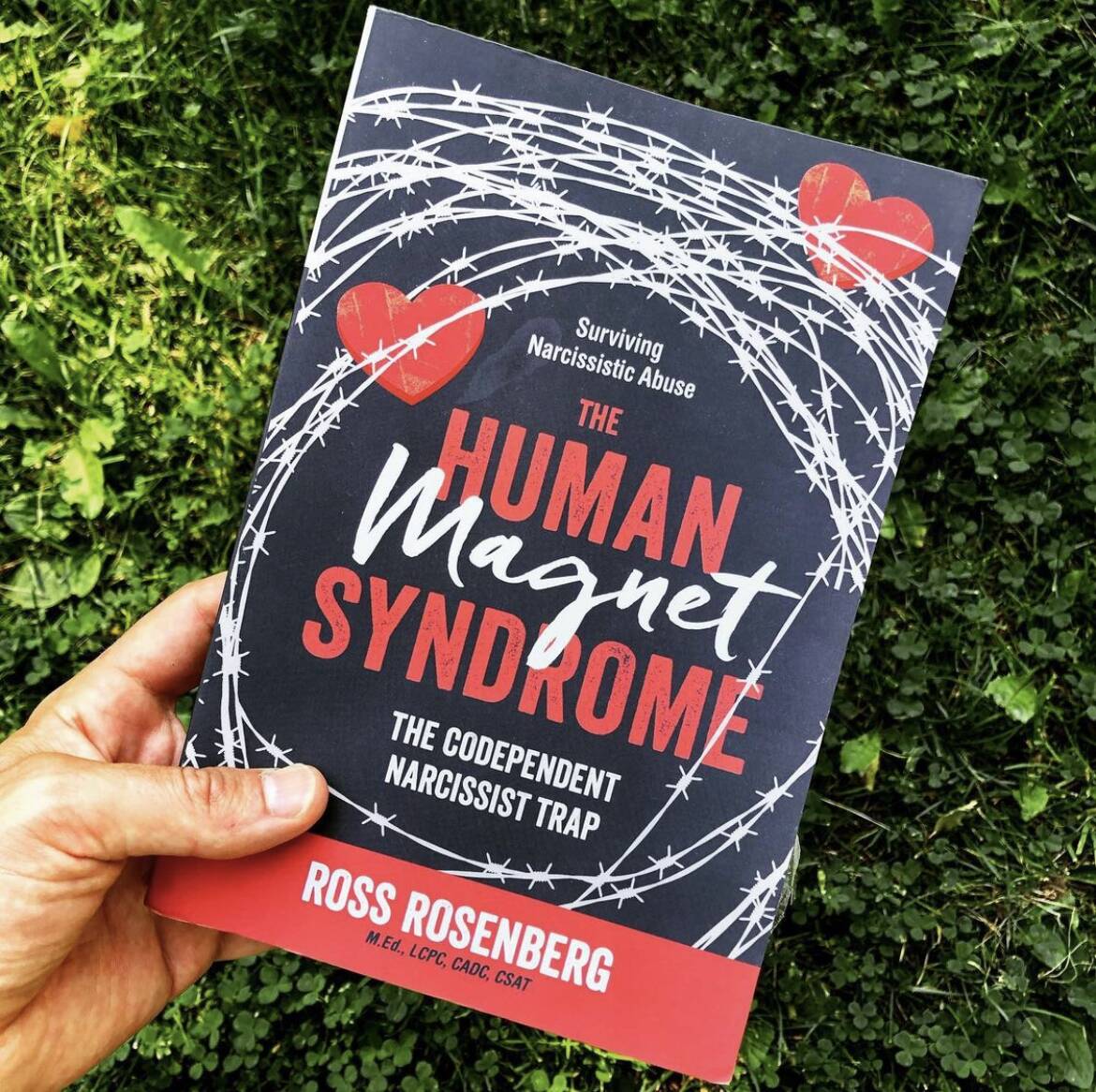
A Joke with 30 Years of Insight
Rosenberg's father said this to him as a joke 30 years before he wrote this book. There is a lot of psychological insight in that joke. Especially since Rosenberg grew up to be a codependent.
In a magnet-like fashion, codependent people are attracted by self-absorbed emotional manipulators. We have all witnessed this phenomenon and scratched ourselves in the head in bewilderment: Why don't these people see that their relationship is dysfunctional?
The magnet-like force that pulls the codependent and the narcissist to each other is what Rosenberg aims to explain in this book.
The Magnetic Pull
The main thesis is straightforward: codependents and emotional manipulators are naturally attracted to each other because of their perfectly compatible dysfunctional inverse personalities.
"A person, whose parents deprived them of unconditional love during their childhood, especially the first five to six years, will likely be drawn to a narcissistic romantic partner by a magnet-like force from which it will seem impossible to break free."
Consciously we desire relationships based on similarities. But this is only secondary to our unconscious preferences. We unconsciously gravitate towards relationships that are familiar and reminiscent of those experienced during our childhood.
People of similar polarities seem uninteresting to each other. When dating someone who "on paper" would be the perfect partner, you can feel that the "chemistry" is missing. It's like kissing a friend.
These types of relationships are resistant to break-up because neither the codependent nor the manipulator can stand being alone. Loneliness triggers shame and a feeling of inadequacy.
📺 Video Review
The Chemistry of Limerence
Rosenberg introduces the concept of limerence — that intense romantic attraction that feels like being high. And it literally is. Dopamine is released from the reward system. Norepinephrine elevates blood pressure and causes the sweaty palms and pounding heart. Serotonin drops, which stimulates compulsive behavior and obsessive thought processes.
It's a cocktail designed by evolution to bond us — and it doesn't care whether the bond is healthy or toxic.
The Personality Disorders
A significant portion of the book maps out the personality disorders that sit on the manipulator end of the continuum:
These terms can help save lives, Rosenberg warns, but can easily be misused to generalize and stereotype.
How Dysfunction Gets Inherited
Most families, especially dysfunctional ones, tend to resist change since it is experienced as stressful and uncomfortable. A child in an attempt to gain independence might be seen as a threat.
"Hence, all families, especially dysfunctional ones, not only resist change, but pass down their shared emotional function to the next generation."
Since emotional manipulators are fundamentally shame-based and anxious about being lovable, they rely on their children to feel competent and worthwhile. The child is burdened by the responsibility of validating their narcissistic parents.
The part about "gifted" or "pleasing" children was fascinating — how some children become hyper-attuned to their parents' emotional needs at the cost of their own development. Rosenberg also describes emotional incest: when a parent demands the child partake in deeply personal interactions typically reserved for an adult partner.
A child's temperament is partly hereditary — anxiety-related traits are 40–60% determined by genes. But genetic roulette could also make the child a disappointment for the narcissistic parent, compounding the dysfunction.
💡 Key Takeaway
What makes me sad about the world we live in? I've been pondering this question lately and I think I've found one answer: how unfair it can be when children have to inherit the unresolved problems from their parents.
⚖️ Verdict
A good book if you want an introduction to the common personality disorders. A fantastic book if you find yourself in an unending loop of dysfunctional relationships.