The Compound Effect
Small daily choices compound into extraordinary results — but only if you can sustain them.
I first heard about this book a long time ago. People in the Instagram book community had been raving about it for years, and I never really got into it — until now. I'd been on summer vacation for four weeks, and during that time I'd been straying away from some positive habits and routines, indulging in sloth and gluttony. I felt like it was time to get back on track, and me being me, I turned to books to help.
The Compound Effect is an inspirational guide that illuminates the way towards achieving big goals by embracing small, consistent actions. Hardy's philosophy goes something like this: it isn't always about massive leaps or revolutionary ideas, but rather about daily decisions, habits, and behaviors. These small choices, over time, create a compound effect — resulting in significant changes in our lives, whether it's wealth, health, or the quality of our relationships.
The Three Friends
Often when we think about compounding, we think about growth — going upwards, going places. But compounding goes both ways. Hardy has a great example of three friends who grew up in the same neighborhood. At the starting point, they're all at a similar stage in life: average height, average weight, average health, all married.
Larry makes no changes at all. He's pretty content with life, even though he sometimes complains that not enough is happening.
Scott decides he wants to see some positive changes. He starts to tweak his daily routine — reading for a few minutes each evening, listening to instructional audiobooks during his 30-minute commute, cutting 125 calories from breakfast, and taking an extra thousand steps each day. Nothing fancy. Nothing revolutionary.
Brad makes some different choices. He gets a bigger TV to enjoy more of his favorite shows and installs a bar in the family room. Nothing crazy — just some "nice lifestyle changes," at least according to Brad.
After five months? No perceivable difference. After ten months? Still nothing to see. But after 25 months, a measurable difference emerges. Scott is trim and Brad is fat. By removing just 125 calories from his diet, Scott lost 33 pounds. Brad gained a similar amount from his drinking and sedentary lifestyle. Scott earned a promotion thanks to acting on what he learned from audiobooks. And Larry? He stayed about the same — just a little more bitter.
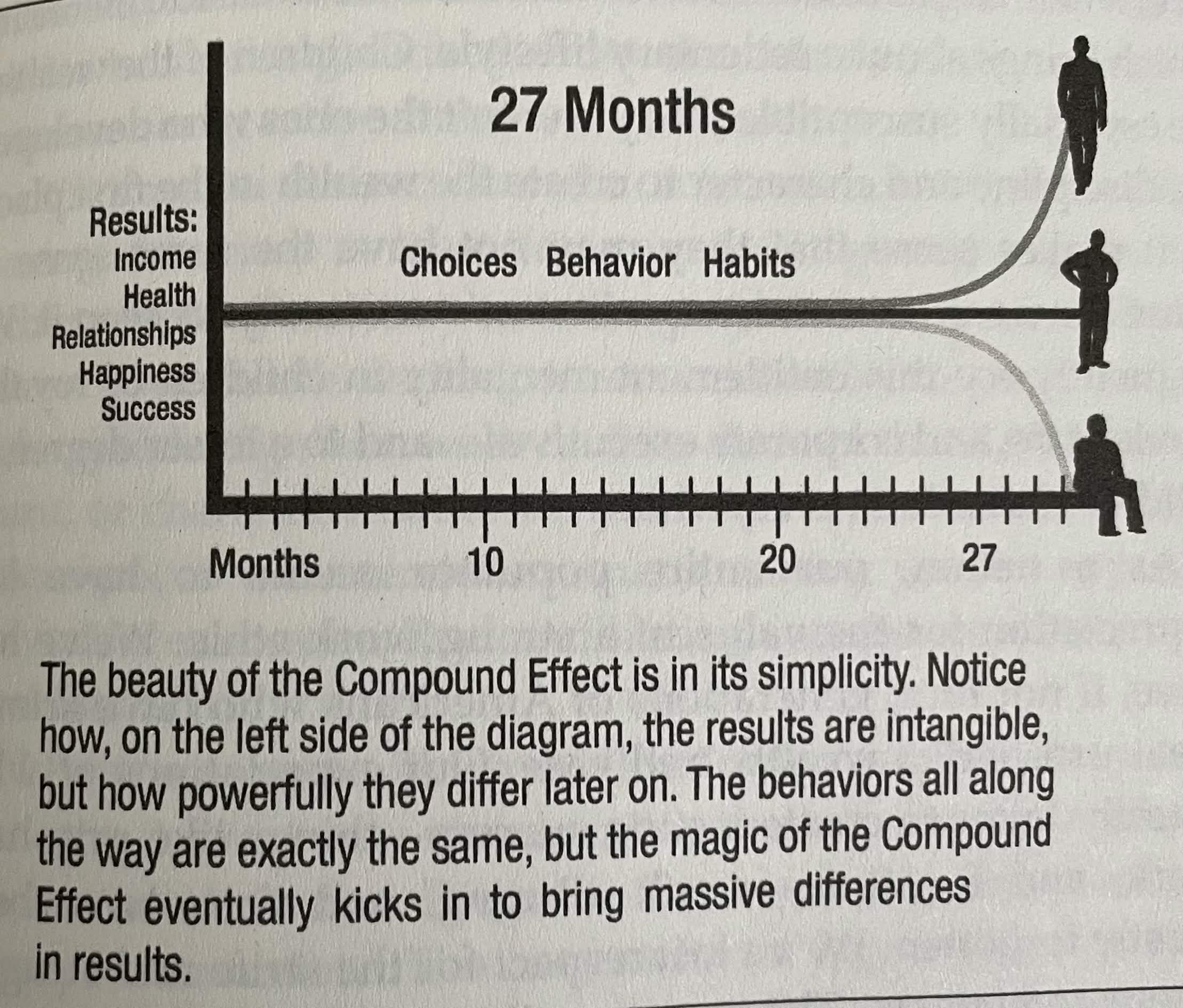
This is the power of compounding. Small actions and behaviors matter, and making the right choices sets the trajectory for our lives.
100% Responsibility
There's one fundamental principle in this book you can't ignore if you want to grow: taking 100% responsibility for your life. We all think we do this, but look closely at your behavior. When was the last time you complained about being in a bad mood because of what someone in your family did? Or blamed traffic for being late? If you did, you're not taking full responsibility — you're acting like a victim of circumstances.
Taking responsibility might seem daunting, but it's actually empowering. It means you are in control, which is quite liberating.
The "Too Much Too Soon" Trap
One of my favorite takeaways is what I call the "too much too soon" trap. It's easy to get overly excited when we set a new goal — lose weight, start a business, whatever. We want massive changes right away. But one of the key components of the compound effect is time. We need to make changes we can sustain — not for a week, not for a month, not for a year, but for decades.
"You will never change your life until you change something that you do daily. The secret to your success is found in your daily routine."
This is where I've failed so many times. I get overly excited about the goal, take on too much, and find myself burned out or overwhelmed. Eventually all the progress just grinds to a halt. If I would have gone slower and been more consistent over a longer time, the results would have been even better.
That's why I'm always more impressed when I hear someone losing 30 pounds over five years than someone on a fad diet who loses the same amount in one month. The former is just a more sustainable way of doing it.
📺 Video Review
💡 Key Takeaway
Consistency beats talent. You don't need to be the smartest, the most charismatic, or the best writer — you just need to keep going when others quit. Small, sustainable daily actions compound into results that are unrecognizable in one to three years.
⚖️ Verdict
After reading this book, I can say it's legit. I didn't find many new ideas that I hadn't heard before, but the ideas that are here are fundamental and crucial. During the last decade I've tried these principles both professionally and privately, and they've been invaluable.
The book is essential for beginner readers — it covers a lot of ground in just 160 pages, and that's a good bargain. But that's also its Achilles' heel: the later chapters lose connection to the core compound effect concept, making it feel shallow in places. It's also a very traditional self-help book with that preppy self-help tone that some people can't stand. I have a pretty high tolerance for it, but your mileage may vary.