Stillness Is the Key
Nothing here is new. That's exactly the point — and exactly why it works.
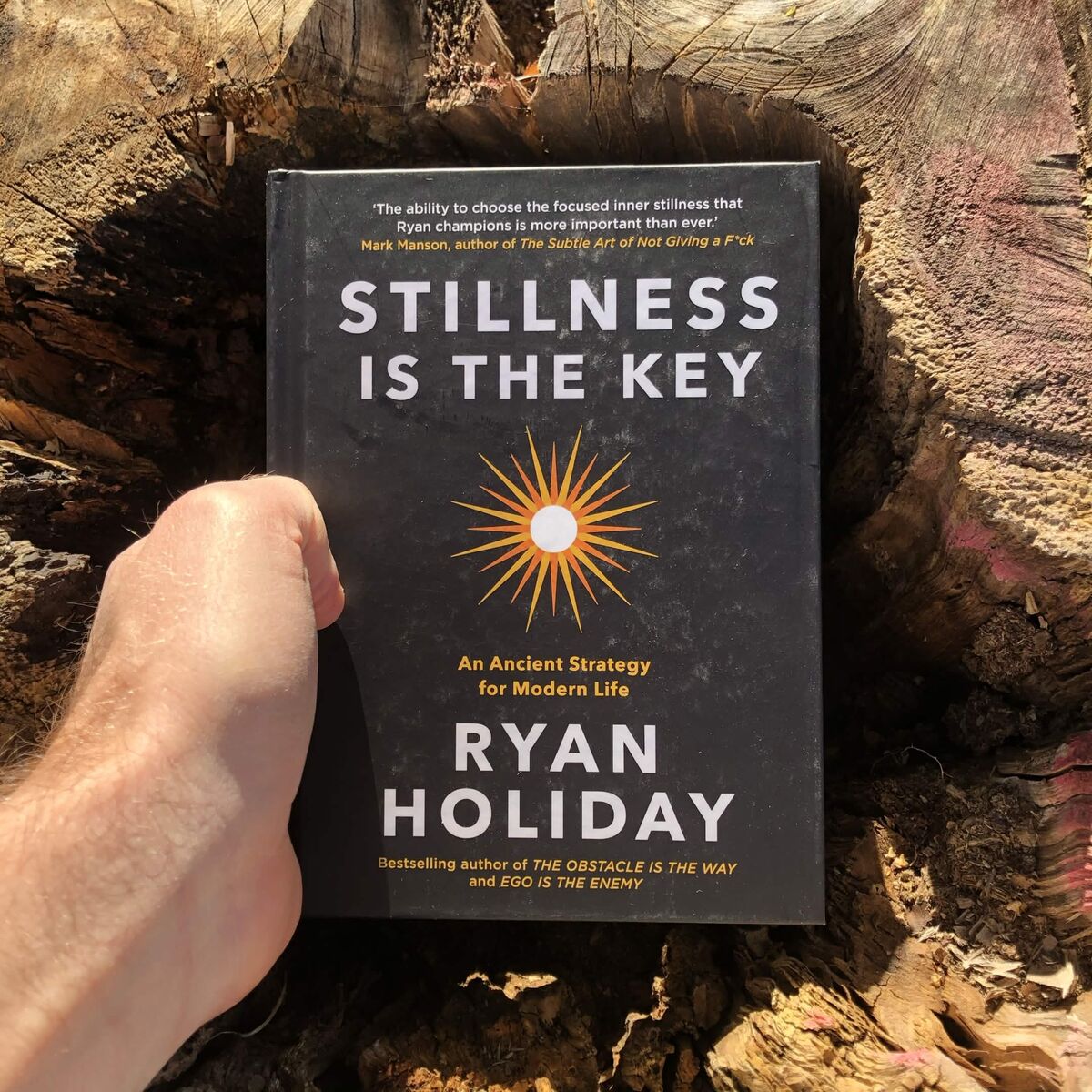
Ancient Strategy, Modern Life
Ryan Holiday has always been at his best when he steps back and lets the wisdom do the talking. Stillness Is the Key draws from the deepest wells — Stoics, Buddhists, Epicureans, the Bhagavad Gita — and weaves their insights into something that feels both timeless and urgently relevant to our overstimulated modern lives.
There is nothing new here. Holiday himself would admit that. The sources are old, even ancient. But that doesn't make the book feel dated. Instead it feels timeless and yet incredibly applicable to how we live right now. That's the trick, and he pulls it off.
Limit Your Inputs
One of the most memorable examples in the book: Napoleon was always weeks behind on his mail — deliberately. He was surprised by how many "urgent" problems had already resolved themselves by the time he got around to them.
Epictetus put it even more bluntly: "If you wish to improve, be content to appear clueless or stupid in extraneous matters."
There is ego in trying to stay up-to-date with everything. At every moment, we should be asking ourselves: is this important? Most of the time, the honest answer is no.
"We have to live in such a way that we stop consuming things that poison and intoxicate us. Then we will have the strength to allow the best in us to arise."
The Power of Ritual
The chapter on routines and rituals hit me the hardest. It starts with Fred Rogers — Mr. Rogers — and how his entire day was built on rituals. He woke up at the same time, took a swim, weighed himself, sang his song, went to the studio, and recorded intros for his show. Over and over and over again.
It might sound boring. But the truth is that good routines are the foundation for comfort and stability. They become the platform from which stimulating and fulfilling work becomes possible. A good routine sets your mind in the right space for doing the work that needs to be done.
"A master has a system. A master turns the ordinary into the sacred. And so must we."
Routine, done for long enough and sincerely enough, becomes ritual. It becomes sanctified. Holy. And the alternative? Waking up to a day where you're bombarded by choices — what to wear, what to eat, what to do first, what to do next. It's exhausting. Eisenhower defined freedom as "the opportunity for self-discipline." That reframe has stuck with me.
📺 Video Review
Beware Desire
Holiday dedicates an entire section to the trap of wanting more. The mentality that gets athletes to the top so often prevents them from enjoying the thing they worked so hard to achieve. The need for progress can become the enemy of enjoying the process.
"The creep of more, more, more is like a hydra — satisfy one desire, whop it off the bucket list, and two more grow in its place."
Epicurus nailed it centuries ago: "Nothing is enough for the man to whom enough is too little." And the Bhagavad Gita says it even more beautifully: "Work done for a reward is much lower than work done in the yoga of wisdom. Set thy heart upon thy work but never on its reward."
Holiday offers two practical tools against runaway desire: a strong moral code, and journaling — the practice of observing your own behavior honestly. Self-awareness as a defense against self-destruction.
Act Bravely
Stillness is not an excuse to withdraw from the world. Quite the opposite. It's a tool to let you do more good for more people. High-minded thoughts and inner work are one thing, but all that matters is what you do. The health of our spiritual ideals depends on what we do with our bodies in moments of truth.
Kennedy's handling of the Cuban Missile Crisis. Lincoln's strategic patience. Marina Abramović sitting in silence for 700 hours in The Artist Is Present. Holiday uses these stories not as decoration but as evidence that stillness under pressure is what separates the great from the merely ambitious.
Get Rid of Your Stuff
Reduce your needs to zero, and you are truly free. Nothing can be taken from you. Holiday calls out "comfort creep" — how we almost without noticing become used to convenience, luxury, and a certain level of service. Monks have long taken vows of poverty not as punishment but because it limits distractions and makes room for the spiritual pursuit they've committed to.
You don't have to become a monk. But the principle is worth sitting with.
💡 Key Takeaway
Build routines. Turn them into rituals. The ordinary becomes sacred when it's done with intention and consistency. Freedom isn't the absence of structure — it's the opportunity for self-discipline. That one chapter on ritual changed how I look at my day.
⚖️ Verdict
This is Holiday at his best — synthesizing ancient wisdom into something practical and personal. Unlike some of his later work in the Stoic virtues series, Stillness Is the Key doesn't feel formulaic. It feels lived. The sources are old, the structure is familiar, but the message lands because Holiday clearly believes in it and has built his own life around these principles.
Read this one. Especially if you feel like the noise of modern life is drowning out the signal.