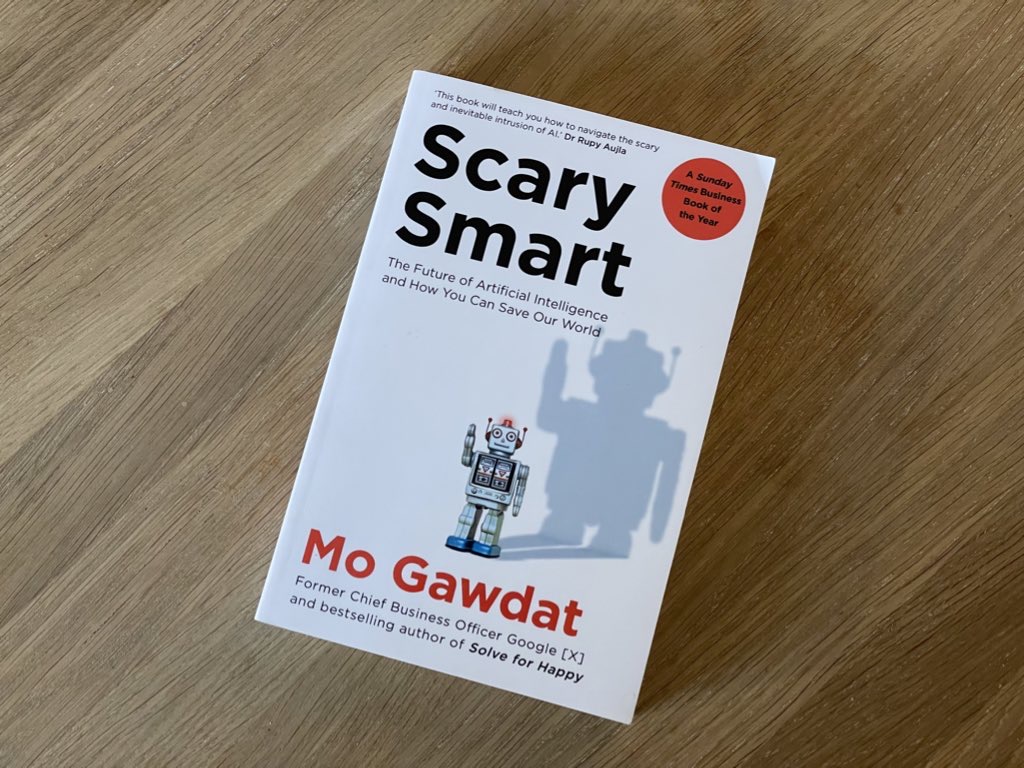
Scary Smart
AI is growing up fast — and we are its parents. The question is whether we're raising a hero or a villain.
The Year Everything Changed
2022 was the year I realized we were going through a monumental shift. At the beginning of that year, I got my hands on a tool that could generate artworks in the style of any artist in seconds — and all it demanded was a single line of text. As someone who works as an artist in the games industry, I was amazed. I know how much work goes into generating images of that quality.
The AI was competent but flawed. It created messed-up faces, the hands were all weird, and it couldn't interpret text properly. Six months later, I revisited the technology and my mind was blown. All the flaws had been fixed. It could now create faces, hands, and the quality of the artwork was beyond most people's capabilities — except maybe the real art masters.
This type of accelerated learning is made possible through neural networks built with deep learning algorithms. This is what we today call AI. The revolution has begun, and we're heading toward very weird times.
Mo Gawdat's Warning
Mo Gawdat is a former Chief Business Officer at Google X and the bestselling author of Solve for Happy. In Scary Smart, he delivers a call to action. Among the book's content we find a short history of AI development, a fascinating chapter on how AI learns — my favorite chapter in the whole book — predictions of how the near future will play out, both the joys and the horrors, and a roadmap for how we can make the infancy of AI as frictionless as possible.
Gawdat argues that we're at a crossroads. It's not yet too late to decide what direction to take AI in. AI is in its infancy, but it's growing up really fast — and metaphorically, we are the parents to this super-child.
We Are the Parents
AI learns from us. It takes instructions from us and we indicate through our actions what it means to live a successful life. This is all fine and good as long as we are good and caring and loving parents. But if you've ever seen a superhero movie, you know that there are also super villains — driven by greed, vengeance, and selfish desires.
Gawdat argues that the guidance and the values we pass on to AI will determine whether the future we're heading toward will be dystopia or utopia. It won't be easy. Bad things will most definitely happen. But AI doesn't have to be the end of humanity.
"When you and I have an accident driving a car, you and I learn. When a self-driving car makes a mistake, all self-driving cars learn."
The Three Inevitables
Gawdat lays out three things we must accept:
One — AI will happen. Two — it will become smarter than us. Three — bad things will happen, at least in the short term. Mistakes and errors will be made.
When you work with exponential technology and you're at one percent, you're almost done. A doubling of one percent is only seven doublings away from one hundred percent. A great example is the Human Genome Project, which was predicted to take about 15 years. After seven years they were only one percent complete. People started looking at the project with a more skeptical tone. But seven years later — they were done.
📺 Video Review
The Singularity
The Singularity is what happens when computers become smarter than us as humans — when we can no longer imagine what the future might have in store. Gawdat points out that we've had singularities before. When humans spoke for the first time, the spoken word was a technology beyond which the horizon of how far we could go was unfathomable to the primitive creatures that preceded it. Religion, politics, education, media, entertainment — all sprang from the spoken word.
"We make the tool, then the tool makes us."
The difference with more recent technology such as AI is the baffling speed in which change happens. The minute we figure out quantum computing and are able to write software for it — that exact minute, AI will eclipse human intelligence. Quantum computers might be 16,000 times more powerful than regular computers within the same timeframe where Moore's Law gives us 16 times.
Why This Matters Now
For the last 10 years I've been reading at least one book each year about AI and automation — not only because it's a fascinating topic, but also because I had a hunch that this technology would have a huge impact on the way we live our lives, probably sooner than people expect. I felt for the longest time that the political and public debate has ignored the question of AI.
The insane developments we've seen in just the past six months, especially with ChatGPT, might have been the wake-up call we all needed. Scary Smart is probably the best introduction to AI for people who don't have a tech background. It's super accessible and paints a shocking yet grounded picture of the future we are facing.
💡 Key Takeaway
AI is inevitable, it will surpass human intelligence, and mistakes will be made along the way. But the outcome isn't predetermined. We are AI's parents — the values, behaviors, and guidance we model today will shape whether this technology becomes humanity's greatest achievement or its worst nightmare. The window to influence that outcome is open now, but it won't stay open forever.
⚖️ Verdict
The book loses a bit of steam toward the end, but as an introduction to the world of AI, Scary Smart is hard to beat. It's accessible enough for complete beginners while still containing genuine insights that will make even informed readers think. I listened to it as an audiobook — the narrator has a bit of an accent, so make sure to sample it before you buy.
If you want to go deeper after this, pick up The Coming Wave by Mustafa Suleyman — it builds on the foundations Scary Smart lays and goes much further into the containment problem and synthetic biology. Together, these two books give you a comprehensive picture of where AI is heading and what's at stake.