Psychology of Intelligence Analysis
A CIA analyst's guide to the mental traps that make smart people get things wrong.
Thinking Is a Skill
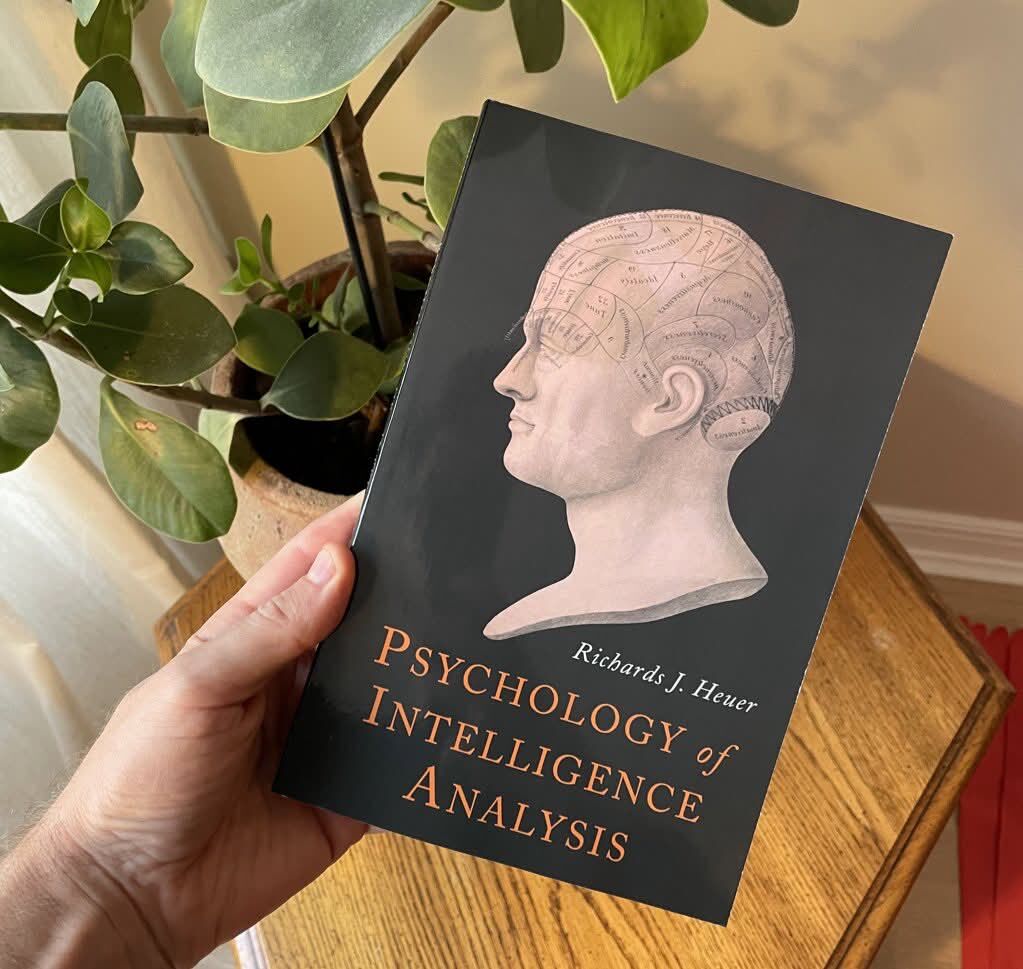
Psychology of Intelligence Analysis is a classic book that examines the psychological factors that impact intelligence analysis — including bias, group dynamics, and cognitive limitations. It was written by Richards J. Heuer Jr., a veteran CIA analyst, and originally published by the CIA's Center for the Study of Intelligence.
The core argument is deceptively simple: analytical thinking is a practical skill, like carpentry or driving a car. It can be learned, and you will improve if you practice. But this is not a skill you pick up in a classroom just by being instructed — it's learning by doing.
Suspend Your Judgment
One of the key principles Heuer lays out is that you should suspend your judgment for as long as possible. You want to have as much information as you can before committing to a conclusion. Why? Because once judgments are made, they stick. Convictions are hard to change once they exist.
But here's where it gets interesting: don't overvalue the importance of more information. Studies show that an increase in information leads to an increase in confidence in your conclusions — but more information actually has a negligible impact on the accuracy of your analysis. Oftentimes, testing more hypotheses is more important than gathering more information.
Deferred Judgment
The single most important technique for creative thinking is called deferred judgment. The concept dictates that we separate the idea generation phase from the evaluation phase. Get all the ideas on the table before you start judging and evaluating them. This is because quantity leads to quality — thinking should range freely in order to get all ideas out. This technique also allows for cross-pollination, with different ideas leading into others that build upon the previous ones.
📺 Video Review
Mental Schemas
"If information does not fit into what people know or think they know, they have great difficulty processing it."
A mental schema is a mental structure that an individual uses to organize knowledge and guide cognitive processes and behaviors. People use schemas to categorize objects and events based on common elements and characteristics, and thus interpret and predict the world.
Heuer provides a great example of how mental schemas work: Chess Masters and ordinary chess players were given 5 to 10 seconds to note the position of 20 to 25 pieces on a chessboard. When the pieces were placed randomly, both groups remembered about six to eight pieces each. But when the pieces were taken from an actual game — and this was unknown to the subjects — the Chess Masters were able to remember almost all positions without error, while the ordinary players still only remembered half a dozen. The exceptional performance of the Chess Masters was due to their ability to recognize relevant patterns. That's a mental schema in action.
How to Evaluate Your Thinking
"The most probable hypothesis is usually the one with the least evidence against it, not the one with the most evidence for it."
This might be my favorite takeaway from the book. It flips how most of us think about evaluating ideas — instead of looking for confirming evidence, look for what disproves your hypothesis. The one that survives the most attempts to kill it is probably closest to the truth.
Unlocking Creative Blockages
Heuer's tips on how to unlock creative blockages really resonated with me. Two practical techniques:
Leverage time. The passage of time allows us to see new connections. Step away from the problem and come back to it.
Talk it out loud. Ask yourself questions and try to answer them out loud. The reason this works is that written word and spoken word are processed in different parts of the brain. Switching between writing mode and talking mode lets you use different neural pathways, and it seems to help unlock new creative ideas.
💡 Key Takeaway
Reading books like this improves your thinking — maybe because they erode the false confidence we all have about how rational we are. It highlights all the shortcomings of human biology, our way of thinking, and how prone we are to misjudgment.
⚖️ Verdict
This book is specifically aimed towards people who work with intelligence — analysts processing information to understand and mitigate threats. That's probably not most of us, and hence this book is not for everyone. I struggled quite a bit with it from time to time because it's quite dry and becomes very technical. But the core insights on bias, mental schemas, and deferred judgment are genuinely useful for anyone who wants to think more clearly. Three stars — valuable ideas in a package that's hard to get through unless this is your field.