I Am Dynamite!
The troubled genius behind the mustache — his ideas, his illness, his fight with God, and why his philosophy still matters.
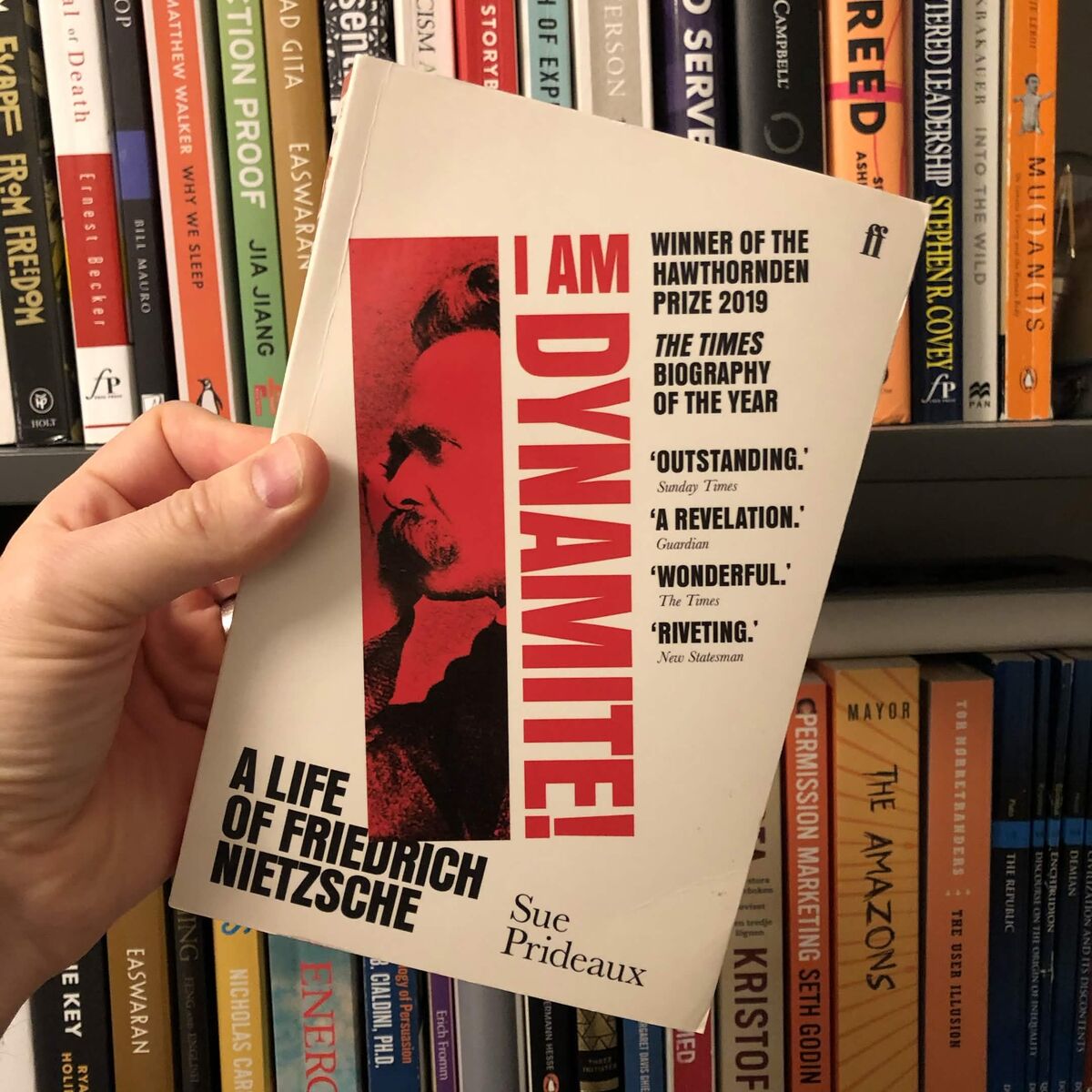
Beyond the mustache, what do most people really know about this troubled soul?
Nietzsche is probably the most influential modern thinker and gave us ideas such as the Übermensch, ressentiment, and eternal recurrence. He pulled the rotting corpse of God from the shadows of the back-alley to the town square for all to see. He wrote powerfully, he wrote boldly — and he picked a fight with every segment of society.
Why I Read This Book
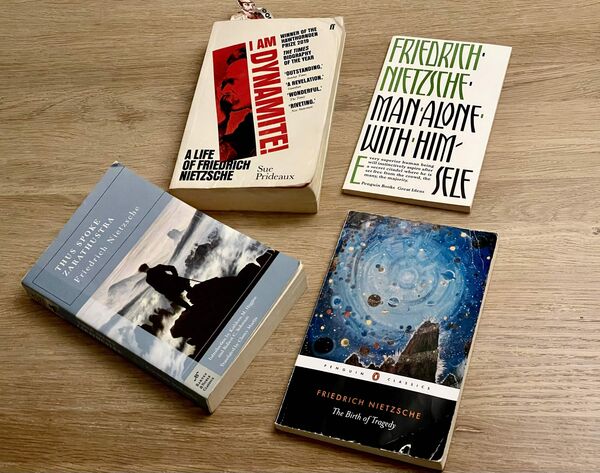
Nietzsche is someone I often heard quoted throughout my reading career. A few years ago his words could be found in every other book I read. I don't know if that says more about what kind of books I read or the impact of his philosophy. Regardless, I finally decided to take a closer look at his work. After reading his books The Birth of Tragedy and Thus Spoke Zarathustra I felt a biography of his life was in order.
About the Book
I Am Dynamite! gives us the life of Friedrich Nietzsche — a giant within modern philosophy. This book gives you a closer look at the man, his life, and his ideas: from his pious childhood, to becoming a young professor at age 24, to his descent into madness. It's also a book that untangles his often misunderstood and misused philosophy.
Sickness and Productivity
From an early age he struggled with his health. He had terrible episodes of headaches with vomiting and extreme eye aches that often lasted as long as a whole week. During these episodes he had to lie in a darkened room.
"He was put to bed in a darkened room with leeches fastened to his earlobes to suck blood from his head. Sometimes they were also applied to his neck. He hated the treatment."
No shit.
The doctors didn't have much hope for him. His school doctor predicted total blindness. But what could have been a crushing fate made him more determined to make something of himself.
"Spurred on by physical limitations and gloomy prognostications, he seized each productive moment. His appetite for work was prodigious."
Nietzsche's struggle with illness reminded me of Beethoven — who, when starting to lose his hearing, had a prolific creative output and worked in a frenzy to squeeze out every last ounce of music within his genius.
📺 Video Review
Nietzsche and Richard Wagner
As a young philology professor, Nietzsche developed a strong and intimate relationship with the famous composer Richard Wagner — the two were pretty much BFFs. But one day their relationship suddenly turned sour.
Nietzsche's sister Elisabeth fabricated the popular idea that Wagner and Nietzsche ended their relationship over differences about the religiosity of the great composer's latest libretto. But it was in fact because of a very different reason.
Nietzsche had found out that Wagner had raised suspicions in a letter to his personal doctor that the professor might be masturbating too much. Wagner had been worried about the professor's bad health and he knew that playing with oneself was a vice associated with eye problems — very similar to what Nietzsche suffered from.
It was when Nietzsche found out about this well-intended, but crushing, correspondence that the relationship between the two men who had been such passionate friends came to a breaking point.
So, maybe "mental masturbation" wasn't Nietzsche's only pastime.
God Is Dead
Nietzsche's statement "God is dead" stated plainly what his age refused to acknowledge. The Enlightenment and the Scientific Revolution had killed God. Without religion and a belief in the divine, there was no longer any moral authority for the laws that western civilization was built upon.
"What happens when man cancels the moral code on which he has built the edifice of his civilisation? What does it mean to be human unchained from a central metaphysical purpose? Does a vacuum of meaning occur? If so, what is to fill that vacuum?"
Nietzsche saw his contemporaries continue to live their lives without concern for this inauthenticity.
"Given the power to live without religion, man must take responsibility for his own actions."
Ressentiment and the Slave Morality
How did we willingly adopt the Judeo-Christian values that turned us into obedient cattle? Nietzsche takes the term "slave morality" from the fact that historically Jews and Christians were slaves, first in Babylon, then under the Roman Empire. Powerless to impose their will upon the world but lusting after power, the slaves were eaten up with resentment against their masters.
"Ressentiment is a word with a fuller meaning than mere resentment and jealousy. It is a neurosis, a need to inflict pain upon the self as well as upon the other."
Ressentiment led the slaves to lie their weakness into strength — to overturn the previous morality of power and replace it with the moral superiority of victimhood and the glorification of the downtrodden. As St. Augustine observed: resentment is like taking poison and hoping the other man will die.
The antidote to the slave morality is the morality of the Übermensch — the free, affirmative, independent spirit.
What to Do?
First, man must become himself.
"Secondly, amor fati; he must accept what life brings, avoiding the blind alleys of self-hatred and ressentiment. Then finally man can overcome himself to find true fulfilment as the Übermensch, the man at peace with himself, finding joy in his earthly purpose, rejoicing in the sheer magnificence of existence and content with the finitude of his mortality."
💡 Key Takeaway
Nietzsche saw modern man as someone who has "no external enemies or obstacles but rips himself apart, persecutes himself, gnaws at himself, gives himself no peace" — like an animal battering himself on the bars of his cage. The way out? Become yourself, embrace amor fati, and overcome yourself to find fulfilment as a free spirit.
⚖️ Verdict
Someone in the comments once said that usually the philosophy is more interesting than the life of the philosopher. That rings true with Nietzsche. He's portrayed as kind of an insecure and socially awkward nerd — but with an inflated ego. Even though his life is relatively uneventful, exploring his philosophical ideas is worth the time investment.
Reading a biography like this one provides a map for how his ideas evolved over time and gives an understanding of the era that gave birth to his philosophy. It's a well-written, engaging, and insightful biography. If you're interested in the crisis of meaning we see played out in different forms within contemporary society, then Nietzsche is someone you definitely should study.
It also led me to buy and read a few other books that influenced Nietzsche throughout his life: Schopenhauer's On the Suffering of the World and Dostoevsky's Notes from Underground. I'm thankful for that, because having one great book lead me to other great books is one of my favorite aspects of the reading journey.