On the Suffering of the World
Philosophy's greatest pessimist makes his case — and you'll never look at an itchy nose the same way again.
The Grumpy Old Man of Philosophy
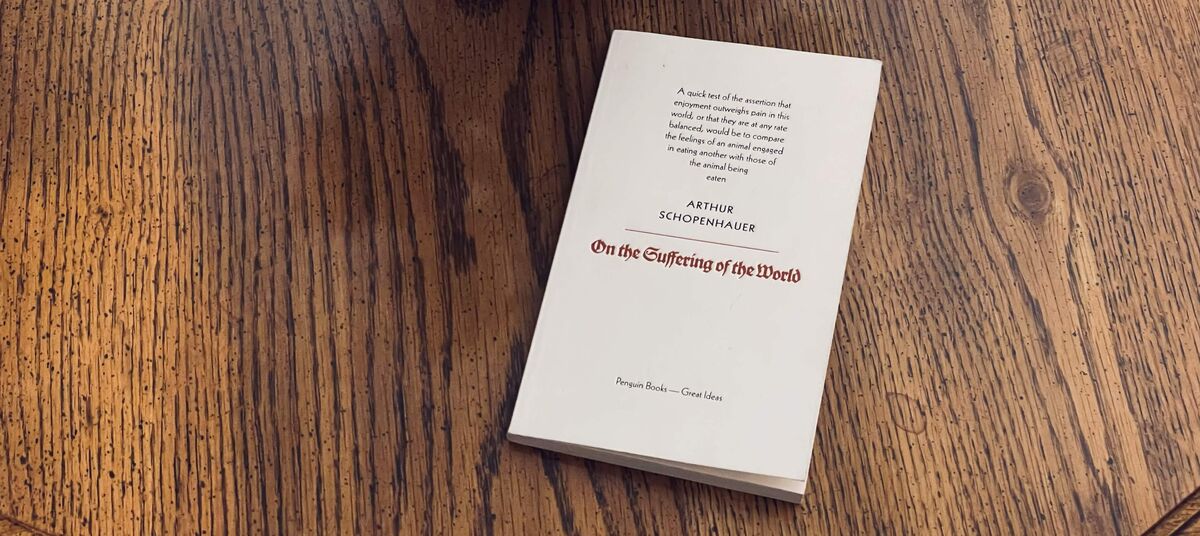
Schopenhauer was a German philosopher (1788–1860) most famous for The World as Will and Representation. This short book is a collection of essays on several topics: aesthetics, suicide, thinking and the intellect, and more.
The author was an old man when he wrote this and it shows — he is not holding back as he shares his dire views on the human condition.
Life's Main Feature: Suffering
First off, he makes it clear that when it comes to life, suffering is its main characteristic. He compares the distribution of pain to pleasure to that of an animal being eaten alive versus the animal eating it:
"A quick test of the assertion that enjoyment outweighs pain in this world, or that they are at any rate balanced, would be to compare the feelings of an animal engaged in eating another with those of the animal being eaten."
And it's quite easy to sympathize with his view once you give the experience of existence some thought. For instance — as I write this I'm tucked in under a cosy cover, my beautiful daughter is by my side, and we live in a heated and spacious dwelling that protects us from the natural elements. I have everything a person can ask for but where do I focus? On the annoying itch on the left side of my nose.
Suffering, frustration and pain tend to take centre stage in how we experience life, while joys and pleasures often take conscious effort to appreciate.
Life as a Penal Colony
Schopenhauer suggests that we might do well to see life as a "penal colony", a form of hell on earth:
"As a reliable compass for orienting yourself in life nothing is more useful than to accustom yourself to regarding this world as a place of atonement, a sort of penal colony. When you have done this you will order your expectations of life according to the nature of things and no longer regard the calamities, sufferings, torments, and miseries in life as something irregular and not to be expected but will find them entirely in order, well knowing that each of us is here being punished for his existence and each in his own particular way."
And maybe instead of calling people "sir" or "monsieur", "fellow sufferer" would be more fitting. This greeting would make us see other people in a truer light and remind us of "the most necessary of all things: tolerance, patience, forbearance and charity."
📺 Video Review
On Thinking for Yourself
He also gives some great tips for all of us book nerds:
"As the biggest library if it is in disorder is not as useful as the small but well-arranged one, so you may accumulate a vast amount of knowledge but it will be of far less value to you than a much smaller amount if you have not thought it over yourself."
"Reading is merely a surrogate for thinking for yourself; it means letting someone else direct your thoughts."
"It may sometimes happen that a truth, an insight, which you have slowly and laboriously puzzled out by thinking for yourself could easily have been found already written in a book; but it is a hundred times more valuable if you have arrived at it by thinking for yourself."
The Nietzsche Connection
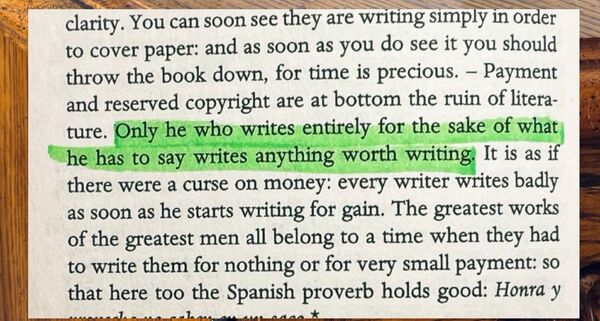
I was reading the great Nietzsche biography I Am Dynamite by Sue Prideaux when I decided to pick up this book. Schopenhauer had a big influence on Nietzsche's thinking and I thought that getting to know this grumpy old man would add further depth to my understanding of the moustachioed Friedrich.
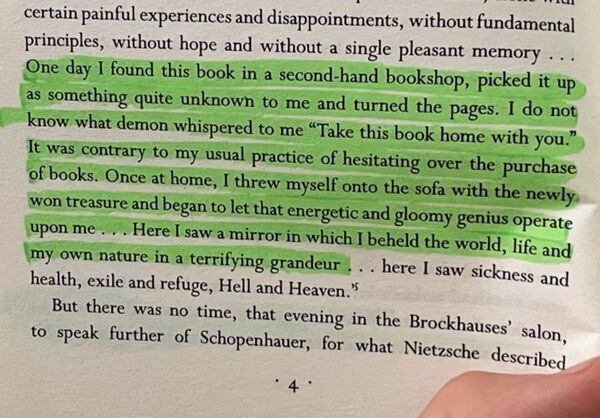
One of the joys of studying and trying to map out the history of ideas is tracing them back through the ages. When reading Thus Spoke Zarathustra, I was taken aback by an elegant metaphor about intellectual life in terms of the sun versus the moon. A moon can shine as bright as a star but it shines with borrowed light — it can only reflect light already produced. It's one thing to learn and recite what others have already come up with; producing original thoughts is a totally different ball game.
In Schopenhauer I ran into the same idea again, but from an earlier pen. So maybe Nietzsche is more moon than sun himself. 😎🌙
On Women… Yikes
While most of the book is packed with powerful aphorisms and insightful thoughts on the human condition, the chapter "On Women" stands out. A lot of things have been added to the category of misogynistic in recent days, but Schopenhauer's take on women is outright nasty.
"Women are suited to being the nurses and teachers of our earliest childhood precisely because they themselves are childish, silly and short-sighted, in a word big children, their whole lives long: a kind of intermediate stage between child and the man, who is the actual human being, 'man'."
I haven't read any biographies about Schopenhauer yet, but judging from the tone he hasn't had much luck with women. I think this chapter says more about Schopenhauer than the role and accomplishments of the person cast as playing the Lady in the 18th century.
💡 Key Takeaway
Suffering is the default state of existence — not an exception but the rule. And paradoxically, accepting this might be the most useful compass for life. When you stop expecting happiness as a baseline and instead measure life by the absence of suffering, you find tolerance, patience, and a strange kind of peace.
⚖️ Verdict
The book held my attention, but it feels a bit unfocused as it covers a wide range of seemingly unconnected topics — from suffering to suicide, aesthetics to women. What strikes me is how piercing and straightforward most of his arguments are, and now I find myself seeing suffering everywhere. A short book and probably a good starting point for anyone wanting to get a taste of Schopenhauer's rather pessimistic but sober view on things.
Maybe except his views on women… I found the chapter quite hilarious though.