Don't Sleep, There Are Snakes
A missionary goes to convert a remote Amazonian tribe — and they convert him instead.
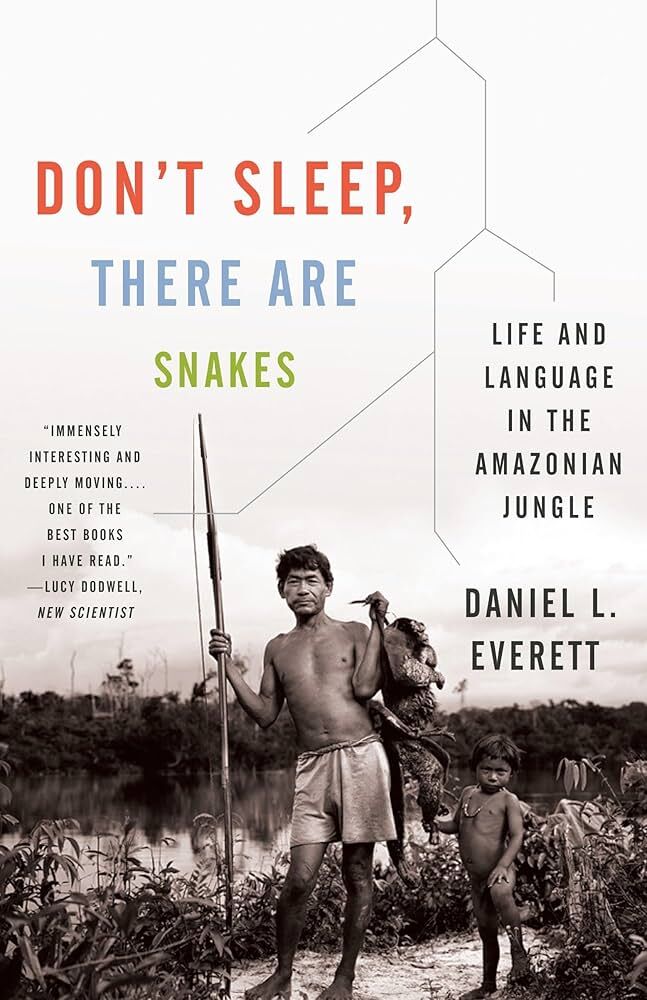
The Setup
Daniel Everett, a Christian missionary and linguist, spent decades deep in the Amazon jungle living among the Pirahã — one of the most isolated tribes on Earth. His mission: learn their language and translate the Bible. He was part of the Summer Institute of Linguistics (SIL), an organization that believes translating the New Testament into new languages is the best way to spread the good news. They don't preach or baptize — they translate.
He wasn't the first to try. For 200 years, missionaries had traveled to the Pirahã to save their souls. Not a single one ever took the bait. They are simply not in the market for being saved.
A Culture That Lives Entirely in the Present
What makes the Pirahã so extraordinary is how radically different their culture is from everything we take for granted. At the heart of it lies what Everett calls the Immediacy of Experience Principle: if you haven't experienced something firsthand, your stories about it are irrelevant. This single principle shapes everything about how they live.
The Pirahã have no creation myth. No oral history. This is extraordinarily unusual for any human culture. They consume everything they hunt and gather immediately — no salting, no smoking, no storing food like other Amazonian tribes. They work only 15–20 hours a week. And among their youth, there is no sense of teenage angst, depression, or insecurity.
They can't learn to count to ten. Not because they're incapable, but because the concept simply has no utility in their world. Left and right don't exist — instead they say "upriver" and "downriver," orienting themselves by external landmarks rather than relative to their own bodies.
"Theories affect our perceptions; they are part of the cultural information that constrains the way we see the world around us."
A Language That Broke Linguistics
The Pirahã language is tonal, with very few distinct sounds — which makes every sentence remarkably long when you have so few building blocks to work with. But the real bombshell was this: the Pirahã language appears to lack recursion — the ability to embed clauses within clauses.
This was devastating for mainstream linguistics. Recursion had been established as the differentiating ingredient of human communication compared to other animals. Noam Chomsky had argued that grammar is essentially hardwired in our genes. B.F. Skinner thought language was just behavior like any other. Everett's findings suggested a third possibility: that culture-based meaning and constraints on talking might be more important than grammar itself. You can't study a language effectively without understanding its cultural context.
What is the most important tool that makes human communication unique? Duality of patterning — we organize sounds into patterns, then organize those sound patterns into grammatical patterns of words and sentences. This layered organization is what enables us to communicate so much more than other animals. But the Pirahã challenge even these assumptions.
The Convert Gets Converted
Here's the best twist in the book. It was almost impossible to convey a message from the first century to the Pirahã. They are only interested in things they have directly experienced, or at most what has been directly experienced by people they know. Ancient stories about a man from Galilee? Irrelevant.
"The Pirahã were not in the market for a new worldview." After 200 years of conversion attempts, not a single one took the bait. They didn't feel lost, so they didn't need saving.
In the end, it was Daniel himself who became the convert. Living among people who were content without myth, without religion, without existential anxiety slowly eroded his faith. He went from believing the Bible was the literal word of God to becoming a closet atheist — and eventually an open one. The missionary became the converted.
💡 Key Takeaway
Perception is learned. We experience the world according to our experience and expectations — "not always, perhaps never to how the world really is." The Pirahã are living proof that much of what we consider fundamental to human nature is actually cultural programming.
⚖️ Verdict
Learning about the Pirahã culture is genuinely fascinating — a window into a way of being human that is so radically different it forces you to question your own assumptions. But the linguistic deep dives can be quite exhausting at times. The technical chapters on phonology and syntax will test your patience unless you're genuinely into linguistics. The cultural and personal narrative carries the book; the academic sections weigh it down.
Worth reading for the cultural revelation and the incredible personal twist. Just be prepared to skim some chapters.