Atlas Shrugged
What happens when the most competent people withdraw their talents from the world?
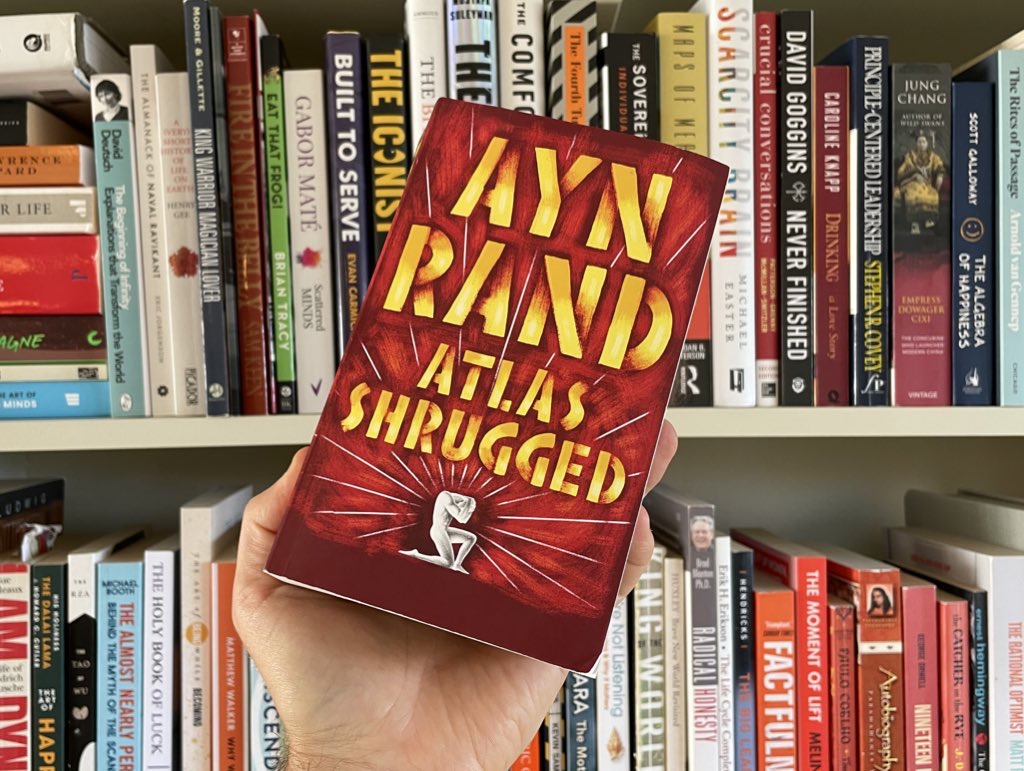
A Behemoth of a Book
Atlas Shrugged is Ayn Rand's magnum opus — an intense philosophical novel that doubles as a manifesto for her objectivist philosophy. First published in 1957, it clocks in at over 1,000 pages. It's a commitment. But if you're the kind of reader who loves diving into a deep, immersive world, the long format gives Rand space to unpack her ideas in a way a shorter book never could.
The book takes place in a dystopian America where the economy is crumbling because of government overreach and Kafka-esque bureaucracy. We follow two driven, relentless industrialists — Dagny Taggart, head of a big railway company, and Hank Rearden, an innovator in the steel sector — as they fight the system and the people Rand calls "looters" and "moochers." Looters are power-hungry individuals who take from society by force. Moochers take through manipulation and appeals to pity. Both live parasitically off the creators and producers.
The mystery ramps up as top minds and talents start disappearing from the world. Who is behind it? Who is John Galt? Is he responsible for the disappearances? Is he the one rallying the top creators to abandon a world that exploits them? The puzzle pieces fall into place beautifully — I won't spoil the details, because the mystery is one of the best parts.
Where It Shines
It's a mix of mystery, romance, and high-stakes drama that keeps you hooked even through 1,000+ pages. Rand's writing is punchy and straightforward. The book has sold over 10 million copies and many people rank it as one of the most impactful books of all time. It was trending again after the 2008 economic crisis, when banks were being bailed out and Rand's ideas about government overreach suddenly felt uncomfortably relevant.
"Run for your life from any man who tells you that money is evil."
The world, the mystery, and the tension absolutely absorbed me from the start. I couldn't put it down. The book forces you to think hard about how society works — about freedom, productivity, and what happens when dependency replaces self-reliance.
📺 Video Review
What It Teaches About Human Nature
Rand is all about individualism over collectivism. She argues that society's progress comes from independent, rational minds who create and chase their own goals. Altruism, she says, is the trap that lets the lazy exploit the capable — turning innovators into slaves. Throughout the book, crushing individual self-interest leads to total societal breakdown. Embracing rational self-interest sparks innovation and real happiness — the happiness of pursuing one's personal aims, practicing and perfecting one's craft.
It hits on ugly truths, too — like how envy of success hides behind morality, and how dependency rots everything.
"I swear by my life and my love of it that I will never live for the sake of another man, nor ask another man to live for mine."
Where It Stumbles
The characters are more like symbols than real people. The heroes are flawless, rational superhumans. The villains are incompetent caricatures. It can feel like propaganda at times. And those long speeches — there's a 60-page radio talk that just goes on forever. These episodes kill the momentum and turn into straight-up lectures. The book prioritizes ideas over storytelling, and that will turn off readers looking for nuance.
Something happened in the middle of the book — the writing became more theatrical. The dialogues felt drawn out. The infamous radio speech could probably have been its own essay, because it doesn't add much to the story. I don't mind thick books if the pages are used wisely, but this one has a lot of fat to trim. It would have been better if Rand was a little more subtle and let the reader think for themselves.
Not everyone is on board with Rand's ideas, either. From the left, it's been criticized as cold-hearted and a love letter to greed and elitism — ignoring real inequalities under capitalism. From the right, it's criticized for its atheism, for ditching faith and traditional morals in favor of cold rationality, and for trashing altruism and family duties.
💡 Key Takeaway
When a society punishes its creators and rewards its parasites, the creators will eventually walk away — and the whole system collapses. Atlas Shrugged is a thought experiment about what that actually looks like, and it's uncomfortably close to dynamics playing out in the real world today.
⚖️ Verdict
A divisive triumph. Absurd and compelling, flawed yet visionary. The world-building, mystery, and tension are phenomenal. But the repetitive hammering of ideology, the caricature characters, and the interminable speeches drag it down. Bring patience. I'm glad I have this classic under my belt — I think about it a lot, and the ideas map to what I see happening around the world. One of my favorite video games, BioShock, is inspired by this book. That's how far its influence reaches.