The Curious Mind of Elon Musk
9 ways he thinks differently — from first principles to existential purpose.
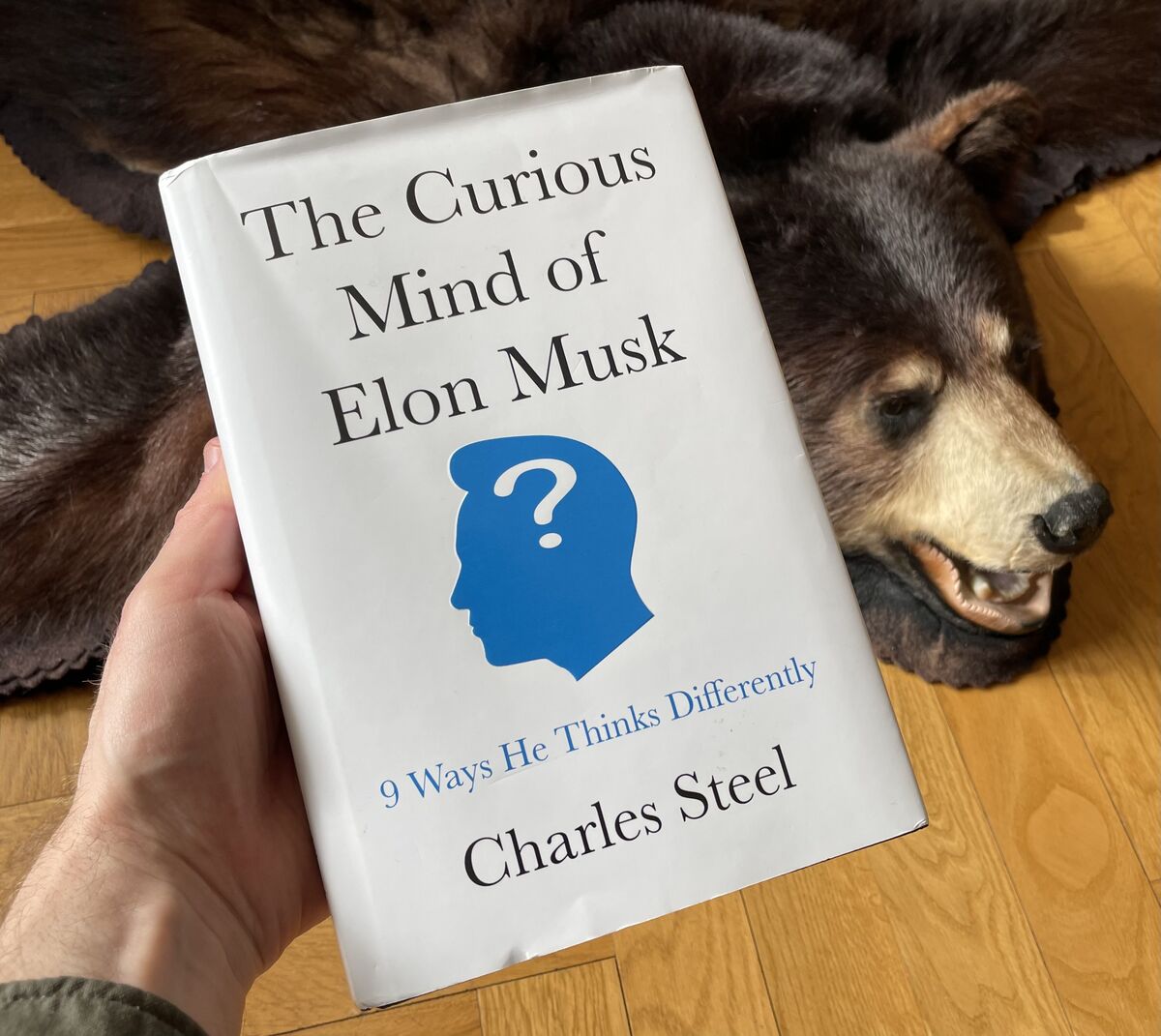
What's It About?
Charles Steel delivers a deep, ideas-driven exploration of how Elon Musk actually thinks — not just what he's built. It traces Musk's obsessive curiosity back to its roots: an early existential crisis shaped by trauma, neurodivergence, and the profound influence of Douglas Adams and The Hitchhiker's Guide to the Galaxy.
Steel maps the mental models and reading list that formed Musk's worldview: first-principles thinking, radical uncertainty, expanding human consciousness, and civilizational-scale purpose. This isn't a conventional biography. It's a guide to the philosophical commitments and intellectual habits behind one of the most polarizing (and effective) builders of our time.
A warning from my own reading: this book will casually add 10–20 new titles to your reading list.
🎯 Why It's on BookLab
There are two standout Musk books right now. Eric Jorgenson's The Book of Elon (from the author of The Almanack of Naval Ravikant) compiles the practical "how he operates." This one goes deeper: why he thinks the way he does, and what shaped that mind.
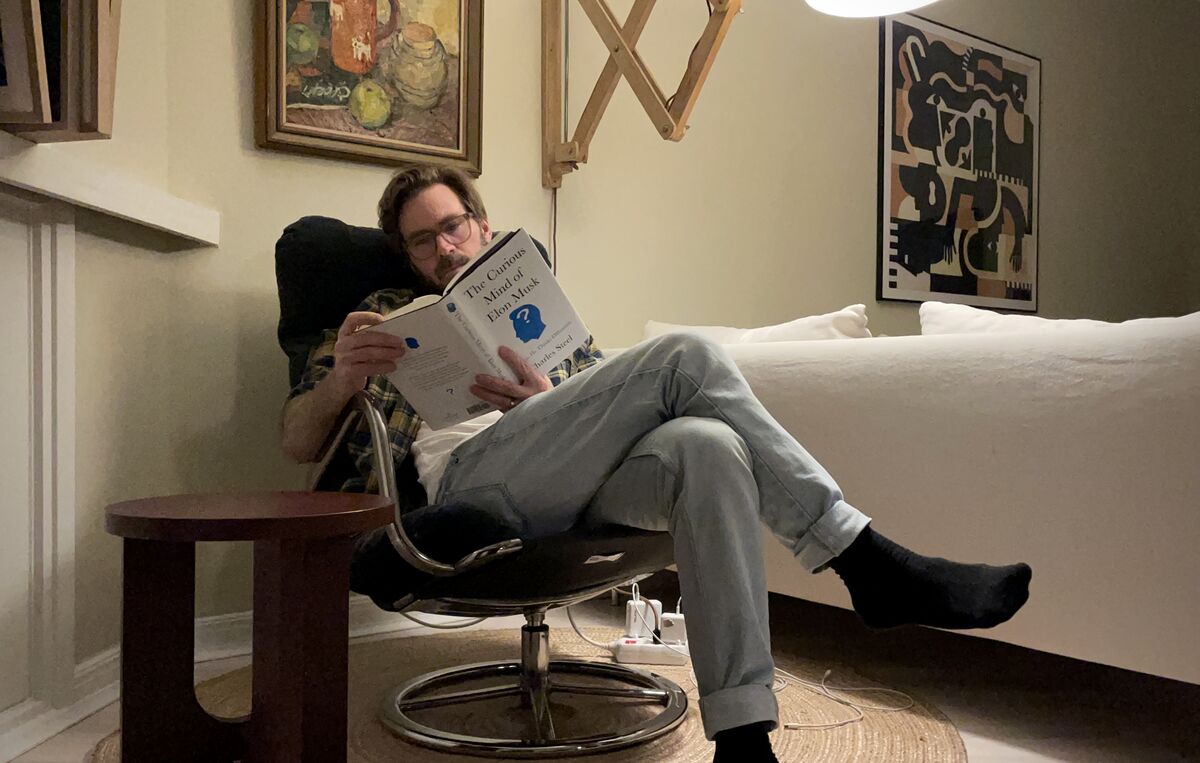
I've been reading it steadily since March and it keeps delivering. It's genuinely one of the best nonfiction books I've picked up in a while — I've recommended it multiple times. It convinced me that, at the end of the day, all you really need in life is coffee and biographies.
It pairs perfectly with more tactical reads because it explains the deeper "why" behind the first-principles obsession, the tolerance for chaos, and the drive to increase consciousness at scale.
If you want to understand the reading list and mental models of the most ambitious builder alive, this is essential.
📖 Key Topics
- Obsessive curiosity & cataloging — the joy of becoming deeply obsessed, making lists, and sorting information
- First-principles thinking — breaking problems down to fundamentals instead of analogies
- Expectations vs reality — "happiness is reality minus expectations"
- Existential purpose & consciousness — the drive to expand what it means to be human
- Embracing uncertainty — turning existential anxiety into fuel
- Skin in the game — why governments and large institutions often fail here
- Neurodivergence, trauma & early influences — how they forged Musk's unique operating system
- Philosophical & literary influences — Douglas Adams' rules for technology, simulation theory, and more
- Agency & building — everything around you was made by people no smarter than you
📝 Highlights from My Reading
Here are some moments that stuck with me — pulled straight from pages I highlighted while reading.
On becoming obsessed (and why lists feel so good)
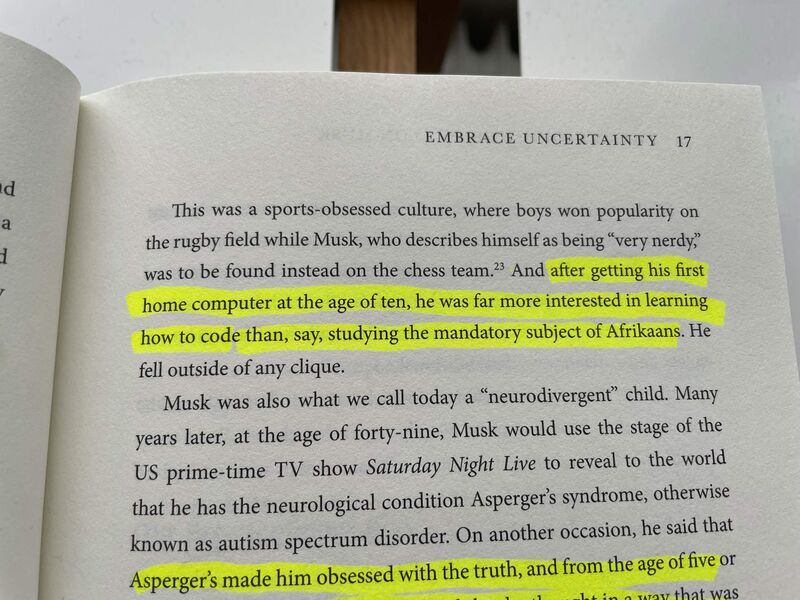
I love becoming obsessed. For me, it has always been some version of making lists, cataloging info, and sorting things. It's just such a satisfying thing for my little monkey brain. This book sparked a family history project for me — it ticks every box for that kind of joyful obsession.
Douglas Adams' rules for technology
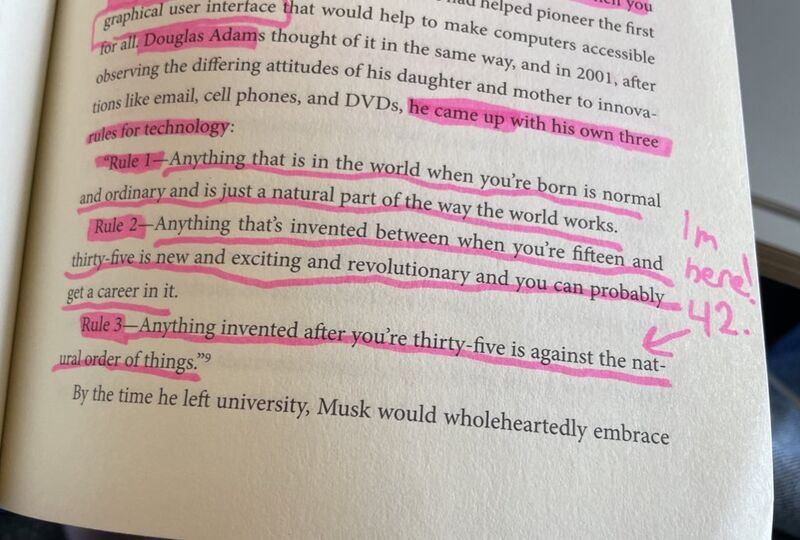
"Rule 1 — Anything that is in the world when you're born is normal and ordinary and is just a natural part of the way the world works.
Rule 2 — Anything that's invented between when you're fifteen and thirty-five is new and exciting and revolutionary and you can probably get a career in it.
Rule 3 — Anything invented after you're thirty-five is against the natural order of things."
It's so easy to become a Luddite with age. This one made me laugh out loud on a 5-hour train ride.
Happiness is reality minus expectations
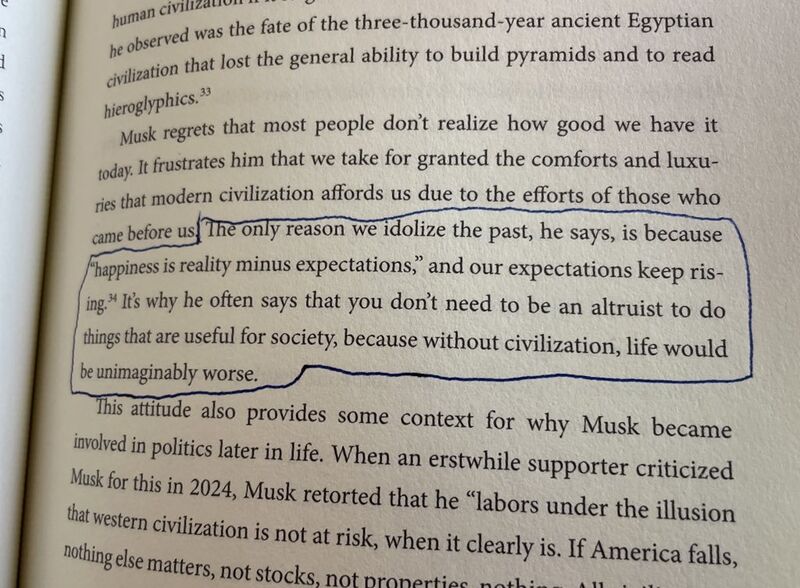
"The only reason we idolize the past, he says, is because 'happiness is reality minus expectations,' and our expectations keep rising."
This explains so much about why we sometimes undervalue how good we have it.
The ultimate unlock
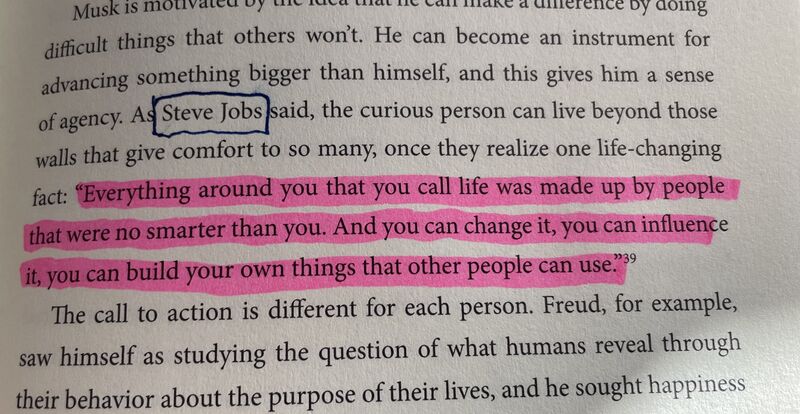
"Everything around you that you call life was made up by people that were no smarter than you. And you can change it, you can influence it, you can build your own things that other people can use."
This quote was a big unlock for me 10 years ago. You know… you can just do things.
Learn more about the author at charlessteel.com.
📺 Full Review
I've now published my full video review of this book — my verdict, what I took away, and why it's a candidate for book of the year.
Read the Full Review →